Rubio: Iran has lost control of the Strait of Hormuz, and its economy is experiencing a complete and total free fall
&cropxunits=450&cropyunits=300&w=770)
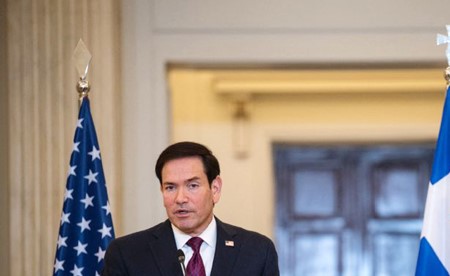
U.S. Secretary of State Marco Rubio said that Iran has “lost complete control” of the Strait of Hormuz, emphasizing that the Iranian economy is “experiencing a total and free-fall collapse.” Speaking during a visit to the Greek capital, Athens, Rubio stated, “The volume of oil currently flowing is almost comparable to what was being transported before the start of this conflict, and thus, they have lost complete control” over the vital strait for Gulf oil exports. He noted that the Iranian economy “is on the verge of reaching a situation seen only in a few countries in the world,” as a result of “crippling” sanctions. He added that every dollar received by the “hardliners” is spent on Lebanon’s Hezbollah and the Hamas movement.
Rubio reiterated that “Iran cannot possess a nuclear weapon,” clarifying that “any agreement they accept and that is acceptable to the United States must ensure that Iran never possesses a nuclear weapon.” He argued that what Iran “was trying to do was build massive conventional military capabilities to such an extent that it would be insulated from any attack.” He affirmed, “Iran has failed to take advantage of multiple opportunities to reach an agreement with us regarding its nuclear program.”
This came after U.S. President Donald Trump stated that his country must finish what it started with Iran, and that his administration is currently considering whether this will be done “nicely or otherwise.”
Rubio’s visit to Athens is aimed at holding a “strategic dialogue” with Greece, a member of the North Atlantic Treaty Organization (NATO), on regional security and energy security, according to the U.S. State Department, while Greece seeks to consolidate its position as a major hub for natural gas transit in Southeast Europe. Rubio told reporters before the visit, “Greece is a very important ally of the United States.” He added, “It is a place where we not only have a military presence, but we also share strong economic ties.” In February, agreements were signed in Athens granting a consortium led by the U.S. energy giant Chevron exclusive rights to explore and exploit hydrocarbons in marine areas south of the Peloponnese peninsula and the island of Crete.
