Saudi-US Talks to Enhance Maritime Security
&cropxunits=450&cropyunits=300&w=770)
Discussions aimed at enhancing maritime security and operations of the military coalition supporting legitimacy against the Houthis.
Translated by Qiyas from الأنباء — Original source
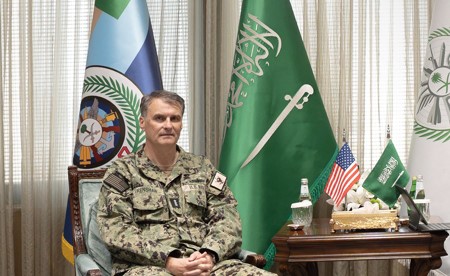
Saudi Chief of Naval Staff Lieutenant General Mohammed Al-Ghribi held talks with Commander of the U.S. Central Command’s Fifth Fleet, Vice Admiral Kurt Renshaw, on maritime cooperation between the two countries, aimed at serving their shared interests and enhancing maritime security and freedom of navigation in the region.
The discussions came as the Saudi-led coalition supporting legitimacy in Yemen announced the interception and destruction of a ballistic missile launched north of Riyadh by the so-called Houthi militia. The coalition stated that the occupied capital, Sanaa, and the provinces of Saada and Amran are sources of Houthi missile threats, emphasizing that the coalition remains committed to neutralizing and destroying the sources of ballistic and land-to-land missile threats.
In the context of continued condemnation of ongoing attacks on Saudi Arabia, the Qatari Cabinet deemed the attacks an unacceptable disregard for civilian lives and a blatant violation of the Kingdom’s sovereignty, reaffirming full solidarity and support for Saudi Arabia in all legitimate measures it takes to safeguard its sovereignty, security, territorial integrity, and Islamic holy sites.
For her part, the United Arab Emirates condemned the targeting of civilians, civilian and economic infrastructure, and ships. The European Union stated that any threat to civilians and critical infrastructure is “unacceptable,” expressing its “full solidarity with Saudi Arabia and its people.”
For further details: The Coalition announces the interception of additional ballistic missiles; Sanaa, Saada, and Amran identified as sources of missile threats; “Fajr Yemen” enhances operations and expands frontlines. U.S.-Saudi maritime security talks and thwarting of new attacks.
The Saudi-led coalition supporting legitimacy in Yemen announced its readiness to counter further terrorist Houthi attacks on the Kingdom, as the Yemeni Armed Forces continue to target key nodes and deployment sites of the terrorist militia. Meanwhile, Saudi Navy Chief of Staff Lt. Gen. Mohammed Al-Ghraibi met with Commander of the U.S. Central Command’s Fifth Fleet, Vice Admiral Kurt Rischau.
According to a post by the Saudi Ministry of Defense on the X platform, Al-Ghraibi and Rischau discussed maritime cooperation between the two countries, aimed at serving their mutual interests and enhancing maritime security and freedom of navigation in the region.
For his part, Brig. Gen. Turki Al-Maliki, the official spokesperson for the coalition forces, stated that a ballistic missile launched by the terrorist Houthi militia from north of Riyadh had been intercepted and destroyed. He confirmed that the coalition had tracked the launch platform using its intelligence systems over the skies of Sanaa and vowed to destroy it.
Earlier, Al-Maliki announced the interception and destruction of another ballistic missile fired by the terrorist militia toward Khamis Mushait. He clarified that the occupied Yemeni capital of Sanaa and the provinces of Saada and Amran are sources of Houthi missile threats, noting that the coalition remains committed to neutralizing and destroying the sources of ballistic and land-to-land missile threats.
In the context of continued condemnation of the ongoing attacks on Saudi Arabia, the Qatari Cabinet strongly condemned the targeting of an electricity distribution station in Medina, which serves the Noble Prophet’s Mosque and civilian infrastructure, by Houthi militias last week. Qatar viewed this attack as a threat to the sanctity of Islamic holy sites, a clear provocation of Muslim sentiments, a reckless disregard for civilian lives, and a blatant violation of Saudi sovereignty.
Qatar News Agency (QNA) reported that this stance was expressed during the cabinet’s regular meeting held yesterday, chaired by Prime Minister and Foreign Minister Sheikh Mohammed bin Abdulrahman Al Thani. The cabinet reaffirmed Qatar’s full solidarity with Saudi Arabia and its support for all legitimate measures taken to preserve the Kingdom’s sovereignty, security, territorial integrity, and Islamic holy sites. It emphasized that Saudi security is an integral part of Qatar’s security and the collective security system of the Gulf Cooperation Council (GCC) states.
Similarly, the United Arab Emirates strongly condemned the continued targeting of civilians and civilian and economic infrastructure in Saudi Arabia by Houthi militias, as well as attacks on Saudi ships in the southern Red Sea and the Bab al-Mandab Strait. The UAE Ministry of Foreign Affairs stated in a press release that these ongoing attacks constitute a blatant violation of Saudi sovereignty and a threat to its security and stability. It reaffirmed the UAE’s full solidarity with and support for the Kingdom in all efforts to safeguard its security and stability.
Meanwhile, European Commissioner for Mediterranean Affairs Dubravka Šuica expressed her strong condemnation of the terrorist Houthi attacks in a post on X, stating that any threat to civilians and critical infrastructure is “unacceptable.” She emphasized her “full solidarity with Saudi Arabia and its people” and stressed the urgent need to halt this dangerous escalation. She affirmed that de-escalation, dialogue, and respect for freedom of navigation and regional security and stability are “essential.”
In Yemen, the Yemeni Armed Forces have intensified their military operations under Operation “Yemen’s Dawn” across several fronts, coinciding with new advances in Taiz Governorate, continued operations in Marib and the western coast, and airstrikes targeting Houthi military capabilities in Sanaa, Saada, and Hodeidah, according to Al Arabiya News.
In Taiz Governorate, the Armed Forces, backed by popular resistance, achieved new advances in the Hayfan district in the southern part of the governorate, a development that expands pressure on Houthi forces in the southern countryside. Fighting also intensified in the Quds enclave in the Al-Mawassit district, where government forces and popular resistance fighters are engaging Houthi militants.
Earlier, Taiz Axis forces carried out five offensive operations on the fronts of Al-Arbaeen north of the city, Al-Aqroud to the south, Al-Awn and Jabal Habashi to the west, and Al-Bayrin on the outskirts of the Al-Kadha front. The Taiz Axis Media Center stated that these operations resulted in the killing of approximately 100 Houthi militants and the wounding of 150 others, in addition to shooting down five drones and destroying or damaging six armored vehicles and a tank.
These operations continue with air support from the coalition, which has focused its strikes on three axes representing the Houthi militia’s strongholds, aiming to cut supply lines and secure navigation in Bab al-Mandab.
In Hodeidah, the coalition destroyed weapons depots, rigged boats, and naval mines, thwarting plans for imminent attacks in the southern Red Sea. In Sanaa, the militia’s command and control stronghold, the coalition destroyed a ballistic missile launch platform. In Saada, the militia’s main stronghold, a strike targeted a warehouse inside a mountainous site containing 20 ballistic missiles.
The Yemeni Air Force launched a series of airstrikes yesterday, targeting weapons depots, military vehicles, and troop carriers of the Houthi militia in northern Marib Governorate and western Al-Jawf Governorate.
