99% Use Safe Drinking Water
&cropxunits=450&cropyunits=337&w=600)
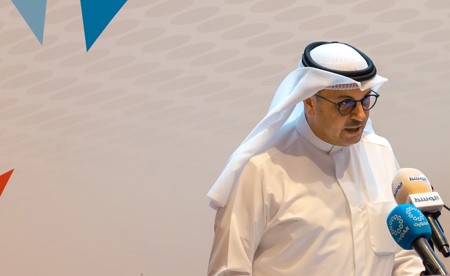
Osama Diab: Kuwait’s Minister of Electricity, Water and Renewable Energy, Dr. Sabih Al-Makhzoum, affirmed that water security has become one of the most prominent developmental challenges worldwide, noting that the water issue is no longer limited to providing a basic life resource, but has become directly linked to food security, energy, economic development, health, social stability, and the capacity to confront the repercussions of climate change.
Al-Makhzoum clarified, in a speech during the high-level dialogue “A Water-Secure Future for All,” hosted by Kuwait yesterday as part of preparations for the 2026 UN Water Conference to be held in Abu Dhabi next December, that Kuwait has accorded strategic importance to the water sector, working to develop systems for water production, transmission, storage, and distribution, while leveraging modern technologies and enhancing operational efficiency.
He pointed out that more than 99% of Kuwait’s population benefits from safely managed drinking water services, according to data from the WHO-UNICEF Joint Monitoring Programme. Al-Makhzoum stressed that “enhancing regional water interconnection represents an important pathway to support supply security and improve countries’ readiness to handle emergencies.”
He emphasized the importance of continuing work on joint and bilateral projects and completing technical studies to strengthen integration and sustainability in the water sector, adding that the challenges posed by conflicts, wars, and humanitarian crises necessitate efforts to provide sustainable, resilient, and safe water sources.
During the high-level dialogue titled “A Water-Secure Future for All,” he affirmed that water security is a cornerstone of food security, energy, development, and stability. The Minister of Electricity stated that wars and crises demand efforts to provide sustainable, resilient, and safe water sources.
Osama Diab: Kuwait’s Minister of Electricity, Water, and Renewable Energy, Dr. Subaih Al-Makhzoum, affirmed that water security has become one of the most prominent developmental challenges globally. He noted that the water issue is no longer limited to providing a basic life resource, but is now directly linked to food security, energy, economic development, health, social stability, and the capacity to confront the repercussions of climate change.
This statement was made by Al-Makhzoum during the High-Level Dialogue on “A Water-Secure Future for All,” hosted by Kuwait yesterday. The event was attended by representatives of governments, the diplomatic corps, international organizations, financial and research institutions, as well as experts and specialists in the water sector. It took place as part of preparations for the 2026 UN Water Conference, scheduled to be held in Abu Dhabi next December.
Al-Makhzoum clarified that Kuwait is aware of the magnitude of water security challenges, particularly given its geographical and climatic nature and the limited availability of natural water resources. Consequently, the country has accorded strategic importance to the water sector, working to develop systems for water production, transmission, storage, and distribution. It has also leveraged modern technologies to enhance operational efficiency, thereby strengthening supply sustainability and improving the readiness of the water system to meet current and future needs.
He emphasized that the quality and safety of drinking water are among the state’s top priorities, alongside ensuring supply sustainability. He explained that relevant authorities apply an integrated system of monitoring and continuous testing to ensure that produced and distributed water meets approved standards and requirements.
He pointed out that the percentage of the population benefiting from safely managed drinking water services in Kuwait exceeds 99%, according to data from the Joint Monitoring Programme (JMP) of the World Health Organization and UNICEF on water supply, sanitation, and hygiene.
Al-Makhzoum stressed that water challenges transcend national borders and cannot be addressed in isolation. He underscored the importance of enhancing regional and international cooperation, exchanging expertise and experiences, developing partnerships, and utilizing technical, research, and financial solutions capable of transforming promising ideas into executable projects with tangible impacts.
He stated that “enhancing regional water interconnection represents one of the important pathways to support supply security and increase countries’ readiness to handle emergencies.”
He affirmed the importance of continuing work on joint and bilateral projects and completing technical studies to enhance integration and sustainability in the water sector.
He added that “the challenges posed by conflicts, wars, and humanitarian crises necessitate efforts to provide sustainable, resilient, and safe water sources to ensure the continuity of basic supplies for populations, while strengthening the resilience of water infrastructure and expanding international cooperation to find practical and sustainable solutions for affected communities.”
For her part, Ghada Fathy Al-Khatib, Representative of the UN Secretary-General and Resident Coordinator in Kuwait, emphasized that the water issue requires broad collaboration among various stakeholders. She noted that the participation of governments, the diplomatic corps, financial institutions, the private sector, and academia in the dialogue reflects the reality that “no single entity can solve the water issue alone.”
Al-Khatib stated that the UN World Water Development Report indicates that none of the water-related Sustainable Development Goal (SDG) targets under SDG 6 are on track. She explained that achieving universal access to safely managed drinking water by 2030 requires accelerating progress six times the current rate, while the sanitation sector requires a fivefold acceleration, and basic hygiene a threefold acceleration.
She added that approximately 2.1 billion people worldwide still lack access to safe drinking water, while around four billion people experience severe water scarcity for at least one month annually. She affirmed that these challenges are directly linked to health, food, livelihoods, dignity, and stability.
For his part, Dr. Matar Al-Nuaimi, Ambassador of the United Arab Emirates to Kuwait, affirmed that the dialogue represents an important opportunity to exchange expertise, discuss common priorities, and formulate practical recommendations and initiatives that contribute to preparations for the 2026 UN Water Conference. The conference will be hosted by the UAE in partnership with the Republic of Senegal in Abu Dhabi from December 8 to 10 next year.
Al-Nuaimi stated that the conference aims to accelerate the implementation of SDG 6, which focuses on ensuring availability and sustainable management of water and sanitation for all. He noted that this is the third UN Water Conference since 1977, following the Mar del Plata conference in 1977 and the New York conference in 2023, and the first led by two countries from the Global South.
He clarified that the conference’s agenda will cover six interconnected themes: water for people, prosperity, and the planet; cooperation; the role of water in multilateral processes; and investments in the water sector. This approach allows for addressing water challenges from a comprehensive perspective that integrates social, economic, and environmental dimensions.
He noted that approximately 2.1 billion people worldwide lack access to safely managed drinking water services, and about 3.4 billion people lack access to safely managed sanitation services, while roughly four billion people face high levels of water stress for at least one month each year. He emphasized that achieving Sustainable Development Goal 6 requires accelerating progress by a factor of six to eight times.
Al Nuaimi pointed out that addressing water challenges requires an integrated approach that considers the nexus between water, food, energy, and the environment. He explained that agriculture depends on water availability, while water supply, treatment, and desalination require energy resources.
He added that global investment needs for water-related infrastructure are estimated at approximately $6.7 trillion by 2030, necessitating a more ambitious and integrated international response that combines innovative financing, water efficiency, reuse, development of sustainable technologies, scientific cooperation, and capacity building.
Al Nuaimi outlined the United Arab Emirates’ efforts in the water sector, highlighting its investments in water desalination technologies, treated wastewater reuse, and enhanced water resource management efficiency, alongside its contributions to development and humanitarian projects worldwide.
He clarified that the Abu Dhabi Global Water Platform, launched by the Abu Dhabi Fund for Development, aims to mobilize $2 billion in financing, including $1 billion pledged by the Fund to be allocated between 2026 and 2030, with the goal of reaching approximately 10 million beneficiaries globally.
He also referred to the Mohammed bin Zayed Green Initiative for Water, which aims to accelerate the development, testing, and implementation of innovative and sustainable technological solutions to address water scarcity, and to enhance international awareness of this challenge.
