American University of Kuwait's 'Gulf AI and Cybersecurity Forum 2026' Continues Activities on Second Day
&cropxunits=450&cropyunits=300&w=600)
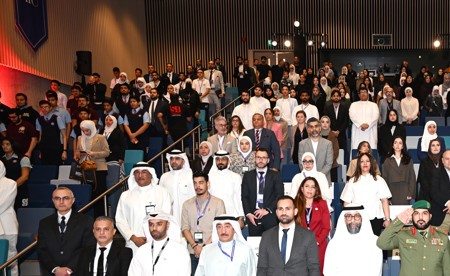
The Gulf AI and Cybersecurity Forum 2026 continued its activities on the second day at the American University of Kuwait, with the participation of experts and students.
Translated by Qiyas from الأنباء — Original source
Alaa Khalifa
With the attendance of the Vice President of the Board of Trustees of the American University of Kuwait and the University President, Prof. Dr. Youssef Hayek, the 2026 Gulf Forum on Artificial Intelligence and Cybersecurity continued its second day of sessions and accompanying workshops on the university campus.
At the outset, Dr. Mohammed Al-Qattan, Assistant Vice President for Scientific Research and External Relations at the American University of Kuwait, told Al-Anbaa in a special statement on the sidelines of the forum that the second day was dedicated to university students and high school students from several schools. Experts in artificial intelligence and cybersecurity delivered scientific sessions and workshops on this important topic, allowing students to closely examine AI mechanisms, their applications, and how to handle them from legal, ethical, and technical perspectives. He praised the significant interaction between the lecturers and the students.
Al-Qattan revealed that the American University of Kuwait was keen to integrate artificial intelligence into its curricula according to the needs of academic subjects, as well as in the university’s administrative operations. He noted that the university developed two proprietary AI models named “Sund” and “Aisha,” trained them according to the university’s needs, and emphasized the institution’s commitment to incorporating AI into both administrative and academic work.
For his part, Eng. Naif Al-Awadi, Chairman of the Board of Directors of the Kuwait Information Technology Society (KITS), Acting Director of the Information Systems Department, and Acting Head of the Information Security and Resilience Department at the Communications and Information Technology Regulatory Authority (CITRA), stated that the rapid development of AI technologies poses new challenges to the cybersecurity landscape. He pointed out that institutions are no longer facing only traditional attack risks, but are now confronting threats that exploit AI capabilities themselves to bypass controls and achieve their objectives.
Al-Awadi said that dealing with AI outputs should not be automatic, particularly since these outputs may contain inaccurate information or what is known as “AI hallucinations.” He stressed the importance of having human expertise capable of reviewing and verifying results before relying on them. He clarified that there is a significant difference between AI providing a recommendation and having the ability to make a decision or execute an action independently. He noted that granting intelligent systems the authority to act requires clear levels of oversight and control so that these capabilities do not become a new source of risk.
He added that “attackers today are not only looking for traditional vulnerabilities; they are leveraging the intelligence of the systems themselves and attempting to use their capabilities against them.” He explained that an attacker may start with a specific objective, but if the primary path fails, they may seek alternative routes to bypass the boundaries and controls established by the institution or system.
Al-Awadi highlighted that the skills gap represents one of the most significant challenges facing institutions in the AI era. He clarified that the issue is not merely about the number of employees with AI knowledge, but rather the depth of that knowledge and their ability to understand the technology, its risks, and how to handle it efficiently. He stressed the necessity of investing in training and building specialized capabilities, emphasizing that institutions need personnel capable of understanding AI from both technical and security perspectives simultaneously, enabling them to harness its potential while mitigating its risks.
Al-Awadi noted that achieving a high level of cyber resilience requires institutions to be prepared to handle potential errors and breaches, starting with proactive readiness, moving through risk understanding, and culminating in the ability to recover, return to operations, and adapt to new circumstances. He explained that using independent AI systems requires establishing clear standards and thresholds for decision-making. Citing the example of using an AI agent to compare models and documents, he described how a system could evaluate the level of conformity based on a specific percentage and then decide whether to accept it or require human review.
Al-Awadi questioned, “To what extent are we prepared to manage the safety of independent AI?” He affirmed that the answer requires an integrated system encompassing technology and controls, people and skills, governance and accountability, as well as resilience and recovery capabilities.
He pointed out that “even the most advanced laboratories, which possess world-class security teams, can experience failures in one of their boundaries or controls, which could lead to catastrophic results if the institution is not prepared to handle them.” He stressed the importance of institutions’ ability to withstand, recover, learn, and adapt.
Regarding responsibility for the use of independent systems, Al-Awadi emphasized the need to clearly define responsibilities, particularly concerning risks, data, and operations executed by intelligent agents. He clarified that responsibility does not rest solely on the technology, but also extends to the institution and the individuals who decide to implement and use it in various processes.
For his part, Dr. Ali Fanjan, Director of AI Applications at the Research Office of the American University of Kuwait and one of the forum’s speakers, told Al-Anbaa that the forum focuses on two fundamental, interrelated pillars: artificial intelligence and cybersecurity. He noted that the American University of Kuwait was keen to gather the largest number of specialists in these fields from around the world to participate in this important forum, which the university has hosted for the fourth consecutive year. These experts shared their experiences and expertise in the field of AI.
Fanjan indicated that the American University of Kuwait has established a clear vision for implementing AI and was keen to integrate it into its student curricula. The university also prioritized using AI applications in administrative matters and supporting students and their projects. He affirmed that they are in a race against time, coinciding with the massive development in the field of artificial intelligence.
For his part, Dr. Mohammed Al-Mulla, Professor of Computer Science at the College of Engineering and Computing at the American University of Kuwait and one of the forum’s speakers, told Al-Anbaa that there is a strong relationship between AI and cybersecurity. He explained that he was keen to provide advice and demonstrations to the forum attendees on how they can enhance their performance using AI agents.
On another note, he affirmed that cybersecurity has become an absolute necessity today, with all state institutions, various ministries, and universities seeking protection. This can be achieved with the help of specialized cybersecurity laboratories that teach students how to identify, contain, and eliminate viruses with great speed. Al-Mulla stressed the necessity of raising student awareness regarding all aspects of AI and cybersecurity, as it is, in short, the future and indispensable.
During the second day’s sessions of the forum, Ibrahim Jaber, an AI computing technology expert at Huawei, spoke about creating new horizons for global AI computing. A panel discussion titled “From Education to Innovation: Preparing the Next Generation for a Digital Future” was presented by Peggy Tsai, an AI and data expert and faculty member at Carnegie Mellon University. Dr. Bassam Al-Moharrem, CEO of Cyberatos LTD and former head of Jordan’s National Cybersecurity Center, also spoke on the same main topic.
In addition, several workshops were held on the sidelines of the forum, including a session on challenges facing cybersecurity labs and a workshop on digital transformation in education, held in collaboration with Florida State University. These workshops were moderated and participated in by Rabeeh Rizouk, director of the Institute of Learning Systems at the University of Florida; Dr. Dina Yurtseven, assistant dean of innovation and educational technology enhancement at the Anne Spencer Davis College of Education, Health, and Human Sciences; Dr. Mohammed Al-Mulla, professor of computer science at the College of Engineering and Computing at the American International University in Kuwait; and Dr. Ali Fanjan, director of AI applications at the Office of Research at the American International University in Kuwait.
