Aoun and Berri Receive Memorandum from 86 MPs Demanding UNIFIL's Stay in the South
&cropxunits=450&cropyunits=300&w=770)
Aoun and Berri received a parliamentary delegation regarding UNIFIL, while the Energy Minister announced a sit-in, the Prime Minister followed up on the Qleiatat airport project, and a Russian-Lebanese economic forum was held.
Translated by Qiyas from الأنباء — Original source
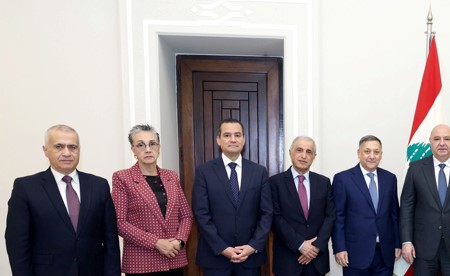
Beirut – Mansour Shaaban: President of the Republic General Joseph Aoun and Speaker of the Parliament Nabih Berri received a delegation representing the 86 MPs who called for the continued presence of international forces (UNIFIL) in the south, and they handed them a memorandum on the matter.
MP Melhem Khalaf said after the meeting with President Aoun that the delegation handed the President a legal study on Resolution 2790, which concluded that there are fundamental difficulties in implementing several of its provisions, especially those related to handing over sites from which UNIFIL withdraws to the Lebanese Army, amid the continued Israeli occupation of the Blue Line. He noted that the delegation called for a review of the resolution to ensure the continuation of the international security umbrella in the south, pointing to the search for alternatives in case it becomes impossible to maintain UNIFIL in its current form, in order to avoid any security vacuum and preserve stability.
From the Baabda presidential palace, Khalaf said: “The greatest danger is that UNIFIL forces withdraw and a vacuum occurs, meaning entrenching the occupation without strengthening the state, and leaving it with its exclusivity, its own capabilities, and its own forces without any rival in the south.”
The parliamentary delegation that visited Baabda and the presidential palace in Aintoura included: Melhem Khalaf, Fayçal Sayegh, Nasser Jaber, Mohammad Khawaja, Qasim Hashem, Edgar Tripoli, Michel Moussa, and Adnan Tripoli.
On another front, Lebanese Energy Minister Joe Saida announced his “withdrawal from attending cabinet meetings until the necessary decisions are taken regarding electricity, including the payment of exemptions and arrears in favor of Électricité du Liban (EDL).”
Saida, in a press conference, explained the financial situation of the institution, noting that “communications with international investors showed that they are demanding financial and security guarantees.” He revealed that “24 companies expressed interest in investing in the energy sector, but with conditions, the most prominent of which is securing financial guarantees.” He called for “adopting a variable tariff linked to fuel prices, alongside addressing non-technical losses, which amount to about 30%, describing it as ‘theft.’” Saida affirmed that the required funds are due and payable obligations, not debts or treasury loans, and include accumulated bills owed by state institutions and public administrative services, such as water establishments and others.
Meanwhile, Prime Minister Dr. Najib Mikati followed up on the progress and preparations for the launch of commercial flights from President René Moawad Airport in Qleiatat, northern Lebanon. He held a meeting attended by Minister of Public Works and Transport Fayez Salamah and those concerned, emphasizing: “The Qleiatat airport project has entered the final stage of implementation, and what is required today is to complete the remaining steps at the necessary speed, without any laxity in technical and security standards, leading to the launch of commercial flights from it next month.”
On another level, the Lebanese-Russian Economic Investment Forum “Beirut 2” was held in Beirut, under the patronage of Minister of Economy and Trade Dr. Amr al-Khatib, who attended. Russian Ambassador Alexander Rodakov spoke, stating that the current level of trade and economic relations between Russia and Lebanon does not meet the interests of both countries, and that the available potential between them has not been fully utilized, calling for “efforts to correct this situation.”
Al-Khatib said that the economic vision is clear, and consists of Lebanon producing more, exporting more, and attracting investments that build an economy capable of growth.
