Stockholm International Peace Research Institute Director: Necessity of Building Trust to Achieve Regional Stability and Security
&cropxunits=338&cropyunits=450&w=770)
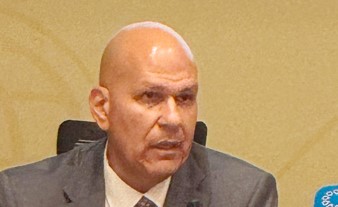
Karim Hajjaj and Mubarak Al-Hajjari Discuss Armament and Stability
Translated by Qiyas from الأنباء — Original source
Osama Diab: Ambassador Karim Hajjaj, Director of the Stockholm International Peace Research Institute (SIPRI), emphasized the necessity and importance of enhancing dialogue, arms control, and confidence-building as fundamental pillars for achieving regional stability and security.
Speaking at a seminar organized by the Saud Nasser Al-Sabah Diplomatic Institute titled “Arms Control and Security Trends in the Middle East,” Ambassador Hajjaj noted that global military expenditure is estimated to have reached approximately $2.9 trillion in 2025, equivalent to 2.5% of global gross domestic product, marking an all-time high and rising for the eleventh consecutive year.
He clarified that the Middle East region has also witnessed a steady increase in the volume and types of armaments, with military spending reaching around $218 billion in 2025, representing a 36% increase over the past decade.
The seminar addressed three main themes: the international landscape, technological developments in arms control patterns, and security transformations in the Middle East, analyzing the rapid shifts in the international security system and their implications for the region.
Regarding the international landscape, Ambassador Hajjaj reviewed the return of conventional wars between technologically advanced states, the fracturing of international alliances, and the intensifying security competition among major powers, alongside the erosion of the foundations of the international order, including arms control regimes and international law, as well as the declining effectiveness of multilateral frameworks.
He also discussed the rapid technological evolution in arms control patterns, including missiles, drones, and artificial intelligence applications, ranging from autonomous weapons systems to decision-support systems in military planning, as well as cyber operations, space armament, and transformations in the economics of war and military manufacturing.
He pointed out that these developments pose new challenges, most notably the unprecedented speed of military interactions, multiple escalation pathways, and the blurring of the line between civilian and military domains.
Concerning security transformations in the Middle East, the seminar addressed the return of armed conflicts between states, the existential nature of conflicts, the intertwining of regional conflict fronts, widespread targeting of infrastructure and civilians, and the inability to achieve military decisiveness despite disparities in capabilities.
The seminar concluded that achieving regional stability requires curbing the arms race, establishing new arms control mechanisms, confidence-building measures, risk reduction, conflict and crisis management, alongside activating peaceful settlement pathways. It also emphasized the importance of establishing a regional security system based on dialogue, respect for sovereignty, and international law, as well as achieving “national resilience” to fortify states against coercion and pressures stemming from conflicts.
For his part, Dr. Mubarak Al-Hajjar, Deputy Assistant Foreign Minister for the Saud Nasser Al-Sabah Diplomatic Institute and Minister Plenipotentiary, stated that the Institute’s hosting of this seminar aligns with its vision to serve as a “Kuwaiti platform where policymakers, diplomats, and international researchers convene to discuss the region’s most sensitive files.”
Al-Hajjar added that “the Kuwaiti diplomat today is required to understand the language of numbers and military technology to the same extent that they understand the language of politics,” emphasizing the importance of keeping pace with rapid developments in security, military, and technological fields and their implications for diplomatic work.
The seminar is part of a series of programs and events organized by the Saud Nasser Al-Sabah Diplomatic Institute in collaboration with international research and academic institutions, aiming to prepare diplomatic cadres capable of reading regional and international transformations, anticipating their trends, and enhancing Kuwait’s presence as a regional hub for dialogue and knowledge exchange.
