Minister of Education: National Progress and Sustainable Development Stem from Education Capable of Creating Knowledge
&cropxunits=450&cropyunits=300&w=770)
Alaa Khalifa: Minister of Education, Mr. Sayed Jalal Al-Tabtabaee, stated that the high patronage of His Highness Amir Sheikh Meshal Al-Ahmad for the 46th Educational Conference of the Kuwait Teachers Association embodies the attention and support accorded to the education sector, which serves as a fundamental pillar in building human capital, developing capabilities, and enhancing its role in the country’s comprehensive development process.
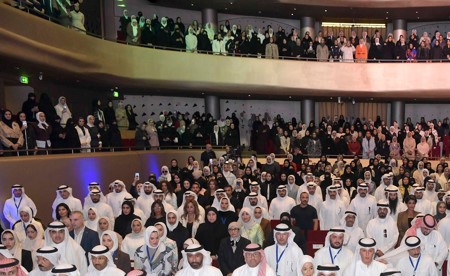
Speaking on behalf of His Highness the Amir Sheikh Meshal Al-Ahmad during the opening of the 46th Educational Conference, held under the theme “Innovative Visions for a Sustainable Educational Future in Kuwait” and running until the 6th, Al-Tabtabaee expressed his honor in conveying the Amir’s greetings and best wishes for success to the participants. He expressed hope that the conference’s deliberations would yield insights and recommendations that contribute to elevating education and building a better future for Kuwaiti youth.
He added that a nation’s progress and the sustainability of its renaissance stem from an education system capable of generating knowledge, developing capabilities, and preparing generations equipped with the tools of the future while simultaneously cherishing their national identity.
He clarified that the conference takes place at a time when education is undergoing rapid transformations in learning tools, teachers’ roles, learners’ needs, and future skills. He noted that while artificial intelligence and digital transformation have become integral to the educational reality, technology, regardless of its advancement, remains a means rather than an end.
Al-Tabtabaee emphasized that the Ministry views the conference as a platform for exchanging expertise and formulating practical, applicable, and measurable visions and recommendations, particularly since the insights and topics discussed align with several projects and plans undertaken by the Ministry of Education, reinforcing the shared direction toward developing a more efficient, effective, and sustainable educational system.
He stated that the Ministry of Education has embarked on a comprehensive reform path in the past phase, driven by a clear conviction that educational development requires an integrated vision, data-driven decisions based on actual field needs, and clear standards applied uniformly.
The education reform plan was described as the starting point of an integrated and continuous path to advance the educational system, focusing on six main axes aimed at addressing priorities and challenges, enhancing performance efficiency, and laying the necessary foundations for transitioning to a new stage of development based on international benchmark standards for measuring and improving educational performance. Consequently, the Ministry pursued multiple parallel tracks, including developing regulatory and legislative frameworks, enhancing human, administrative, and financial resources, improving the school environment, promoting digital transformation, developing teacher and educational leadership preparation, diversifying educational pathways, and opening broader opportunities for learners to discover their talents and interests.
Al-Tabtabaee highlighted another equally important aspect: the efficiency of educational spending and maximizing its impact begin with the proper utilization of human resources and their allocation according to the actual needs of schools, as the equation is clear: the learner is the foundation of our work, and the teacher is the core of the educational process in our schools.
He emphasized that investment in education begins with investment in teachers, and therefore, the qualification and preparation of new teachers constituted one of the fundamental pathways in the reform process. The national “Trainee Teacher” program was launched to establish a promising phase in the preparation of new teachers, through a program spanning a full year that combines theoretical qualification with actual field practice within schools, and is based on international professional standards, thereby linking academic knowledge with the professional and behavioral competencies necessary for practicing the teaching profession.
Education at the Forefront of Priorities
For his part, Secretary-General of the Gulf Cooperation Council (GCC) Jasem Al-Budaiwi stated in his speech that education constitutes one of the most important pillars in building human capital and a key driver for achieving sustainable development. He pointed out that positive indicators in general education within GCC member states reflect the significant attention and continuous investment in rising generations.
Al-Budaiwi expressed his deepest gratitude and appreciation to His Highness Prince Ali for his gracious patronage of the conference, commending the support of GCC leaders for the joint Gulf effort aimed at facilitating education for students who are citizens of GCC states, as well as working to enhance Gulf integration in the educational field.
He affirmed that education comes at the forefront of the priorities of GCC member states, as it is the nucleus of joint Gulf action and a weapon for progress and development in various fields. He noted that the trajectory of joint educational and pedagogical work preceded the establishment of the GCC in 1981, through the Arab Educational Institute for Gulf Countries, which was founded in 1975 under the supervision of the ministers of education and culture at that time.
He clarified that the number of students in general education in GCC member states exceeded 11 million during the 2024-2025 academic year, representing approximately 17.4% of the total population of the GCC states. Meanwhile, the number of schools and educational institutions exceeded 45,000, with more than 960,000 male and female teachers working within the general education system.
Strategic Plans
For his part, Chairman of the Board of Directors of the Teachers Association, Hamad Al-Houli, emphasized in his speech that the high patronage of the conference reflects the political leadership’s attention to the educational system and its support for efforts aimed at developing it and enhancing its outcomes, alongside strengthening the status of teachers and their pivotal role in building human capital and contributing to shaping the nation’s future.
He added that the conference activities include 24 sessions and workshops, with the participation of a select group of specialists, academics, and educators from within and outside Kuwait, and an expected educational attendance of no less than 3,000 participants.
Al-Houli explained that the conference highlights the preparation of teachers to keep pace with the requirements of modern education, the development of their professional and leadership competencies, and the role of educational leadership in improving the quality of education and managing change and development in educational institutions.
