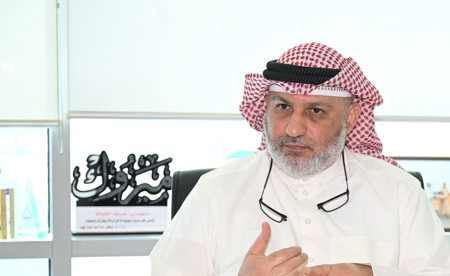
Video: Sharif Al-Khayat to Al-Anba: No Air Pollution in Kuwait in the 'Scientific Sense'.. Dust is Mostly Desert and Cross-Border
&cropxunits=450&cropyunits=300&w=770)
The Director of the Air Quality Monitoring Department confirmed that Kuwait does not suffer from scientific pollution and that most of the dust is desert-based and cross-border.
Translated by Qiyas from الأنباء — Original source
Sharif Al-Khayyat, Director of the Air Quality Monitoring Department at the Public Authority for Environment (PAE), confirmed that the measurement results issued by air quality monitoring stations distributed across Kuwait do not indicate the presence of pollution in the scientific sense. He clarified that most concentrations of gaseous pollutants fall within the limits and national standards adopted in the country, while some observed increases are limited to specific and temporary cases.
In a special interview with "Al-Anbaa," Al-Khayyat stressed the necessity of distinguishing between gaseous pollutants and suspended dust. He explained that Kuwait is geographically located in a corridor for sandstorms, and chemical analyses conducted as part of a major research project showed that most of the dust reaching monitoring stations consists of natural desert elements. According to the study results he cited, the contribution of industrial sources to dust remains limited.
He warned against relying on readings from some low-cost sensors or unofficial sites as representative of Kuwait’s air quality, highlighting the significant differences between these devices and the reference measurement equipment used by the PAE in terms of device nature, installation location, calibration, maintenance, and result evaluation.
In another context, Al-Khayyat revealed the completion of the preparation of Kuwait’s Third National Communication on Climate Change. He explained that it includes an inventory of greenhouse gas emissions, along with studies to assess the vulnerability of vital sectors in the country to the future impacts of climate change, including water resources, health, the coastal strip, and the marine environment.
Details:
First, how do you assess the current air quality in Kuwait?
Air quality assessment in Kuwait is conducted through a large number of air quality monitoring stations and observatories distributed across most areas of the country. Some of these stations are owned by the Public Authority for Environment, while others are owned by various entities and oil companies and are subject to monitoring and evaluation by the PAE. Overall, measurements recorded at Kuwaiti stations indicate the absence of pollution in the scientific sense of the definition. Scientifically, air pollution is defined as a long-term rise in the concentration of one or more air quality pollutants to levels exceeding the national standards adopted in the country. This definition does not apply to Kuwait regarding air quality pollutant concentrations, as most gases measured at different monitoring stations yield results within national standards. We may witness, in rare cases, a rise in the concentration of a specific gas for a very short period, after which it returns to its normal level. This may result from a specific incident or traffic congestion in a certain area. Hence, a distinction must be made between a temporary and limited rise in an indicator and the presence of continuous pollution according to the scientific definition.
What are the main pollutants monitored by air quality stations?
Most Kuwaiti stations monitor the main gaseous pollutants, which the World Health Organization (WHO) has recommended measuring due to their link to human health: carbon oxides, sulfur oxides, nitrogen oxides, and ground-level ozone, in addition to what is known as suspended particulate matter. The PAE has added a group of other pollutants monitored and measured at stations, such as hydrogen sulfide gas, ammonia gas, a group of hydrocarbon vapors, and methane gas. Additionally, meteorological factors are measured at each station, including wind speed and direction, temperature, and relative humidity. Kuwait measures suspended dust in sizes of 10 microns and 2.5 microns, in accordance with prevailing recommendations. Stations may monitor some increases in indicators related to suspended dust, but the climatic and geographical nature of Kuwait must be considered. Kuwait is located in a corridor for sandstorms; some of these storms may have local sources, while most are transboundary, coming from other countries and regions. Consequently, sandstorms directly affect the concentration level of dust particles in Kuwait’s atmosphere.
These readings are monitored and made available to the public through the National Air Quality Monitoring Network and the "Our Environment" website, affiliated with the PAE. The website contains health warnings for citizens in case of a rise in any gaseous pollutant. My advice to the public is always to obtain air quality information from official sources and not to rely on unofficial readings issued by unknown or unapproved entities.
Regarding dust concentrations, some consider the rise in fine particles as evidence of industrial pollution. Have studies proven the nature of the dust in Kuwait?
A major research project is being conducted in cooperation between the PAE, the Kuwait Institute for Scientific Research, and the Harvard T.H. Chan School of Public Health. The project includes an important axis related to studying dust concentrations and the chemical composition of the dust reaching monitoring stations. Chemical analyses conducted showed that most of the dust we monitor at our stations is desert dust. This means that the chemical compounds associated with dust particles are mostly composed of natural elements sourced from the desert. Therefore, according to our results, the portion resulting from industrial sources regarding dust is very limited. Furthermore, the prevailing wind direction in Kuwait, which is often northwesterly, contributes to carrying some pollutants, whether gaseous or associated with dust particles, toward the Arabian Gulf, away from residential areas.
Regarding monitoring devices, you mentioned that unofficial entities publish data and readings. What is the problem with them?
There are devices used to measure some indicators, but they differ fundamentally from the reference devices used in official networks for air quality monitoring. For example, there are low-cost sensors, some of which are designed primarily for indoor use. Nevertheless, they may be placed outdoors, and their data may be published as if they were data from a specialized network monitoring outdoor air. This is where the problem begins.
What is the difference between these devices and the PAE’s stations?
The device we use is a specialized analytical instrument with high monetary value. Therefore, it cannot be assumed that the result of a simple sensor will be equal to that of a reference analytical device. The difference is not limited to the device’s price; our devices undergo calibration processes that may be monthly, as well as periodic maintenance every three months. Results are continuously evaluated to ensure their accuracy and output quality. In contrast, for simple sensors, we may not even know where they were installed, whether they were placed outdoors, inside a home or office, or in an unsuitable location for measurement.
Why does the placement of the device affect the reading?
If a device designed for indoor use is placed inside a home, for example, near the kitchen, it may record high readings due to cooking fumes or other sources present inside the home. These numbers may then be broadcast as representing the outdoor air quality in the area, making the reading misleading. When we talk about a national monitoring network, we must know the station’s location, the nature of the device, its calibration and maintenance procedures, and the surrounding conditions. Placing a device inside a home and then publishing its readings globally as outdoor air measurements is a major scientific problem.
So, is your basic message to the public to rely on the official source?
Certainly, citizens are expected to obtain information related to air quality from official and approved sources. There are unknown entities that publish air quality maps and readings and broadcast numbers to the public, but this data may not be accurate or representative of the actual situation. The problem is that some companies or entities may treat environmental issues commercially, conducting daily and annual rankings from worst to best for countries’ air quality and publishing them to the public. Consequently, citizens may trust the results of an unknown entity and doubt the results of national entities that possess monitoring networks, approved devices, and systems for calibration, maintenance, and data verification.
Sometimes data on air quality is also published from a station belonging to the US Embassy. How do you view these readings?
Regarding the US Embassy station, there are two main points that need clarification. First, readings are evaluated according to a standard used in the United States. This standard differs from the national standard adopted in Kuwait and also from the unified Gulf standard issued by the General Secretariat of the Gulf Cooperation Council (GCC). It deals differently with the nature of local and regional atmospheric conditions. Second, the station is located at a single point within Kuwait, in the Salmiya area (Bayan). A single station cannot represent the air quality of all of Kuwait. Furthermore, it is part of a diplomatic mission; therefore, we do not have complete detailed information about the device or its operation and calibration mechanisms to conduct a direct technical comparison with the national network.
However, a study conducted by the Harvard T.H. Chan School of Public Health in 2021, which compared the results of PAE stations and private Harvard stations with those of the US Embassy station, concluded that the US Embassy station recorded results 10-20 micrograms per cubic meter higher than the other stations. This study is scientifically peer-reviewed and published in one of the world’s prestigious scientific journals.
Regarding respiratory diseases, air quality in Kuwait is often linked to respiratory diseases. How do you view this link?
When discussing this topic, it is essential not to limit the view to outdoor air only, but to also consider indoor air quality. A person spends a significant part of their day inside buildings; therefore, the period during which they are directly exposed to outdoor air may be much less than the time they are exposed to indoor air.
What do you advise on days when dust levels rise?
We have proven through studies that most of the dust Kuwait is exposed to is desert dust. This dust may affect some people, particularly more sensitive groups, those suffering from respiratory diseases, children, and the elderly, while its impact may be less on others. In conditions with high dust, it is beneficial to wear masks when going out, especially since society has become accustomed to them following the coronavirus pandemic experience. The goal here is to minimize direct exposure to dust as much as possible.
On climate change, where has Kuwait reached in preparing the Third National Communication?
The United Nations Framework Convention on Climate Change (UNFCCC) has obligated countries to prepare a document known as the "National Communication," which countries submit every five years. This document serves as a tool to report on two main issues: first, the volume of the country’s emissions, i.e., the extent to which the country’s activities contribute to emissions causing global warming, including carbon dioxide and other greenhouse gases, and predicting their future volume. Second, it identifies sectors within the country that may be affected by climate change.
Kuwait, like other countries, prepares these communications to disclose the volume of its emissions and the degree of vulnerability of its various sectors to climate change. The ultimate goal of these communications is to possess clear data and studies that help various entities in planning, whether to reduce emissions or to adapt to the unavoidable impacts of climate change.
How many national communications has Kuwait prepared so far?
We prepared the First National Communication in 2012, the Second in 2019, and we completed the preparation of the Third National Communication in 2026. These communications are prepared in cooperation with and technical supervision by specialized UN organizations, which review studies to ensure methodological soundness, data completeness, and accuracy. The preparation process is not the sole responsibility of the PAE; it is carried out through working groups comprising various sectors of the state and relevant entities. We have fully completed the preparation of the Third National Communication, which is currently under review by the United Nations Environment Programme (UNEP). After the review is completed, necessary procedures will be finalized to formally submit it to the Convention.
How does the UN determine the inventory years relied upon by these communications?
The preparation of the National Communication is subject to specific guidelines from the UN. When we prepared the First National Communication, the guidelines required preparing an inventory of greenhouse gas emissions in Kuwait for the year 1994, even though the report itself was issued in 2012. For the Second National Communication, the inventory was required for the year 2000. For the Third National Communication, the inventory was prepared based on 2005 data. Each communication is not limited to a single inventory year; rather, data is used to predict the emission trajectory in the coming years.
What distinguishes the results of the Third National Communication?
In the Second National Communication, when we used 2000 data, we estimated the emission trajectory up to 2035 using a scientific methodology consistent with the reporting requirements approved by the UNFCCC Secretariat. When we later moved to prepare the Third National Communication and monitored the actual emissions for 2005, we found that the actual emission value was lower than what we had previously predicted. This means that Kuwait has implemented efforts and projects to reduce emissions, and their impact was reflected in the actual results appearing in the report.
Regarding sector vulnerability, what does the communication include besides the emissions inventory?
The second very important aspect is studying the degree of vulnerability of the country’s sectors to climate change and how these sectors would be affected if temperatures rise to higher levels in the future. The five sectors studied in the Third National Communication showed varying degrees of vulnerability to the future impacts of climate change.
What sectors were included in the study?
We discussed five main sectors within the Third National Communication. The first sector is meteorology, where we studied temperature increases and predicted their trajectory up to 2100, along with predicting a decrease in rainfall rates up to 2100. The second sector is water resources, where we studied how water resources might be affected in the future due to rising temperatures and decreasing rainfall. The third sector is health and climate change, which included studies on cardiovascular diseases, respiratory diseases, and mental health. The fourth sector addressed sea-level rise and its impact on the coastal strip, investigating areas that could be affected or submerged if the Arabian Gulf’s sea level rises. The fifth and final sector is the marine environment and fisheries.
Regarding the marine environment, how can climate change affect it?
Climate change leads to an increase in water temperatures, which in turn may change some chemical and physical properties of seawater. Changes in these properties, such as water temperature, salinity, and acidity, may lead to negative environmental phenomena such as coral bleaching. It may also lead to the disappearance or change in the distribution of some fish species.
You mentioned that health is one of the most prominent sectors studied. What did the study include?
The study presented by the Ministry of Health within this axis was comprehensive and important. It addressed respiratory diseases in light of the potential increase in dust waves, as well as heart and artery diseases in light of rising temperatures. We also included the axis of mental health and its impact from climate change, which is a new aspect addressed in the study. Extreme heat, dust, and harsh climatic conditions do not limit their effects to physical aspects only; they can extend to mental health as well.
How do you compare Kuwait’s contribution to global emissions with the volume of climate change’s impact on it?
The main idea we clarify through the communication is that Kuwait’s contribution to total global emissions is very limited compared to the global total, while the impact of climate change on it can be significant. This is due to the nature of the state, climatic conditions, and available resources. A prominent example of this is the water sector.
Sherif Al-Khayat, Director of the Air Quality Monitoring Department at the Public Authority for Environment, confirmed that Kuwait relies primarily on seawater desalination to provide fresh drinking water. He noted that as temperatures rise, consumption can increase, whether for personal use, laundry, or various daily needs. He added that authorities must be aware that future temperature increases could drive up water demand, while the population—both citizens and residents—is changing and growing over time. The population is continuously increasing, and residential, commercial, industrial, and agricultural sectors are constantly expanding, leading to higher water demand. Furthermore, the impact of climate change adds additional pressure on the country’s future water needs, necessitating new projects to increase water production.
He explained that the same logic applies to electricity. We live and work in buildings where we maintain comfortable indoor temperatures using air conditioning due to the extremely hot weather during the long summer months of the year. If external temperatures rise above current levels, air conditioners will operate for longer periods and at higher capacity to maintain a suitable indoor environment, which means an increased demand for electricity and energy.
Al-Khayat stated that there are many factors that must be studied as potential sources of pollution in homes, including the cleanliness of sewage systems and air conditioning units, ensuring they are free from dust, fungi, or respiratory pathogens; the presence of plants or pets indoors; whether cooking fumes are well isolated from seating areas; smoking and shisha use in enclosed spaces; and the use of cleaning products containing irritants for people with respiratory conditions. All of these are potential sources and factors that should not be dismissed before directly blaming outdoor air quality. He noted that in several complaints, the source of the problem was internal rather than external. At the same time, they do not rule out the influence of outdoor air, particularly for individuals who are more sensitive to dust.
