British Ambassador: Committed to Kuwait's security and stability... Defense cooperation between the two countries continues
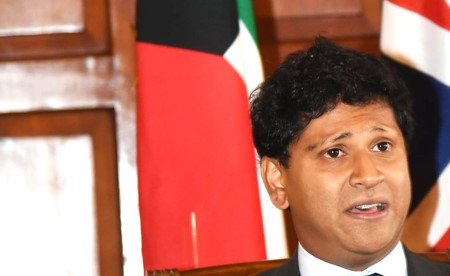&cropxunits=450&cropyunits=300&w=770)
Qudsi Rashid confirms UK's commitment to Kuwait's security and stability, noting the UK's shift in official stance toward the Israeli occupation of the West Bank and its support for a two-state solution through sanctions on settlements
Translated by Qiyas from الأنباء — Original source
Kuwait officials confirmed that Qadsi Rashid, the British Ambassador to Kuwait, stated that his country has changed its position regarding the Israeli occupation of the West Bank as part of its efforts to preserve the two-state solution. He noted that the official British stance now considers the occupation itself illegal and unacceptable under international law, whereas previous focus had been largely on the illegality of settlements.
During a press meeting with several local media outlets, Rashid emphasized the United Kingdom’s commitment to Kuwait’s security and stability, confirming the continuation and development of defense cooperation between the two countries. This includes the “Rapid Centurion” anti-drone system, as well as enhancing air defense capabilities, training, and the exchange of expertise.
He stated that Kuwaiti-British relations are also moving toward expanding partnerships in investment, technology, artificial intelligence, cybersecurity, clean energy, education, and healthcare, reflecting, in his words, the multi-dimensional nature of the relationship between the two countries.
**Change in Stance Toward the Occupation**
Rashid explained that the British government saw the necessity of changing its approach toward Israel in light of what he described as the increasing threat to the prospects of establishing a Palestinian state. He noted that the British Foreign Secretary outlined the contours of this change before Parliament, in press interviews, and during a Labour Party conference. Furthermore, the Foreign Secretary publicly criticized what he termed the “ethnic cleansing” carried out by settlers in the West Bank, pointing out that the Israeli government sometimes ignores the actions of these settlers.
Regarding Gaza, Rashid said the British Foreign Secretary spoke of reliable evidence of war crimes being committed, affirming the UK’s support for independent investigations into what occurred, whether before the International Criminal Court or the International Court of Justice.
He indicated that the change in the British position would be accompanied by specific measures, including expanding sanctions related to illegal settlements, banning the import of products originating from them into the UK, and preventing British companies from providing services that support those settlements.
Responding to questions about the possibility of circumventing the ban on settlement products by altering origin data or routing them through Israeli or Palestinian supply chains and intermediaries, Rashid said the Foreign Secretary announced the government’s intention to ban the import of goods produced in illegal Israeli settlements in the occupied Palestinian territories. This is part of a broader package of measures aimed at protecting the viability of the two-state solution.
He added that implementation details and enforcement mechanisms would be determined by relevant legislation and guidelines, acknowledging that tracking product origins is not simple. However, he pointed to British precedents for banning imports from illegally occupied territories, such as the Crimean Peninsula and Russian-occupied areas of Ukraine. He clarified that importers and companies bear the responsibility of ensuring the source of their goods, and that circumventing sanctions constitutes a legal violation. He stressed that these measures target the activities of illegal settlements and do not aim to restrict trade with Israel in general.
**Discourse, Policy, and Measures Have Changed**
Addressing criticisms that the British steps are late, Rashid said the UK has long maintained that Israeli settlements in the occupied Palestinian territories are illegal under international law, and that the announced measures reflect growing concern over the expansion of settlements, the escalation of settler violence, and their impact on the prospects of achieving a two-state solution.
He added that the British government is responding to ground realities and taking necessary steps to protect the chances of reaching a two-state solution through negotiation, while simultaneously affirming the continuation of economic, security, and people-to-people ties with Israel.
He noted that many countries in the region have consistently expressed concern over the expansion of settlements and welcomed stronger international efforts to support international law and preserve the possibility of a two-state solution.
Regarding coordination with Kuwait and Gulf states on settlement products, he said Britain remains in close contact with its regional partners, including Kuwait, on a wide range of Middle East issues, but that trade policy decisions ultimately remain the prerogative of each government.
He added that the British government has also expanded the scope of arms export restrictions to Israel. He clarified that previous restrictions focused on preventing the export of weapons that might be used in military operations in Gaza, while the new scope includes weapons that could be used to entrench the illegal occupation of the West Bank.
Rashid affirmed that “the discourse has changed, the policy has changed, and the measures have changed,” stressing that these steps do not signify British hostility toward Israel or the Israeli people. He reiterated that his country still views the two-state solution as the option capable of achieving peace and protecting the interests of both Palestinians and Israelis.
He stated that the October 7 attacks were condemned and that Hamas should not have a future role in governing Gaza. He added that Israel has a legitimate right to self-defense, but that this “does not justify what Gaza has witnessed in recent years.”
He noted that the British Foreign Secretary also explained his position based on his identity as a British Jew, affirming the possibility of supporting Israel’s right to exist while simultaneously criticizing its government’s actions.
He pointed out that Britain is not alone in changing its stance, citing France and Canada among the countries mentioned by the Foreign Secretary, along with other nations that have taken steps regarding settlements or are considering similar measures.
Responding to a question about reconciling the recognition of Israel’s legitimacy with describing its presence in the West Bank as an occupation, he said his country’s position is clear and based on a two-state solution within the 1967 borders. He explained that Israel’s right to exist does not grant it the right to occupy the West Bank, and that Palestinians must be allowed to establish their state.
He noted that Britain recognized the State of Palestine in 2024 and took further steps in 2025, continuing to take additional measures now.
**Kuwait’s Security is a Priority**
Regarding Kuwaiti-British affairs, Rashid affirmed that his country’s commitment to Kuwait’s security and stability is embodied in a broad and extensive partnership encompassing defense cooperation, military training, professional exchange, strategic dialogue, and close diplomatic communication.
He said Britain stood by Kuwait during the crisis with Iran, working closely with Kuwaiti partners to support regional security and stability. He explained that it deployed the “Rapid Centurion” air defense and anti-drone system in Kuwait following Iranian strikes in the region, to help protect British and Kuwaiti personnel and interests.
He confirmed the continued presence of the system in Kuwait since last April, noting that British military personnel responsible for operating it remain in the country and will continue to work within air defense efforts in coordination with the Kuwaiti side. He added that the UK provided additional support through “Orca” anti-unmanned aerial system capabilities and continued the exchange of expertise, training, and operational experiences to enhance Kuwait’s readiness and capacity to face changing threats.
He clarified that cooperation also includes British air surveillance officers at the air defense operations center, and British military personnel working with their Kuwaiti counterparts and personnel from other countries within command headquarters to contribute to protecting Kuwaiti airspace. Additionally, British companies are holding discussions with Kuwaiti military authorities regarding supplying the country with modern defense technologies.
**“Rapid Centurion”**
When asked about the number of “Rapid Centurion” systems, Rashid clarified that there is one British system in Kuwait, not a single aircraft or piece of equipment. He explained that it is an integrated system comprising means for monitoring, detection, tracking, and countering drones, which communicates with command headquarters to determine how to handle aerial threats.
He noted that the British system covers a specific part of Kuwaiti airspace, as a single system cannot cover the entire country. He pointed out that other systems are operated by Kuwait, the United States, and Jordan, covering different areas, but declined to disclose the location of the British system.
Regarding satellites, he said there is an exchange of information and space imagery, along with discussions between governments and the private sector regarding the potential for additional support. However, he clarified that satellites do not monitor everything, and that radars are more effective in the rapid detection of incoming ballistic missiles and drones, given the short time frame between launch and impact, which may be less than two or three minutes.
He added that while ballistic missiles can cause significant damage if they hit their targets, they are relatively easier to detect and intercept. Drones, however, pose a greater challenge due to the potential for launching large numbers of them and the difficulty in detecting and countering them.
He affirmed that Britain views defense cooperation with Kuwait on two levels: dealing with current threats and working together over the next three to five years to develop capabilities to face future threats.
**Defense Cooperation Extending Over 30 Years**
Rashid explained that the defense relationship between the two countries is deep and multi-faceted, having evolved over decades. It includes military training, defense education, operational cooperation, security consultations, and regular high-level dialogue between the armed forces and the two governments.
He noted that the British Military Mission has been a cornerstone of defense cooperation between the two countries for over 30 years. Its personnel reside permanently in Kuwait and work with the Kuwaiti Armed Forces to provide training, advice, and expertise in a wide range of defense capability areas. He added that the mission has continued its cooperation and training with Kuwaiti partners, including the National Guard, affirming that these activities enhance capabilities and interoperability, contributing to collective security and regional stability.
**Hormuz: The Solution is Diplomatic, Not Military**
Regarding the Strait of Hormuz, Rashid said his country has discussed the file with Kuwait and that closing the strait is unacceptable. He called on Iran to open it immediately and unconditionally, restoring freedom of navigation.
He added that disrupting navigation harms Kuwait and the world, affirming that the solution must be diplomatic through a return to negotiations, not military.
He stressed that the UK considers Kuwait a close strategic partner and old friend, and that the importance of the Gulf to global energy supplies and international trade makes cooperation with Kuwait and regional partners to support maritime security, de-escalation, and freedom of navigation a continuous priority.
He explained that Britain continues to contribute to international efforts to ensure the safe passage of commercial ships through major sea lanes, remains in close dialogue with Kuwait regarding regional security challenges, and constantly evaluates how to utilize defense, security, and diplomatic cooperation to support stability and prosperity in the Gulf.
He said his country is committed to working with Kuwait, the Gulf Cooperation Council (GCC) countries, and the international community to protect freedom of navigation and international trade routes, noting that safe sea lanes are essential for global prosperity.
He added that the UK played a leading role in establishing the multinational maritime mission for the Strait of Hormuz and continues to work with partners to enhance maritime security. He clarified that the multinational task force conducts training and maritime security activities in the vicinity of the strait to help deter threats, reassure commercial shipping, and support the free flow of trade and energy supplies in accordance with international law.
Regarding steps Britain might take if threats to commercial ships continue, he said it will continue to work with allies and partners to protect freedom of navigation and the safe movement of ships through international waters, including contributing to multinational maritime security arrangements in and around the Strait of Hormuz.
He affirmed that the British response is under continuous review and that his country is ready to work with international partners through appropriate diplomatic, security, and defense measures to protect navigation, reduce risks to sailors, and uphold international law.
**Britain: No Long-Term Military Solution in Yemen**
Regarding developments in Yemen and the Bab al-Mandab, Rashid described the regional situation as unstable, expressing concern over Houthi movements in recent weeks.
He affirmed the UK’s unequivocal condemnation of renewed attacks on Saudi Arabia, including strikes targeting civilian infrastructure and energy facilities, and the continued threat to international navigation.
He said these attacks endanger civilians, destabilize the region, and threaten vital trade routes and energy supplies. He stressed that the Houthis pose a threat to Gulf security, freedom of navigation, and the global economy.
He called on the Houthis to immediately cease their attacks and return to the path of negotiations under UN mediation, affirming that continued fighting will not yield a positive result and that there is no long-term military solution, but rather a sustainable settlement achieved through diplomacy and negotiations.
He explained that his country remains in close contact with Saudi Arabia, Kuwait, and other Gulf partners regarding air defense, maritime security, and the protection of vital national infrastructure. This cooperation includes training, defense communication, information exchange, and coordination on shared regional threats.
He added that Britain supports Saudi defenses and stands by Kuwait in defense matters, noting that British ground-based air defense equipment and British military personnel were present in Saudi Arabia prior to the recent attack to help counter missile and drone attacks.
He said that in response to a request from the Saudi government, the UK agreed to provide one Royal Air Force “Voyager” aircraft for aerial refueling to support Saudi defensive activities in defending the Kingdom and the legitimate government in Yemen, allowing Saudi aircraft to remain airborne for longer periods.
**Wide Opportunities**
Rashid said he sees significant opportunities in financial services, professional services, infrastructure, clean energy, healthcare, technology, education, advanced industry, and data, where Britain possesses advanced expertise, while Kuwait has ambitious development goals.
He identified financial and professional services, technology, digital innovation, and clean energy as key sectors that could benefit in Kuwait, explaining that the agreement allows for deeper partnerships, greater investment flows, and broader knowledge exchange.
He called on Kuwaiti companies to consider opportunities for long-term partnerships, innovation, and investment with the UK, alongside trade, affirming that combining British expertise and innovation with Kuwaiti investment can support economic growth in both countries. He noted that he has already held meetings with companies exploring export opportunities between the two countries, including a company producing a food product seeking to enter the British market. He anticipated that the transition from ratifying the agreement to its full implementation and seeing practical results would take several years.
**244,000 Electronic Travel Authorizations for Kuwaitis**
Regarding travel, Rashid said the Electronic Travel Authorization (ETA) system has received a positive reception in Kuwait, reflecting the strength of ties between the two peoples. He explained that Britain had issued approximately 244,000 ETAs to Kuwaiti citizens by June 2026, with continued demand for travel for tourism, business, education, and family visits.
He clarified that the number of authorizations does not necessarily represent the number of travelers or flights, as a person may obtain an authorization without traveling, or use it for multiple trips. He affirmed that Kuwaitis enjoy streamlined procedures for obtaining the authorization, with application completion taking a short time and issuance often occurring within minutes. He noted that the system is under continuous review to explore ways to facilitate procedures and ensure it is not misused.
**14,000 Kuwaiti Students in British Universities**
Regarding education, he said education is one of the strongest pillars of the Kuwaiti-British relationship, estimating the number of Kuwaiti students studying in British universities at around 14,000, including government-sponsored scholars and self-funded students, while noting that these figures are approximate.
He explained that Britain is one of the most popular destinations for higher education among Kuwaitis, with majors including computer science, cybersecurity, business administration, accounting, finance, engineering, medicine, pharmacy, other health fields, as well as data, artificial intelligence, and technology.
He noted that these fields align with Kuwait’s ambitions under Vision 2035 and the skills required to build a modern knowledge-based economy.
He affirmed that regional developments have created challenges for international travel and planning, but they have not indicated, in his view, a long-term decline in Kuwaiti interest in studying in Britain, affirming that demand for British education continues.
He called on Kuwaiti students to explore educational opportunities across the UK and not limit themselves to London, pointing out that there are world-class universities in England, Scotland, Wales, and Northern Ireland.
**British Schools: A Bridge Between the Peoples**
Regarding British schools in Kuwait, Rashid affirmed their important role in the bilateral relationship. He noted that Kuwait hosted the first British school in the Gulf and currently includes 12 member schools of the British Schools Middle East Association, along with many other schools offering the English curriculum. He explained that these schools form a bridge between the two countries, providing a strong foundation for many students who later choose to continue their higher education in the UK. He added that the English curriculum is internationally valued for providing a strong foundation in core subjects and focusing on analytical thinking, creativity, and problem-solving.
He noted that British schools in Kuwait strengthen enduring ties between the peoples, allowing students to gain international perspectives while maintaining their local identities and values. He pointed out that many who later study in Britain return to Kuwait to contribute to government, business, healthcare, education, and other sectors.
**Research Cooperation**
Regarding research cooperation, he said the British Council works with partners in both countries to connect universities, researchers, and institutions, and to develop joint projects in health, artificial intelligence, digital technologies, water security, sustainability, and skills development.
He explained that the value of these partnerships extends beyond academic research, bringing together expertise and providing opportunities for students and researchers, helping both countries develop practical solutions to shared challenges.
He noted numerous partnerships between British universities and Kuwaiti institutions, some conducted directly without embassy intervention, citing cooperation between King’s College London and Abdullah Al-Salem University, which involves research to launch joint initiatives in medical training.
**Cooperation Agreements**
Regarding the possibility of signing new cooperation agreements between Kuwait and Britain, Rashid said bilateral relations already include a large number of agreements and cooperation areas, and his priority is their implementation and deepening their practical results in education, health, defense, cybersecurity, and investment.
He added that he is not seeking to sign agreements merely for announcement purposes, but is focusing on actual work, citing his meetings with British companies operating in the healthcare sector and educational institutions exploring cooperation opportunities with Kuwait.
He explained that joint meetings within bilateral cooperation mechanisms are usually held every six months to a year, noting that regional escalation conditions have affected priority arrangements, and that both sides are looking to hold the next meeting at the end of this year or early next year.
**First Year in Kuwait**
In evaluating his first year as ambassador to Kuwait, Rashid said he arrived in the country on October 1 of last year and did not expect Kuwait to face Iranian attacks. He explained that the escalation of hostilities shifted his priorities and made his primary mission to demonstrate his country’s political, diplomatic, and military support for Kuwait.
He noted that the attacks brought back memories of the 1990 invasion, affirming his commitment to ensuring Britain fulfills its obligations of friendship and partnership with Kuwait.
He explained that British ministers and military officials visited the country during the attacks to show solidarity, while his country sent personnel, equipment, and defense capabilities to support it. He added that the nature of today’s defense partnership differs from 1990, as Britain works with Kuwait as an ally and partner, supporting its armed forces’ capacity to protect the country.
He said the arrival of the “Rapid Centurion” system and receiving a call informing him of the first drone being intercepted by it were among the proudest moments of his first year. He mentioned that approximately 40 British military personnel were in Kuwait before the escalation, working within various cooperation areas with the Kuwaiti Armed Forces, after which some of their tasks shifted from training and education to supporting defense operations.
He noted that one British military specialist in air defense worked alongside his Kuwaiti counterparts within the operations
