Minister of Development and Sustainability: Kuwait is committed to consolidating sustainability and enhancing joint Arab environmental efforts
&cropxunits=450&cropyunits=300&w=770)
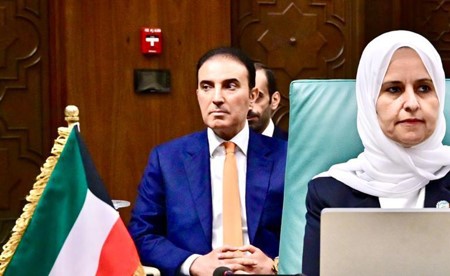
Dr. Reem Al-Faleh, Minister of State for Development and Sustainability, affirmed that Kuwait is committed to entrenching sustainability within an integrated national framework, while simultaneously supporting the transition of joint Arab environmental action from a phase of coordination and exchange of views to the implementation of measurable programs and initiatives that yield tangible impacts across Arab countries. This statement was made in Kuwait’s address at the 37th session of the Council of Arab Ministers Responsible for Environmental Affairs, held at the headquarters of the Arab League Secretariat in Cairo, with the participation of ministers and senior officials concerned with environmental affairs from Arab countries.
Al-Faleh stated that, in line with the high directives of His Highness the Amir Sheikh Meshal Al-Ahmad Al-Jaber Al-Sabah and His Highness the Crown Prince Sheikh Sabah Al-Khaled Al-Sabah, Kuwait continues to support the trajectory of joint Arab action and expand areas of cooperation and integration in environmental protection, combating climate change, and achieving the Sustainable Development Goals (SDGs).
She added that the environment is no longer a separate sectoral issue, but has become an integral part of the national and regional security framework and a cornerstone of economic and social development, encompassing the protection of human health, conservation of natural resources, and safeguarding the rights of future generations.
Al-Faleh outlined the key steps taken by Kuwait in 2026, highlighting the establishment of a dedicated Ministry of Development and Sustainability, which oversees relevant authorities in environment, agriculture, and food security, thereby enhancing institutional integration and cementing sustainability as a comprehensive national path.
She clarified that the Cabinet has approved the first unified government framework for environmental sustainability reports, which annually measures the performance of government entities through 14 national indicators, with results aggregated into a National Environmental Performance Report, thereby enhancing transparency and governance and linking environmental policies and programs to measurable and monitorable indicators.
On the issue of climate change, Al-Faleh stated that Kuwait is proceeding with the implementation of its National Low-Carbon Development Roadmap 2060, which aims to achieve carbon neutrality in the oil and gas sector by 2050, with the goal of reaching carbon neutrality across the rest of the country’s sectors by 2060.
She added that Kuwait has trained its first cohort of national negotiators specialized in climate change, comprising approximately 100 negotiators from various scientific and legal disciplines, alongside continuing partnerships with the private sector to expand renewable energy and energy storage projects.
She noted that enhancing national preparedness for environmental risks represents one of the main pathways within the sustainability framework; Kuwait has developed a risk management system based on data, monitoring, and early warning, and has prepared a National Environmental Risk Register.
At the Arab level, Al-Faleh called for developing a model for joint environmental action to address challenges such as water scarcity, desertification, land degradation, loss of biodiversity, extreme weather phenomena, and pollution, emphasizing that the scale of current challenges necessitates moving from exchanging views and coordination to clear executive programs measured by their results and impact.
She stressed the need to enhance Arab solidarity and coordination in regional and international forums to reflect the priorities, developmental needs, and specificities of the Arab region, and to support the right of Arab states to achieve a just and balanced transition toward more sustainable economies, taking into account differences in national conditions, capacities, and resources.
She underscored the importance of directing Arab cooperation toward sectors with direct impact, including the green and circular economy, combating desertification, protecting biodiversity and the marine environment, improving air quality, and integrated waste management, as well as leveraging scientific research, modern technologies, and nature-based solutions.
She called for expanding the participation of youth, women, civil society organizations, and the private sector in the environmental action framework and building partnerships capable of translating SDG targets into concrete projects and measurable outcomes.
Al-Faleh concluded that the true benchmark for the success of joint Arab environmental action lies in “our ability to transform recommendations into policies, policies into programs, and programs into real impact that Arab citizens can feel, preserving our nations’ resources and capacities and enhancing their resilience and adaptability.”
