16 cases permitting disclosure of patient confidentiality
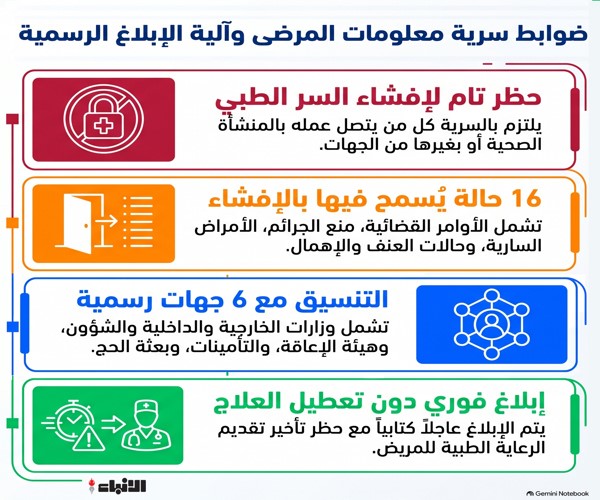
The Minister of Health issued a decree regulating the disclosure of patient confidentiality in 16 specific cases, with notification to relevant authorities.
Translated by Qiyas from الأنباء — Original source
Minister of Health Dr. Ahmed Al-Awadi issued a decision regulating the procedures for reporting patient cases and the coordination mechanism with relevant authorities. The decision, published by Al-Anbaa, stipulates that medical practitioners are prohibited from disclosing any confidential information about a patient, whether such information came to their knowledge through their professional practice, was discovered during their practice, was entrusted to them by the patient, or was learned from others. This prohibition applies to all individuals whose work involves access to such confidential information, including staff at the concerned health facilities and other relevant entities.
The decision permits the disclosure of confidential information in the following cases, provided that all government and private health facilities and the relevant committees report to the Assistant Undersecretary for Technical and Health Affairs.
For further details: Al-Anbaa publishes the full text of the decision, outlining 16 cases in which patient confidentiality may be breached, and mandating immediate and undelayed reporting of cases requiring notification of the competent authorities. The Minister of Health regulates procedures for reporting patient cases.
Minister of Health Dr. Ahmed Al-Awadi issued a decision regulating the mechanism for reporting patient cases and the coordination mechanism with relevant authorities. The decision, issued by Minister Al-Awadi and published by "Al-Anbaa," stipulates that medical practitioners are prohibited from disclosing any confidential information regarding a patient, whether such information came to their knowledge or was discovered through their professional practice, or if the patient entrusted it to them, or if they heard it from others. This prohibition applies to all individuals whose work involves access to such secrets, including employees in the concerned health facilities or other entities.
Exceptions for Disclosure
The decision permits the disclosure of confidential information in the following cases, provided that all government and private health facilities and the relevant committees notify the Assistant Undersecretary for Technical and Health Affairs:
* In compliance with a written order issued by the court, the Public Prosecution, or one of the competent investigative authorities, or when appearing before such authorities.
* Disclosure of marital medical matters concerning one of the spouses, provided that the disclosure is made directly to that spouse in person after obtaining their written consent. This consent is not required if the disclosure is necessary to avert an imminent health risk to the other spouse.
* Disclosure to competent official authorities with the aim of preventing or reporting a crime.
* Reporting infectious diseases in accordance with the provisions of Law No. 8 of 1969 concerning Health Precautions for the Prevention of Infectious Diseases and its amendments. Such disclosure is restricted to the authorities specified by the Ministry.
* The patient’s written consent to disclose their confidential information to a specific person or entity within the scope defined by the patient.
* Information and data exchange required by the necessities of professional practice, whether among the medical staff, with the administrative body of the health facility, with the patient’s relatives, or with their legal representative, when necessary. This exchange must be limited to those involved, kept to the narrowest possible extent, and restricted to what is necessary to perform their duties and responsibilities.
* Cases of violence and child abuse in accordance with the provisions of Law No. 21 of 2015 concerning the Rights of the Child.
* Cases of neglect and violence against the elderly in accordance with the provisions of Law No. 18 of 2016 concerning Social Care for the Elderly.
* Patient deaths that, by law or due to the circumstances of the case, require notifying security authorities or the consulate of the deceased’s country of nationality, as well as other relevant authorities.
* Cases of elderly persons who no longer require therapeutic care within the health facility, and whose care cannot be transferred to their relatives or provided appropriately elsewhere.
* Cases of newborns with unknown parents or unknown lineage, or those resulting from illicit relationships, and other cases requiring special legal or social measures.
* Cases of patients with prolonged stays in government health facilities whose health condition has stabilized or whose treatment phase has ended, and who cannot be discharged or transferred to their relatives or provided with appropriate care outside the facility.
* Cases involving persons with disabilities that require measures or services falling under the jurisdiction of the Public Authority for Persons with Disabilities.
* Cases of infectious diseases, including those listed in Cabinet Decision No. 435 of 2023 and its amendments, as referenced in Decision No. 208 of 2026, concerning the following diseases: Tuberculosis, Leprosy, Parasites, Intestinal Microbes, Sexually Transmitted Diseases (Syphilis, Herpes, AIDS), Specified Psychiatric and Neurological Diseases, and Chronic Kidney Failure patients.
* Health information regarding Hajj pilgrims in accordance with the health requirements approved for the Hajj pilgrimage, based on recommendations from the General Directorate of Technical Affairs.
* Cases reviewed and handled by the Medical Committee of the Public Institution for Social Security.
Coordination and Communication with Relevant Authorities
The mechanism stipulates that the Assistant Undersecretary for Technical and Health Affairs shall directly or through delegation of the relevant General Director coordinate and communicate with the concerned authorities regarding any reports received, according to each authority’s jurisdiction.
Six Authorities for Reporting and Coordination
The mechanism specifies that reporting and coordination regarding the cases mentioned in the decision shall be directed to the following authorities, each within its jurisdiction:
* Ministry of Foreign Affairs: In cases requiring communication with embassies or consulates or diplomatic authorities, or coordination regarding the transfer of patients or deceased persons’ bodies to or from Kuwait.
* Ministry of Interior: In cases requiring security or legal measures, verifying the identity of the patient or deceased, completing procedures related to residency or nationality, or handling cases of individuals with unknown identity, unknown parents, or unknown lineage. It also covers cases where residents contract infectious diseases or medical reports regarding prisoners for their medical release.
* Public Authority for Persons with Disabilities: In cases involving persons with disabilities, when their condition requires care, shelter, or services falling under the authority’s jurisdiction.
* Ministry of Social Affairs: In cases involving the elderly, patients with prolonged stays, and individuals with unknown parents or lineage, and other cases requiring the provision of care, shelter, or social protection.
* Head of the Kuwaiti Hajj Mission and any other government authority whose legal jurisdiction requires coordination to complete procedures related to any of the cases outlined in this decision.
* Medical Committee of the Public Institution for Social Security: In cases requiring presentation or falling under the committee’s jurisdiction regarding the verification of disability percentages or insurance matters in accordance with the Social Security Law.
Written Report on Cases
The mechanism states that the health facility administration, through the competent administrative or medical department, shall prepare a written report on the patient cases specified in Article One. The report must include the following data:
* The patient’s or deceased’s details, to the extent necessary to complete the procedure.
* A summary of their health, social, and legal status.
* The reason for the report and the required action to be taken.
* Supporting documents and reports.
* The name, title, and contact details of the official responsible for following up on the case at the health facility.
Confidentiality of information and health data must be observed, and disclosure should be limited to the extent necessary to achieve the purpose of the report.
Immediate Reporting Without Delay
The decision states that reports regarding cases requiring such action must be submitted immediately upon the arrival of the case, without delay, through official approved communication channels. This urgent report must be followed by a written notification supported by the necessary documents. It is noted that reporting does not justify suspending the provision of necessary healthcare to the patient or delaying any urgent medical measures required by their condition.
Special Register for Correspondence and Procedures
The decision indicates that the health facility shall follow up on the reporting with the competent authority and record all correspondence, procedures, and responses in a special register established for this purpose. A copy of this register shall be kept in the patient’s medical or administrative file, as appropriate.
