Minister of Education launches 'Smart School' project at Jamana Secondary School: Developing education as an integrated system
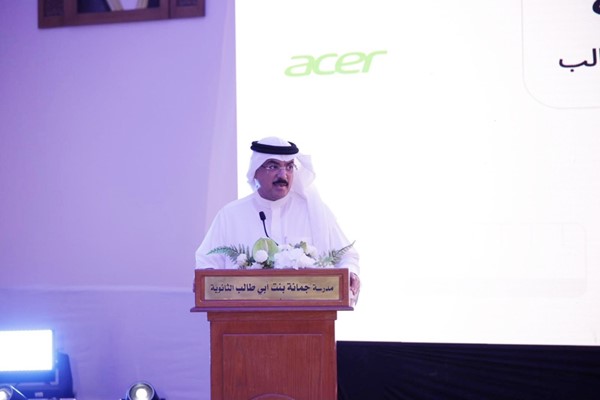
The Minister of Education launched the Smart School project in collaboration with Google at Jamana Secondary School to enhance education.
Translated by Qiyas from الأنباء — Original source
Alaa Khalifa: Minister of Education, Eng. Syed Jalal Al-Tabatabai, inaugurated the “Smart School - Albus” project in collaboration with Google for Education, at Jamana bint Abi Talib Girls’ Secondary School, one of the schools implementing the Pathways System. The event was attended by the Assistant Undersecretary for Educational Affairs, Eng. Hamad Al-Hamad, and several senior officials from the Ministry of Education.
Minister Al-Tabatabai affirmed that the Ministry is steadfastly advancing its comprehensive reform and development agenda for the educational system, working to achieve the desired goals and aspirations in line with the high directives of the political leadership, and amidst the continuous support and attention afforded to the education sector.
He clarified that educational development is not tied to a single project or isolated technological tool, but rather relies on an integrated system that combines modern curricula, educational pathways, teacher qualification, school environment development, and technology. During his speech, Al-Tabatabai delivered three core messages to teachers, parents, and administrative staff within the Ministry of Education, emphasizing that the success of any development project requires the integration of roles among all stakeholders in the educational system and a spirit of teamwork.
In his first message, Al-Tabatabai addressed teachers, affirming the nobility of their mission and the importance of their pivotal role in shaping the future of students. He noted that teachers remain the fundamental pillar of development success, regardless of how advanced tools and technologies become, due to their role in guiding learners, developing their capabilities, and transforming modern technologies into educational practices with real impact.
In his second message, he addressed parents, affirming that they are key partners in their children’s educational journey and success. He likened the educational system to a ship sailing toward its development goals, steered by a comprehensive partnership between families on one hand, and the Ministry of Education, teachers, and school administrations on the other, ensuring steady progress toward the desired objectives.
In his third message, Al-Tabatabai emphasized the importance of the role played by administrative staff in the Ministry of Education in supporting the educational process and providing the necessary organizational and administrative environment for the success of development projects. He stressed that the synergy between the educational field and administrative sectors is a fundamental element in translating reform and development plans into tangible results within schools.
For her part, Monira Al-Adwani, principal of Jamana bint Abi Talib Girls’ Secondary School, stated that hosting the “Smart School” project alongside the implementation of the “Pathways System” represents a comprehensive educational experience that supports the Ministry’s direction toward transitioning from traditional methods to an experience based on research, exploration, interaction, and innovation.
Al-Adwani expressed her pride in Jamana Secondary School being selected to host the project and implement the Pathways System, affirming that the school aims to provide a successful model for the school of the future, contributing to knowledge creation and the development of students’ skills, and empowering them with modern learning tools to keep pace with future requirements.
On her part, Lubna Tariq, Director of Digital Transformation at Google for Education, explained that the “Albus” project is part of a global alliance implemented in more than 15 countries, involving over 4,000 students and 600 teachers, to assess the impact of technology in classrooms. She noted that field results proved the experience’s ability to save teachers between 5 and 10 hours per week, while increasing student interaction and self-directed learning rates by more than 70%.
