Rubio Reassures Salam of Washington's Commitment to Supporting Lebanon and Implementing the Tripartite Framework Agreement for Stability
&cropxunits=450&cropyunits=300&w=600)
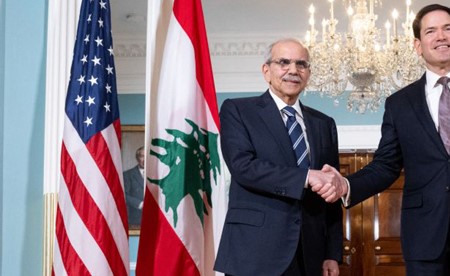
Meeting between Salam and Rubio in Washington to discuss support for the Lebanese Army and implementation of the Tripartite Framework Agreement for Stability
Translated by Qiyas from الأنباء — Original source
Washington — Mansour Shaaban and News Agencies: Lebanese Prime Minister Nawaf Salam met with U.S. Secretary of State Marco Rubio at the U.S. Department of State headquarters in Washington, in the presence of Minister of Foreign Affairs and Emigrants Youssef Raji, U.S. State Department counselor Dan Heller, Lebanon’s Ambassador to the United States Nada Hamada Maawad, and the U.S. Ambassador to Lebanon Michael Aisner.
In a statement, the Prime Minister’s Office said the meeting discussed developments in Lebanon and the region, and the path toward restoring Lebanon’s full sovereignty. Salam stressed that Lebanon looks forward to a renewed partnership with the United States that aligns with the project of rebuilding the state and strengthening its legitimate institutions. He emphasized the necessity of moving to a phase of activating the trilateral framework and translating the principles of reciprocity and gradualism into practical steps and tangible results on the ground, leading to the restoration of Lebanon’s full sovereignty, the complete Israeli withdrawal from Lebanese territories, and the monopolization of weapons by the state across its entire territory.
Salam called for establishing a clear timeline for implementing the commitments outlined in the framework, ensuring progress in the tracks of Israeli withdrawal, the extension of state authority, and the monopoly of weapons. The Prime Minister’s Office conveyed Rubio’s reaffirmation of the United States’ commitment to supporting Lebanon and its legitimate institutions, as well as continuing support for the Lebanese Armed Forces and enhancing their capabilities. He also underscored the importance of advancing the implementation of the trilateral framework to achieve stability and security.
Meanwhile, the Lebanese ministerial delegation, led by Salam and including Finance Minister Yassin Jaber and Minister of Energy and Water Joseph Saadeh, began its meetings in Washington with senior officials at the World Bank and the International Monetary Fund. Discussions focused on the path of financial and banking reforms and the steps required to advance negotiations between Lebanon and the IMF. A notable highlight of the visit was a meeting between President Salam and Minister Jaber with U.S. Treasury Secretary Scott Bessent.
In a related development, the Lebanese-American Association for Democracy (LACD), which concluded its activities in Washington, issued a statement saying that the paper presented by the association’s coordinator, George Moussa, during his meetings with officials and advisors in several offices of members of the U.S. Congress, addressed support for the Lebanese Armed Forces, strengthening state institutions and monopolizing weapons, Lebanon’s sovereignty, and the withdrawal of foreign military forces from its territories, alongside enhancing the partnership between Lebanon and the United States. It also included economic and financial reforms, combating corruption, banking sector reform, and recovering depositors’ funds, government reform and decentralization, and the safe and dignified return of displaced Syrians, in addition to enhancing the participation and representation of Lebanese expatriates in the democratic process.
In Baabda, MP Samy Gemayel, after meeting with President of the Republic General Joseph Aoun, said: “If we were to describe the President of the Republic, we would say he has the patience of Job, and the endurance for which we congratulate him. Despite all the betrayal and campaigns he faces, he maintains his calmness and places the country’s interest above all else. We have shared with the President of the Republic our views on what is happening and the necessity of taking advanced steps regarding the implementation of government decisions.”
Meanwhile, former Lebanese President General Michel Suleiman met with the Kuwaiti Ambassador to Lebanon, Mohammed Sultan Al-Sharji, to discuss bilateral relations and regional developments. Suleiman thanked Kuwait for its continuous support for Lebanon through investment projects and through the Kuwaiti Support Fund, whose operations were halted by proxy wars and whose facilities were destroyed.
During his reception of Al-Sharji in Yarze, east of Beirut, Suleiman stressed the necessity of “the Lebanese state implementing its sovereign decisions, particularly the monopolization of weapons, which has become a fundamental condition for any Arab or international support.” The two agreed that “all investments await the establishment of a sovereign state that decides on war and peace, a state that safeguards the security of its people and distances itself from axis conflicts.”
For his part, the “Lady of the Mountain” (referring to the Kataeb Party) stated: “At this time every year, world leaders gather in New York to repeat the same speeches and achieve the same results.” He questioned, along with other Lebanese, “about the role of the United Nations in Lebanon after the collapse of Resolution 1701?” and renewed his call for the international community to respect its commitments toward Lebanon.
In the south, the Israeli army continued its open war on targeted areas and carried out a massive bombing in the town of Mansouriya in the Sidon district, causing strong tremors whose echoes reached the city of Sidon and its surroundings. The National News Agency reported that “a force from the Engineering Corps of the Lebanese Army dismantled an Israeli surveillance camera equipped with a solar power system, which had been planted by a drone at the edges of the Zebqine Valley in the Sidon district.”
