One million dinars outside 'Tenders' oversight
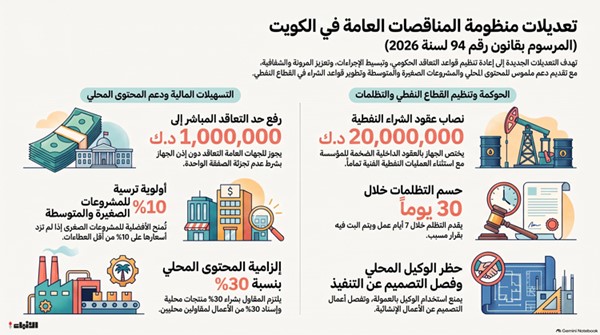
Kuwait: Law Decree No. 94 of 2026 amends the Public Tenders Law to raise the maximum contracting limit without Central Agency approval to one million dinars, while prohibiting bid splitting, expanding support for local content, and regulating the jurisdiction of Kuwait Petroleum Corporation
Translated by Qiyas from الأنباء — Original source
Decree-Law No. 94 of 2026 to Amend Certain Provisions of Law No. 49 of 2016 on Public Tenders, published in the Official Gazette (Kuwait Today) in its issue dated September 27, 2026, establishes rules for government procurement and contracting. This step aims to simplify contracting procedures, address difficulties and issues revealed by practical application, and enhance the flexibility of relevant entities, thereby ensuring that tender procedures are implemented quickly, efficiently, transparently, and fairly.
In this context, the new decree focused on raising the maximum contract value that public entities may conclude without the approval of the Central Tenders Board to one million dinars, while prohibiting the fragmentation of a single contract to reduce its value and evade the Board’s jurisdiction. Additionally, small and medium-sized enterprises were granted preferential treatment in awarding contracts, provided their bids comply with specifications and conditions and their prices do not exceed 10% of the lowest acceptable bid.
Regarding the oil sector, the decree stipulates that the Central Tenders Board has jurisdiction over procurement contracts executed within Kuwait by the Kuwait Petroleum Corporation and its wholly owned subsidiaries, where the value exceeds 20 million dinars. Contracts with values below this threshold fall under the jurisdiction of the procurement committees of the Corporation and these companies. This threshold may be increased by a Cabinet Council decision based on a proposal from the Corporation’s Board of Directors. The decree also exempted all oil operations from the provisions of the Tenders Law, regardless of their value, and added a detailed definition of oil operations to the law.
The decree expanded the scope of local content support. It obliged foreign or local contractors to purchase at least 30% of the products listed in the Industrial Directory issued by the Public Authority for Industry. Furthermore, it required foreign contractors to subcontract at least 30% of the awarded contract work to local contractors, of which 10% must be allocated to small and medium-sized enterprise owners, in accordance with the controls outlined in the law.
For more details: One million dinars as the maximum limit for public entity contracting without “the Board’s” approval… and prohibition of contract fragmentation to circumvent the threshold. A decree redraws the rules of “public tenders” in Kuwait. By Ahmed Maghrabi
Kuwait’s public tenders system has entered a new phase of reorganizing government procurement and contracting rules, following the issuance of Law-Decree No. 94 of 2026 amending certain provisions of Law No. 49 of 2016 concerning public tenders, published in the Official Gazette (Kuwait Today) on Sunday, September 27, 2026. The amendments aim to simplify procedures, address difficulties and issues revealed by practical application, and enhance the flexibility of concerned entities, thereby ensuring that tender procedures are implemented with speed, efficiency, transparency, and fairness.
The amendments bring direct changes to the government contracting landscape. They raise the maximum value of contracts that public entities may conclude without the approval of the Central Tenders Board to one million Kuwaiti dinars, while prohibiting the fragmentation of a single contract to lower its value and evade the Board’s jurisdiction. Additionally, small and medium-sized enterprises (SMEs) are granted priority in awarding contracts, provided their bids comply with specifications and conditions and their prices do not exceed 10% of the lowest accepted bid.
In the oil sector, the decree assigns the Board jurisdiction over procurement contracts executed within Kuwait by the Kuwait Petroleum Corporation (KPC) and its wholly-owned subsidiaries, where the value exceeds 20 million Kuwaiti dinars. Contracts below this threshold fall under the jurisdiction of the procurement committees within KPC and its subsidiaries. This threshold may be increased by a Cabinet decision based on a proposal from the KPC Board of Directors. The decree also exempts all oil operations from the provisions of the Tenders Law, regardless of their value, and adds a detailed definition of oil operations to the law.
The decree expands the scope of local content support. It obligates foreign or local contractors to purchase at least 30% of the products listed in the Industrial Catalog issued by the Public Authority for Industry. Furthermore, foreign contractors are required to subcontract at least 30% of the awarded contract works to local contractors, with 10% of that portion reserved for SMEs, in accordance with the controls stipulated in the law.
The amendments also prohibit the use of local agents or commission agents in all contracting procedures, according to rules approved by the Cabinet. They mandate the separation of design works from construction works, unless the nature of the works requires otherwise. The decree also introduces periodic re-evaluation of general contracting companies’ classifications and reorganizes the Appeals Committee for decisions issued by the Board’s Management Council.
The decree sets a seven-working-day deadline for appealing the Council’s decisions, starting from the date of publication of the decision or notification to interested parties, whichever is earlier. The Appeals Committee must rule on the appeal and issue a reasoned decision within a period not exceeding 30 days from the date of submission. The procurement process may be suspended pending the resolution of the appeal.
The decree also reorganizes the composition of the Board’s Management Council. It stipulates that the Council shall continue in its current composition at the time the decree enters into force until the end of its term. The next Council’s composition shall be subject to the new provisions. The Law-Decree will enter into force three months after its publication in the Official Gazette.
Below are the key provisions of the law:
**Article One**
The following texts replace the texts of Articles (2/Thirdly/Item 3, 5, 19/First Item, 26, 31, 39/Items 1 and 2, 41/Second Paragraph, 49/Second Paragraph, 62, 62 bis, 78, 87) of Law No. 49 of 2016 mentioned above:
**Article (2/Thirdly/Item 3)**
3- Kuwait Petroleum Corporation and its wholly-owned subsidiaries:
Regarding procurement cases related to (items – contracts – services), the Central Tenders Board has jurisdiction over procurement contracts executed within the State of Kuwait with a value exceeding twenty million Kuwaiti dinars, in accordance with the provisions of this law. Procurement committees are formed within the Kuwait Petroleum Corporation and its wholly-owned subsidiaries, with jurisdiction over contracts with values below that threshold. Minutes of procurement contracts conducted by these committees shall be referred to the Central Tenders Board, the Court of Audit, and the Ministry of Finance. These committees are also responsible for setting special conditions to facilitate the qualification of SMEs, in coordination with the National Fund for Supporting and Developing Small and Medium Enterprises.
The threshold mentioned in the preceding paragraph may be increased by a Cabinet decision based on a proposal from the Kuwait Petroleum Corporation Board of Directors.
Subject to the provisions of Article (152) of the Constitution, all oil operations, regardless of their value, are exempt from the provisions of this law.
The procurement committees mentioned shall conduct their activities and appeals against their decisions shall be handled in accordance with the rules, procedures, and fees approved by the Kuwait Petroleum Corporation Board of Directors, adhering to the principles of transparency, disclosure, commitment, governance, fairness, equal opportunity, and avoidance of conflicts of interest, with the aim of optimal utilization of the funds of the Kuwait Petroleum Corporation and its wholly-owned subsidiaries. The provisions of this law shall apply only to matters not covered by these rules and procedures and to the extent that they do not conflict with them.
The Supreme Petroleum Council has the right to authorize the Corporation or one of its wholly-owned subsidiaries to purchase or import items, or to instruct contractors to carry out works urgently, due to the nature of the required materials or works, or due to urgent or emergency circumstances, in accordance with rules and procedures approved by the Council, without being bound by any existing rules or procedures. The Chairman of the Corporation’s Board of Directors shall notify the Supreme Petroleum Council of contracts concluded under this arrangement at the first subsequent meeting.
**Article (5)**
The Board of Directors of the Central Tenders Board shall consist of:
A – (Seven) members appointed by a decree based on the nomination of the competent Minister and with the approval of the Cabinet, for a non-renewable term of four years. Among them, a full-time Chairman and Vice-Chairman shall be appointed. The term of three members of the first constituted Board shall end two years after their appointment, excluding the Chairman and Vice-Chairman. A decree shall be issued to renew the membership of those whose terms expire and to appoint their replacements for a four-year term. The Cabinet shall determine their allowances, and their dismissal shall be by decree based on a proposal from the competent Minister.
Members must be Kuwaiti citizens of integrity, with expertise and specialization in engineering, judicial, medical, and economic affairs, and in fields related to the Board’s work. No one who has been issued a final judgment of bankruptcy or a conviction for a felony or a crime involving moral turpitude or breach of trust shall be eligible.
B – A representative of the Office of Legal Opinions and Legislation.
C – A representative of the Ministry of Finance.
D – A representative of the government entity that will supervise the implementation of the tender, without voting rights.
The selection of representatives for the entities mentioned in items (B, C, D) shall be periodic, with a maximum term of two years for each representative.
The Board of Directors may engage experts, whether from the concerned entity or others, to clarify any matters directly related to its jurisdiction, without granting them voting rights.
**Article (19/First Item)**
First: Public entities subject to the provisions of this law may contract for any purpose stipulated in this law without the Board’s approval, using the appropriate method according to circulars issued by the Ministry of Finance, based on the needs of the concerned entity, provided the contract value does not exceed (1,000,000/- KWD) one million Kuwaiti dinars.
Contracting in this manner for the same items or works exceeding this threshold is not permitted during the fiscal year.
Entities may cooperate with the Procurement Systems Administration in accordance with the rules and systems of centralized procurement conducted by the said Administration.
When applying the provisions of the preceding paragraph, fragmentation of a single contract into smaller contracts to reduce its value below the Board’s jurisdiction is prohibited. The concerned entity shall provide the Ministry of Finance with periodic reports every six months regarding contracts concluded within the specified threshold.
The value of the contract mentioned shall be reviewed by a Cabinet decision, either increasing or decreasing it, based on a recommendation from the Board.
**Article (26)**
The Classification Committee shall classify general contracting companies into four categories based on their financial and technical capabilities. The Board shall set special conditions to facilitate the entry of SME owners into the fourth category. Classification shall be re-evaluated periodically according to the bases and criteria established by the Classification Committee.
The Executive Bylaws of this law shall specify the deadlines and procedures for submitting registration and classification requests, the conditions for each, the classification categories, the review process, and the deadlines and procedures for appealing decisions issued regarding them. Classification does not replace pre-qualification procedures for bidders, and the concerned entity must take these procedures to ensure that bidders are qualified to execute the contract.
**Article (31)**
Subject to Law No. (1) of 2016 and Law No. (116) of 2013 mentioned above, and relevant international agreements, the following conditions are required for anyone submitting a bid in public or limited tenders, or in cases of direct practice and contracting:
First: The bidder must be an individual or a company registered in the Commercial Register.
Second: The bidder must be registered in the Suppliers or Contractors Register, depending on the nature of the tender, practice, or direct contracting.
The Executive Bylaws shall specify the conditions and controls for the participation of SME owners in procurement processes subject to the provisions of this law.
**Article (39)**
1- Before offering the supply of items or construction works in a public tender, and after preparing final designs and separating design works from construction works unless the nature of the works requires otherwise, the concerned entity must prepare the tender documents. It must set detailed specifications for each item or performance of each work, the scope of the procurement, the specified time and place for contract execution, and the criteria for evaluating bids. It must also provide necessary instructions to contractors, drawings, and detailed bills of quantities showing item details and price schedules. International standard specifications and government supply specifications must be observed.
2- The Executive Bylaws shall determine cases where fees are charged for providing tender documents to interested participants.
**Article (41/Second Paragraph)**
The Board may assign suitable personnel from the Board to examine samples from a technical perspective in submitted bids, verify their compliance with announced conditions, and confirm the availability of technical sufficiency conditions. The Board may engage experts whose opinions it deems useful, and specialists shall submit reports on their research findings and recommendations to the Board.
**Article (49/Second Paragraph)**
Envelopes shall be returned to the Board. The Board may assign suitable personnel from the Board to provide an opinion when necessary. Financial envelopes for these bids shall not be opened until the technical recommendation regarding them is received. Financial envelopes for technically unacceptable bids shall be returned to their owners unopened.
**Article (62)**
Subject to international and regional agreements ratified by the State of Kuwait, the Cabinet shall determine the competent Minister or the concerned public entity to issue a decision regarding the regulation of provisions for products granted priority in public entity procurements.
**Article (62 bis)**
The Board or the competent procurement entity shall award contracts to bids submitted by SME owners, provided they comply with specifications and conditions and the prices offered do not exceed 10% of the lowest accepted bid.
A bidder may not combine the priority granted to products under Article (62) with the award priority granted under the preceding paragraph in the same tender. In such cases, the Board shall determine the award based on whichever consideration it deems appropriate.
**Article (78)**
An Appeals Committee against Board decisions shall be established, attached to the Cabinet. It shall consist of five members, specialized legal, financial, and technical experts, appointed by a decree based on the nomination of the competent Minister, for a non-renewable term of three years.
Any interested party may appeal to the Appeals Committee against Board decisions within seven working days from the date of their publication or notification to interested parties, whichever is earlier.
The Board shall provide the Committee with documents and information related to the appeal upon request.
The Committee shall study the appeal, rule on it, and issue a reasoned decision without taking any awarding procedures within a period not exceeding thirty days from the date of submission. If the appeal is accepted, documents shall be returned to the Board to complete procedures and affairs according to its legal authority, adhering to the Committee’s decision, and the Board’s notification thereof shall be considered execution.
The Executive Bylaws shall regulate the Committee’s rules and procedures for work, submission, study, and ruling on appeals, notifying the appellant and the Board of its decision, and cases for refunding appeal fees. In all cases, the Committee may suspend procurement procedures pending the resolution of the appeal.
**Article (87)**
Subject to legal provisions regarding direct foreign capital investment, the concerned entity shall monitor the compliance of foreign or local contractors with purchasing at least 30% of the products listed in the Industrial Catalog issued by the Public Authority for Industry. If these are unavailable, they may be purchased from local suppliers registered in the Board’s supplier lists, provided this is proven by official receipts from the purchasing entities.
The concerned entity shall also monitor the foreign contractor’s compliance with subcontracting at least 30% of the awarded contract works to local contractors registered in the Board’s contractor classification lists across various categories, with 10% of that portion reserved for SME owners, depending on the nature of the contract or contractors registered and classified with the Municipality of Kuwait, Kuwait Petroleum Corporation, or its subsidiaries, after obtaining approval from the entity supervising the contract execution. This percentage may be increased or decreased by a Cabinet decision based on a proposal from the Board.
**Article Two**
The following definition is added to Article (1) of Law No. 49 of 2016 mentioned above:
Oil Operations: All technical operations related to the exploration, production, processing, and export of oil and gas, including in particular all operations and stages necessary for the exploration and prospecting of oil and gas, field development, drilling and maintenance of hydrocarbon wells, production of hydrocarbon materials, processing, storage, transportation, loading, shipping, sale, and purchase of oil and gas, their derivatives, chemical materials, petrochemical products and their derivatives and extracts, including all operational and specialized services related thereto.
**Article Three**
1- Article (7) of Law No. 49 of 2016 mentioned above is repealed.
2- Any provision in other legislations that conflicts with the last paragraph of Article (31) replaced by this Law-Decree is also repealed.
3- The provisions of Article One of this Law-Decree shall not apply to procurement processes announced before its entry into force, except for Articles (62) and (62 bis).
**Article Four**
The Management Council of the Central Tenders Board shall continue in its composition at the time this Law-Decree enters into force until the end of its term. The composition of the next Council shall be subject to the provisions of Article (5) replaced by Article One of this Law-Decree.
**Article Five**
Ministers shall execute this Law-Decree according to their respective jurisdictions. It shall enter into force three months after its publication in the Official Gazette.
**Explanatory Memorandum**
for Law-Decree No. 94 of 2026 amending certain provisions of Law No. 49 of 2016 concerning public tenders
Law No. 49 of 2016 concerning public tenders was issued to regulate procurement and tender processes conducted by government entities, within a framework of transparency, equality, and equal opportunity among competitors, according to stipulated provisions.
However, the practical application of some provisions of the aforementioned Public Tenders Law revealed a number of practical difficulties and issues that had negative effects on the implementation of the law as intended.
In light of the above, and given that the Emiri Order dated 10/5/2024 included a provision in Article (4) stating that laws shall be issued by law-decrees, this Law-Decree, consisting of five articles, was prepared to simplify procedures, address difficulties and issues resulting from practical reality, and enhance the flexibility of concerned entities in dealing with practical facts, thereby achieving the interest of work and ensuring that public tender procedures are implemented with speed, efficiency, transparency, and fairness.
Article One of the Law-Decree addressed the replacement of some articles of Law No. 49 of 2016, as follows:
Item (3) of Article (2/Thirdly) was amended by raising the financial threshold for contracts under the jurisdiction of procurement committees in the Kuwait Petroleum Corporation and its wholly-owned subsidiaries, with the possibility of increasing this threshold by a Cabinet decision based on a proposal from the KPC Board of Directors.
The procurement unit was replaced by procurement committees within the Kuwait Petroleum Corporation and its wholly-owned subsidiaries. These committees shall conduct their work according to rules and procedures approved by the Corporation’s Board of Directors. The amendment also mandated that these rules and procedures adhere to the principles of transparency, disclosure, commitment, governance, fairness, equal opportunity, and avoidance of conflicts of interest. A new provision was introduced stating that the provisions of the Public Tenders Law shall apply only to matters not covered by these rules and procedures and to the extent that they do not conflict with them.
The amendment also authorized the Supreme Petroleum Council to authorize the Kuwait Petroleum Corporation or one of its wholly-owned subsidiaries to purchase or import items, or to instruct contractors to carry out works urgently.
Article No. (5) was amended regarding the composition of the Board of Directors, by removing the membership of representatives from the State Planning Commission, the Public Authority for Manpower, the Public Authority for Persons with Disabilities, and the Public Authority for Small and Medium Enterprises Development. The provision in Item (D) of the same article, concerning the representative of the government entity supervising the tender implementation, was amended to state that their participation in the Board of Directors shall be without voting rights.
Item (First) of Article No. (19) was amended to raise the maximum value of contracts that public entities may conclude without the Board’s approval to one million Kuwaiti dinars. The contract value shall be reviewed by a Cabinet decision, either increasing or decreasing it, whenever necessary, based on a recommendation from the Board. The reference to coordination with the National Fund for Supporting and Developing Small and Medium Enterprises mentioned in this article was deleted.
Article No. (26), concerning the classification of general contracting companies, was amended by adding a provision requiring periodic re-evaluation of classification according to the bases and criteria established by the Classification Committee.
Article No. (31) prohibited the use of local agents or commission agents in all contracting procedures, according to rules approved by the Cabinet based on a proposal from the competent Minister after coordination with relevant entities.
Items (1, 2) of Article No. (39) were amended by separating design works from construction works, and exceptionally allowing their combination if the nature of the works requires it. The exemption of SME owners from fees for obtaining tender documents was abolished.
