Italian Ambassador: Kuwait is a Strategic Partner; We Work to Enhance Defense and Economic Cooperation, Protect Regional Security, and Ensure Freedom of Navigation
&cropxunits=450&cropyunits=300&w=770)
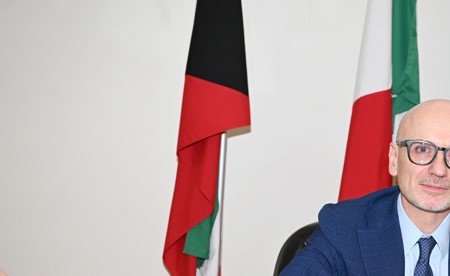
Italian Ambassador Lorenzo Morini details bilateral defense cooperation with Kuwait, including the defense agreement, aircraft deal, and protection of navigation.
Translated by Qiyas from الأنباء — Original source
Osama Diab: The Ambassador of the Italian Republic to Kuwait, Lorenzo Morini, affirmed the depth and distinction of Kuwaiti-Italian relations across various fields, particularly defense, security, economy, investment, and education. He noted that Italy is keen on continuing its support for Kuwait and contributing to enhancing the region’s security and stability, alongside safeguarding freedom of navigation in the Strait of Hormuz in accordance with international law.
Morini, during a meeting with representatives of several local newspapers, stated that defense and security cooperation between Kuwait and Italy was strong prior to the recent crisis. He explained that approximately 400 Italian military personnel were stationed in Kuwait as part of the international coalition against ISIS, primarily operating from Ali Al-Salem Air Base and other sites in the country.
He added that the Italian soldiers were directly affected by security developments and were forced to remain in shelters for extended periods. He emphasized that Italy’s message from the outset was clear: “We are here to stay and help and support Kuwait.”
Morini praised the support provided by Kuwaiti authorities to Italian military personnel during that period, noting that they were provided with all necessary logistical support, food, water, and other essentials, despite the difficult conditions, rapid alerts, and inability to move far from the shelters.
He clarified that Italy was later forced, for security reasons, to relocate most of its military personnel out of Kuwait. He confirmed that no serious injuries occurred among them, except for some minor ones, thanks to the efficiency of the shelters and Kuwaiti defense systems. He noted that a group of military personnel remained in Kuwait and are currently not operating within the international coalition, but rather providing support to the Kuwaiti Armed Forces within the framework of bilateral defense cooperation.
Regarding the Defense Cooperation Agreement between the two countries, Morini revealed that Italy has completed its ratification procedures, with only the signature of the Italian President remaining as a final formal step. He expected to notify Kuwait of Italy’s ratification soon. He added that Kuwait ratified the agreement last June, while the Italian Parliament approved it in early August, expressing hope that all procedures would be completed and the agreement would enter into force soon.
He explained that the agreement focuses on training, joint exercises, and the exchange of expertise, information, and defense materials. It does not relate to a specific deal or a particular weapons system, but rather constitutes a general framework paving the way for signing memorandums of understanding and detailed agreements in various fields, including anti-drone systems.
He noted that Italy is also negotiating a cooperation agreement with the Kuwait National Guard, covering the exchange of expertise in protecting facilities and strategic infrastructure, protecting dignitaries, combating the smuggling of antiquities and artworks, and leveraging the expertise of the Italian Carabinieri in these fields.
On the Eurofighter deal, Morini clarified that its agreement dates back to 2016 and is separate from the new Defense Cooperation Agreement. He revealed that three aircraft remain undelivered to Kuwait. He stated that the three aircraft are ready for delivery, but security conditions over the past months prevented their transfer to Kuwait. “We were waiting for the situation to stabilize, and the aircraft are ready for delivery,” he added.
He explained that the Eurofighter program is based on a contract between the Kuwait Air Force and the Italian company Leonardo, with the Italian government playing a supervisory role to ensure service quality and the company’s commitment to contract terms and rules governing bilateral relations. He added that personnel working on the program handle maintenance, technical support, training, facility management, and assistance in transporting the aircraft, while Kuwaiti pilots fly the planes after receiving training at Italian facilities under Italian government supervision.
Regarding the Sky Guard system, the Italian Ambassador revealed continued cooperation with Kuwait on several defense systems, noting that Italian companies have already supplied the Kuwait National Guard with short-range weapon ammunition and other materials. He added that Kuwait acquired the Sky Guard air defense system from an Italian company more than 15 years ago. It has undergone continuous updates to keep pace with evolving threats, particularly drones, which have seen significant changes in speed and capabilities.
He pointed out that work is currently underway to update the system to make it more responsive to modern threats. He noted that it operates in an integrated manner with the Patriot system, with each system handling different types of targets within a central command center that determines the most appropriate mechanism and system for dealing with each threat.
Morini noted that the radar at Kuwait International Airport, provided by Leonardo, was damaged during the crisis. He highlighted that Italy managed to provide an alternative radar to Kuwait within a few weeks, despite the fact that manufacturing its components usually takes months. He explained that this is an example showing that bilateral cooperation is not limited to direct military matters but also includes essential civilian equipment for Kuwait’s security and stability.
He also clarified that training programs are divided into long academic courses lasting a year or more, and short specialized courses lasting between one and three months. These include training for Eurofighter pilots, combating transnational criminal organizations and terrorism, protecting archaeological sites and strategic facilities, and other areas.
In the field of training, Morini said that approximately 30 members of the Kuwait Air Force are currently in Italy, along with two officers from the Naval Force. He noted the presence of an Italian military officer at the Mubarak Al-Abdullah College of Joint Command and Staff as part of expertise exchange programs. He reiterated that training programs are divided into long academic courses and short specialized courses covering various fields.
Regarding maritime cooperation, Morini affirmed Italy’s readiness to assist Gulf Cooperation Council (GCC) countries in protecting the region and securing navigation. He explained that Italy is pushing within the European Union to extend the scope of the EU’s Aspides mission—which focuses on securing navigation around the Bab el-Mandeb—to include protecting ships passing through the Strait of Hormuz.
Morini emphasized that Kuwaiti-Italian discussions focus on supporting Kuwait’s self-defense and helping prevent any potential aggression, alongside rallying international support for respecting international law and ensuring freedom of navigation in the Strait of Hormuz. He stated that freedom of passage in the strait represents a vital interest for Kuwait, Italy, Europe, Asia, and the international community as a whole, given its link to energy supplies, food, medicines, and global supply chains.
He clarified that Kuwait is one of the leading suppliers of jet fuel to Europe, while Qatar is a major supplier of natural gas to Italy. Additionally, materials produced by countries in the region for fertilizer manufacturing all require passage through the Strait of Hormuz. He warned that disruptions in navigation in the Hormuz Strait or Bab el-Mandeb would directly impact global prices, even for countries obtaining gas and oil from other sources, as prices are subject to supply and demand equations in international markets. He noted that gas prices in Europe have risen by between 30% and 40%.
Morini praised Kuwait’s performance during the crisis, affirming that it demonstrated great resilience and maintained the availability of food, energy, and water without significant issues. He stated that Kuwait responded with high efficiency in air defense and logistics, and that the number of interception operations relative to the volume of attacks reflected exceptional effectiveness, describing the performance of Kuwaiti authorities as “excellent.”
He affirmed that Kuwait is capable of playing an important political role in the region due to its diplomatic approach, good relations with various GCC countries and regional partners, and its commitment to dialogue, respect for international law, and the role of the United Nations. He added that Kuwait serves as a strategic hub for Italy due to its direct communication channels with regional leaders, making continued communication important for exchanging messages and supporting settlement efforts.
He noted that the second summit between the European Union and the GCC, scheduled to be held in Riyadh at the end of October, will form an important milestone for unifying efforts, ideas, and resources, and pushing toward a fair and acceptable settlement that respects international law.
On the economic level, Morini said the two countries are working to support partnerships between the private sectors, encouraging Kuwaiti investments in Italy and Italian investments in Kuwait. He explained that several Italian companies operate in the Kuwaiti market, either as service providers or through establishing local companies, noting Italy’s aspiration to increase its presence while attracting more Kuwaiti investments. He pointed out that Kuwait Petroleum International (Q8) represents one of the most prominent Kuwaiti investments in Italy and is highly regarded by the Italian government.
He revealed arrangements for a visit by a delegation from the Confindustria association, which represents industrial and commercial companies in northern Italy, noting that it encompasses more than 7,000 companies, representing a significant percentage of Italy’s GDP. He affirmed that the visit aims to open a direct channel between Kuwaiti and Italian companies, allowing the private sectors of both countries to discuss business opportunities and joint projects.
Morini clarified that the food production and distribution sector represents one of the most promising areas of cooperation. He mentioned discussing ideas to encourage Kuwait to invest in small and medium-sized Italian companies operating in this field. He added that these companies can export their products to Kuwait or form partnerships with the Kuwaiti private sector to produce food locally. He emphasized that Italy possesses expertise in agriculture and food production in arid environments, particularly in Sicily, Calabria, and Sardinia, where some climatic conditions resemble those in Kuwait, allowing for the utilization of this expertise to support Kuwaiti food security.
He stated that recent crises and the coronavirus pandemic have proven the importance of developing local production, given the potential impact on supply chains and the difficulty of accessing food during emergencies.
The Italian Ambassador pointed to significant opportunities for cooperation in the health sector, particularly in treating age-related diseases such as diabetes and osteoporosis, as well as rehabilitation, remote treatment, and home care. He added that Kuwait and Italy face similar demographic challenges with the increasing number of elderly people, affirming the possibility of forming partnerships between medical institutions and universities in both countries, leveraging Kuwait’s advanced health infrastructure and Italian specialized expertise. He also affirmed Italy’s readiness to assist Kuwait in developing a national civil protection system for responding to emergencies, natural disasters, and the impacts of climate change, drawing on Italy’s integrated experience within the European Union system.
Regarding visas, Morini revealed that the number of visas issued by the embassy between January and September 2026 amounted to about half the number recorded during the same period in 2025. He attributed the decline to the crisis and the near halt of travel during March, April, May, and part of June. He confirmed that the decrease was concentrated in tourist visas, while business and family visit visas remained at their usual levels. He added that study visas increased by about 10%, from nearly 50 visas last year to about 60 this year. He noted that the number of Kuwaiti students studying in Italian universities ranges between 150 and 200 annually, a figure that is rising.
He denied any changes to the Italian visa system or the adoption of a new standalone electronic application, affirming that Italy is part of the Schengen system, which includes 28 countries, and any modification must be agreed upon collectively in Brussels. He described rumors to the contrary online as “fake news.”
Regarding the wearing of the niqab in Italy, Morini clarified that general law requires individuals to show their faces in public places and during document verification for security reasons. He affirmed that the measure does not target women or religious beliefs, as wearing the hijab is permitted, but one cannot enter certain public places, such as museums, with the face fully covered. He noted that the rule applies equally to men and women.
On calls to boycott Israeli products, Morini stated that the file is being discussed within the European Union and that Italy cannot make an independent commercial decision, as trade policy falls under the jurisdiction of the European Union.
