Cosmic Lens May Solve the Mystery of Black Hole Mergers Once Deemed Impossible
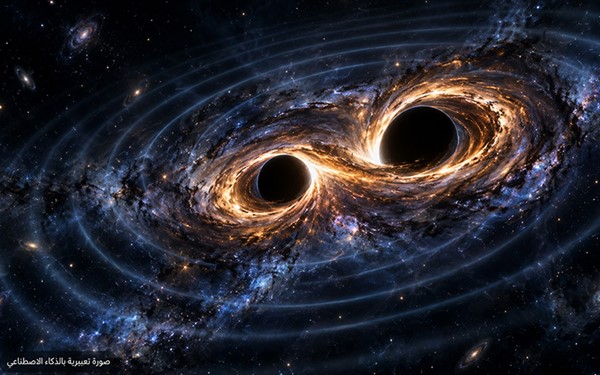
When the LIGO observatories in the United States detected a gravitational wave signal named GW231123, scientists appeared to be facing an event that was difficult to explain: two black holes with masses of approximately 100 and 140 times that of the Sun had merged to form one of the most massive black holes observed in this manner.
The problem lies in the fact that stellar evolution models do not easily predict the formation of black holes within this mass range. Extremely massive stars may explode completely, leaving no black hole behind—a phenomenon astronomers refer to as the mass gap.
However, a recent study suggests that the two black holes may not have been that massive to begin with. The gravitational waves might have passed close to a massive object during their journey to Earth, causing spacetime to bend and amplifying the signal, in a phenomenon known as “gravitational lensing.”
If this hypothesis is correct, the true mass of the resulting black hole would be around 140 solar masses rather than approximately 240, thereby reducing the conflict with black hole formation models.
Yet this solution opens up a new puzzle: such amplification requires a rare lensing object, such as a dense star cluster or a massive compact object, which has not yet been found. Therefore, gravitational lensing remains a plausible explanation, but not definitive proof of what occurred.
