Bahraini Foreign Minister: Implications of Iranian Attacks Extend Beyond the Region and Impact the Global Economy
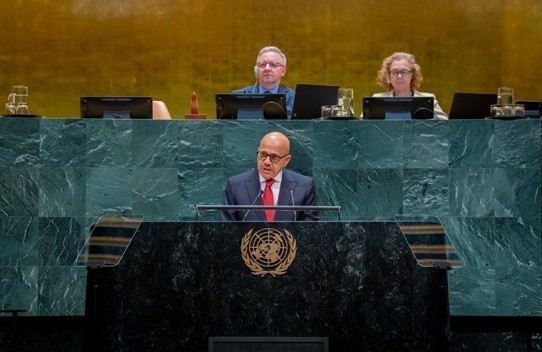
Bahraini Foreign Minister Abdul Latif bin Rashid Al Zayani warned that the repercussions of Iranian attacks on Gulf Cooperation Council (GCC) countries and Jordan extend beyond the region, affecting global energy and foo
Translated by Qiyas from الأنباء — Original source
Bahraini Foreign Minister Abdul Latif bin Rashid Al Zayani warned that the repercussions of Iranian attacks on Gulf Cooperation Council (GCC) countries and Jordan extend beyond the region, affecting global energy and food prices, shipping and insurance costs, and supply chains.
This statement was made during Al Zayani’s address at the high-level general debate of the 81st session of the United Nations General Assembly on Friday.
Al Zayani stated that GCC countries and the Hashemite Kingdom of Jordan have been subjected to “waves of unjustified Iranian attacks using ballistic missiles and drones.” He clarified that these attacks targeted civilian facilities, residential areas, ports, airports, and energy installations, representing a “blatant violation of international law and the UN Charter.”
He noted that Iranian aggression has amounted to approximately 7,000 incidents, including the launch of ballistic and cruise missiles and drones, as well as the targeting and detention of commercial vessels in the region. Al Zayani added that around 1,000 cargo and tanker ships, carrying approximately 20,000 sailors, have been detained, while 72 commercial vessels were targeted, resulting in the deaths of 22 sailors.
He highlighted that these figures represent ships, ports, markets, and families awaiting the return of their loved ones, pointing to attacks on commercial vessels in the Strait of Hormuz, the laying of mines in an international waterway, and restrictions on transit traffic.
Al Zayani reaffirmed Bahrain’s solidarity with the Gulf states that were attacked, praising the efficiency of the Bahraini Defense Force and the air defense systems of sister GCC countries, as well as their readiness to counter the attacks. He emphasized that these countries have the right to take lawful measures to defend their sovereignty and territorial integrity, in accordance with Article 51 of the UN Charter and the GCC Joint Defense Agreement.
At the same time, the Bahraini minister stressed his country’s commitment to the highest degree of restraint and its dedication to achieving security and peace for the peoples of the region.
Regarding the Strait of Hormuz, Al Zayani affirmed that it constitutes an international waterway and that the right of passage for ships is established under the UN Convention on the Law of the Sea. He expressed Bahrain’s rejection of imposing any permit system or fees on ships transiting the strait, or using international waterways as a means of pressure, economic blackmail, or seizure of vessels.
He warned that accepting such practices in one international waterway could open the door to similar demands in other routes upon which global trade depends, emphasizing that resorting to alternative routes should not replace compliance with international law.
Al Zayani also addressed rapid developments in the field of artificial intelligence, noting that two years ago, Bahrain’s Crown Prince and Prime Minister called for the adoption of an international treaty to govern the development of AI, thereby contributing to supporting peace and preventing the escalation of conflicts. He affirmed that the goal is not to hinder technological progress, but to surround its growth with guarantees ensuring its use serves peace and stability.
In conclusion, the Bahraini Foreign Minister called for strengthening the UN’s capacity to implement its resolutions, emphasizing that the challenge lies not in issuing more resolutions, but in ensuring their implementation and protecting the rights they establish.
