Minister of Labor Discusses with Head of National Coordinating Committee for Combating Illegal Migration the Enhancement of Joint Cooperation
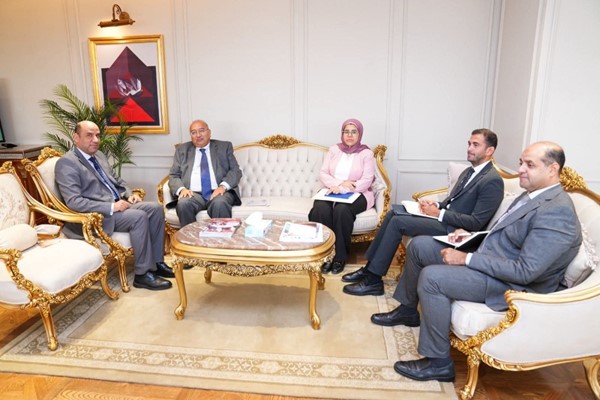
Meeting between the Minister of Labor and the Head of the National Coordinating Committee for Combating Illegal Migration
Translated by Alqyas from Al-Anba — Original source
Cairo - Ahmed Sabry: Minister of Employment Hassan Radad met with Ambassador Amr Ramadan, Chairman of the National Coordinating Committee for Combating and Preventing Irregular Migration and Human Trafficking, at his office in the New Capital, to discuss ways to enhance coordination and cooperation on shared files, particularly regarding the fight against irregular migration, raising awareness of its risks, and providing safe and viable alternatives for youth through training, employment, and linking skills to labor market needs.
During the meeting, both sides reviewed the importance of integrating the efforts of the Ministry of Employment and the National Committee for Combating and Preventing Irregular Migration, within the framework of a comprehensive national vision aimed at reducing the drivers of irregular migration and raising youth awareness of the dangers of traveling through illegal routes, alongside providing legal pathways for work and training within Egypt and abroad.
The Minister of Employment emphasized that the Ministry attaches great importance to combating irregular migration by working to provide real employment opportunities, expanding the vocational training and labor market qualification system, and enhancing youth skills in line with local and international market needs. He also highlighted the regulation of processes for deploying Egyptian workers abroad to ensure workers' rights and protect them from exploitation, brokers, and unlicensed entities.
The Minister pointed out that the National Employment Strategy represents one of the main pillars in this context, aiming to achieve greater alignment between the outputs of education and training and labor market needs, expanding employment opportunities, and leveraging new transformations in the labor market and future jobs. This contributes to providing positive alternatives for youth and enhancing decent work opportunities.
He also outlined the Ministry’s efforts to develop the vocational training system through its affiliated training centers, expanding training linked to the needs of projects and investments, alongside programs to prepare youth for locally and internationally demanded professions. He stressed that providing skills and employment opportunities is one of the most important axes in addressing the economic and social causes that may lead some youth to consider irregular migration.
The meeting also addressed the importance of intensifying awareness efforts through cooperation among relevant authorities to highlight the risks of irregular migration and expose the methods used by human smuggling networks to attract youth. Emphasis was placed on directing youth toward official and safe channels to obtain employment opportunities domestically and internationally.
Ambassador Amr Ramadan, Chairman of the National Coordinating Committee for Combating and Preventing Irregular Migration and Human Trafficking, presented his vision for developing the Committee’s work in the coming period. He noted that since assuming his position, he has been keen to study the Committee’s activities over the past eight years, reviewing its executed activities, achievements, and identifying the challenges and obstacles facing efforts to combat irregular migration on the ground.
He clarified that the Committee includes approximately 30 ministries and official entities as members. He indicated that the coming phase will see the launch of a ten-year strategy to combat irregular migration, based on a comprehensive approach addressing the various economic, political, and social dimensions of the phenomenon. This requires the concerted efforts of different state institutions. Ambassador Ramadan stressed the importance of supporting these efforts by relevant authorities, particularly those linked to employment, training, and youth preparation, thereby expanding the scope of safe and legal alternatives for those seeking work and enhancing the state’s capacity to address the causes of irregular migration and mitigate its risks.
Both sides agreed on the importance of continuing coordination and exchanging information and expertise to support national efforts in this file, and to enhance employment, training, and safe work pathways within a comprehensive vision that places youth at the heart of development efforts and provides them with real opportunities for work within Egypt and abroad through official channels.
