Government Unveils 'Syria Without Camps' Vision: Goal Is Not to Remove Camps but to Eliminate the Need for Them
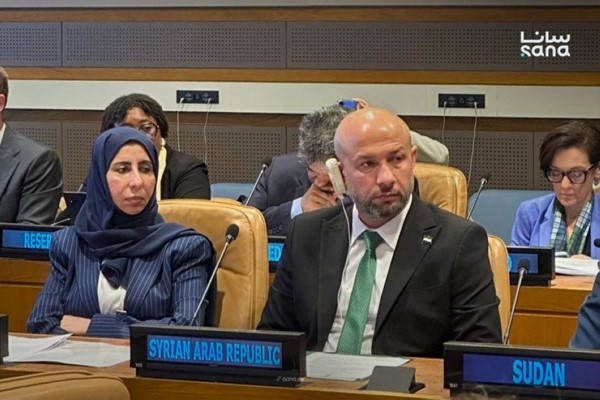
Launch of 'Syria Without Camps' vision during a UN seminar
Translated by Alqyas from Al-Anba — Original source
Syria has presented the international community with a vision of “Syria without camps,” describing it as a pathway that begins with preparing return areas, securing services and job opportunities, and culminating in the voluntary, safe, and sustainable return of residents, rather than merely closing displacement camps. This was stated during a high-level seminar organized by the Permanent Mission of Syria to the United Nations in New York, on the sidelines of the 81st session of the UN General Assembly, titled “Regional Stability, Security, and Sustainable Return: The Imperative of Syria Without Camps.” In it, Minister of Emergency and Disaster Management Raed al-Saleh summarized the core of the vision, stating, “Our goal is not to dismantle the camps, but to eliminate the need for them.”
Al-Saleh clarified in an interview with the Syrian Arab News Agency (SANA) that the government is working to build new partnerships that shift international support from funding emergency response to financing solutions, by ensuring the conditions that enable return. These conditions include, foremost, clearing mines and rubble, preparing areas, and then rehabilitating infrastructure and services. He said, “We do not need to improve camp conditions; we need our people in the camps to return safely, with dignity, sustainably, and voluntarily to the areas from which they were forcibly displaced by the ousted regime.”
The Syrian vision aligns with an international call to reconsider the nature of the response to the displacement file. The Director-General of the International Organization for Migration, Amy Pope, emphasized that the success of this path requires government participation and political will, and a transition from aid to more sustainable solutions.
Al-Saleh noted that the government launched 300 projects last week in areas of the rural districts of Aleppo, Hama, and Idlib, to improve roads, water, health services, and other basic needs, which facilitate the return and stabilization of populations. He added that efforts are underway in parallel to mobilize additional funding to increase the number of projects and enhance service levels, including infrastructure rehabilitation and securing job opportunities.
These projects are part of a government process initiated by Decree No. 59 of 2026, which established a committee chaired by the Minister of Emergency and Disaster Management to prepare infrastructure in destroyed areas, paving the way for the return of residents.
For his part, Alexander de Croo, Administrator of the United Nations Development Programme (UNDP), affirmed that returning home is not the end of displacement, but the beginning of recovery. He pointed to the start of rubble and mine clearance and the restoration of health services in Syria. Meanwhile, Tom Fletcher, Under-Secretary-General for Humanitarian Affairs and Emergency Relief Coordinator, called for supporting the “no camps, no tents” framework and translating it into effective implementation.
For his part, UN High Commissioner for Refugees Filippo Grandi noted the return of 1.8 million displaced persons from neighboring countries to their homes, emphasizing the importance of supporting recovery efforts, economic revitalization, and the reintegration of displaced persons, and converting financial pledges into tangible projects that benefit the population.
The Syrian approach goes beyond requesting funding to building partnerships based on knowledge exchange and strengthening local capacities. Minister al-Saleh indicated that the government is working to attract expertise and build the capacities of Syrians, while simultaneously transferring the expertise accumulated by Syria during years of response to other regions. He highlighted the participation of a Syrian rescue team in the response to the earthquakes that struck Venezuela last June.
He affirmed that the government will not force any family to return, and that its responsibility lies in ensuring the conditions that make tents unnecessary. He said, “By the directives of the President, my duty is to provide the appropriate conditions so that a family does not need this tent, and moves voluntarily, safely, with dignity, and sustainably.”
Al-Saleh stressed that ensuring these conditions is “not merely a task, but a commitment by the government.”
