Al-Badawi: Gulf states have faced more than 7,000 attacks by Iranian missiles and drones
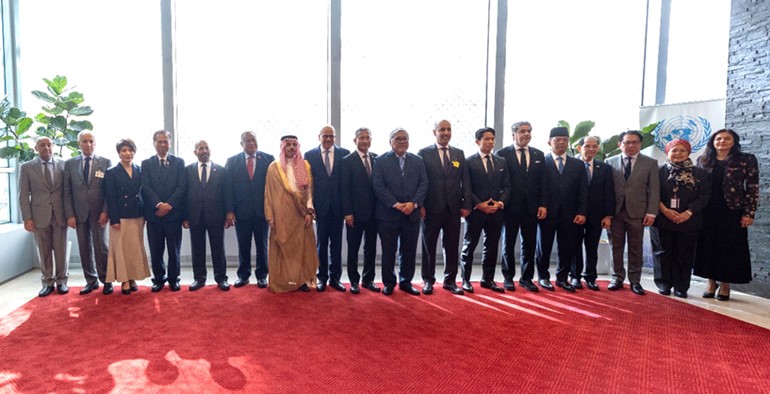
Jasim Al-Budaiwi, Secretary-General of the Cooperation Council for the Arab States of the Gulf (GCC), affirmed that Iran’s disruption of international navigation and closure of the Strait of Hormuz constitute a “flagrant violation” of the 1982 United Nations Convention on the Law of the Sea.
He made these remarks in a speech delivered the previous evening during the joint ministerial meeting between the GCC and the Association of Southeast Asian Nations (ASEAN), held on the sidelines of the High-Level Week of the 81st session of the United Nations General Assembly in New York.
Hamad Al-Marri, Assistant Minister of Foreign Affairs for GCC Affairs, participated in the meeting, which discussed follow-up on the outcomes of the second GCC-ASEAN Summit and ways to enhance and develop opportunities for joint cooperation between the two sides across various fields.
The meeting also examined a number of regional and international issues and developments of mutual interest, with participants exchanging views on them.
Al-Budaiwi stated that the repercussions of these developments have not been confined to the region but have extended to countries around the world. He clarified that GCC member states have been subjected to more than 7,000 ballistic missile and drone attacks by Iran since February 28, targeting vital facilities and causing significant human casualties and material damage.
He emphasized that GCC states were not parties to the war, and that they made intensive mediation efforts and exercised the highest degree of restraint with the aim of containing the escalation.
He underscored the GCC states’ position calling for Iran’s full compliance with United Nations Security Council Resolution 2817, the permanent and unconditional cessation of attacks, ensuring their non-recurrence, and the restoration of navigation in the Straits of Hormuz and Bab el-Mandeb to the status quo ante prior to February 28.
Al-Budaiwi expressed the GCC states’ rejection of any unilateral measures imposing fees or conditions on the right of passage, while holding Iran fully legally responsible and liable for compensation for the damages resulting from its attacks.
Regarding Gulf-Asian relations, Al-Budaiwi noted that this meeting is a continuation of the momentum achieved by the two GCC-ASEAN Summits held in Riyadh in 2023 and Kuala Lumpur in 2025, and their contribution to advancing cooperation and partnership between the two sides toward broader horizons, serving the interests of their peoples and supporting stability and prosperity in both regions.
He expressed his confidence that enhancing cooperation between the two sides in light of current circumstances will have a positive impact on the trajectory of joint efforts, especially given that their relations are “historical and well-established” and are witnessing growing development. He called on technical working groups to intensify their efforts to develop areas of cooperation in a manner that achieves mutual benefit and shared interests.
