Al-Badawi: Gulf states subjected to more than 7,000 attacks by Iranian missiles and drones
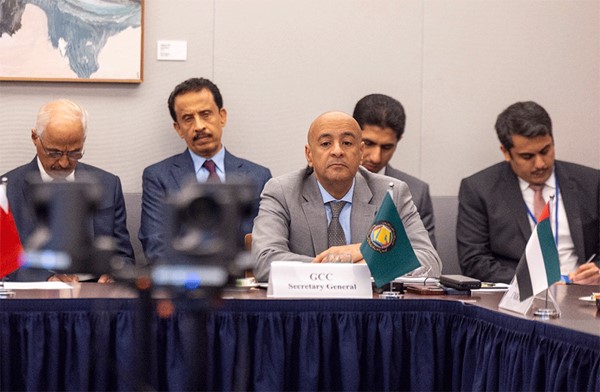
The Secretary-General of the Gulf Cooperation Council (GCC), Jassem Al-Bouaidi, affirmed that Iran’s disruption of international navigation and closure of the Strait of Hormuz constitute a “blatant violation” of the 1982 United Nations Convention on the Law of the Sea.
This statement was made by Al-Bouaidi in his speech delivered yesterday evening, Wednesday, during the joint ministerial meeting between the GCC and the Association of Southeast Asian Nations (ASEAN), held on the sidelines of the high-level week of the 81st session of the UN General Assembly in New York.
Al-Bouaidi stated that the repercussions of these developments were not confined to the region but extended to countries worldwide, noting that GCC states have been subjected to more than 7,000 ballistic missile and drone attacks by Iran since February 28, targeting vital facilities and causing human casualties and severe material damage.
He emphasized that the GCC states were not parties to the war and had made intensive mediation efforts while exercising the utmost restraint to contain the escalation.
He stressed the GCC’s position calling for Iran’s full compliance with UN Security Council Resolution 2817, an immediate, permanent, and unconditional halt to attacks, and the restoration of navigation through the Strait of Hormuz and the Bab al-Mandab to their pre-February 28 status.
Al-Bouaidi expressed the GCC’s rejection of any unilateral measures imposing fees or conditions on the right of passage, while holding Iran fully responsible for the legal liabilities and compensation for damages resulting from its attacks.
Regarding Gulf-Asian relations, Al-Bouaidi said this meeting builds on the momentum achieved by the Gulf-Asia summits in Riyadh in 2023 and Kuala Lumpur in 2025, which contributed to broadening cooperation and partnership tracks between the two sides in ways that serve the interests of their peoples and support stability and prosperity in both regions.
He expressed confidence that enhancing cooperation between the two sides in light of current circumstances will have a positive impact on joint efforts, especially since their relations are “historically entrenched” and witnessing continuous development, calling on technical working groups to intensify their efforts to develop cooperation areas in a manner that achieves mutual benefit and shared interests.
