Trump: I am considering reaching an agreement with Iran or "sending it to hell"
&cropxunits=450&cropyunits=300&w=770)
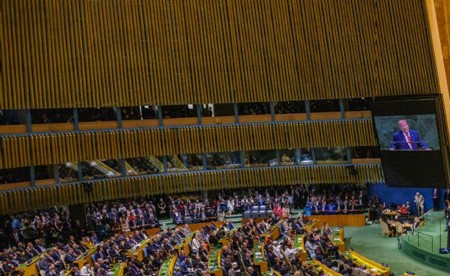
The 81st session of the United Nations General Assembly opened its annual high-level general debate yesterday, during which world leaders outline their priorities and positions on various issues. The general debate commenced under the theme “Restoring Trust, Managing Change: A United Nations that meets the needs of all,” alongside approximately 170 events at the UN headquarters in New York. The city is transforming this week into the world’s largest diplomatic and political gathering to discuss key global issues and priorities, ranging from peace and security and climate change to artificial intelligence and sustainable development.
Khaleel Rahman, President of the current session of the General Assembly, took the podium first, followed by UN Secretary-General António Guterres, who presented the organization’s annual report (A/81/1). As is customary, Brazilian President Luiz Inácio Lula da Silva was the first to address the assembly.
Subsequently, US President Donald Trump delivered the address of the host country of the UN headquarters. He asserted that the United States has returned stronger than ever, boasting that its military is the strongest in the world, and emphasized that its future is very bright and its economy is the envy of the world. He addressed several international files, most notably the war with Iran, stating that “Iran is the world’s foremost sponsor of terrorism. I call on them to make a deal, but their leaders continue to refuse.”
He added, “After giving them every opportunity, I decided to intervene to ensure we never face such a nightmare again.” Trump claimed that “Iran was the bully in the Middle East, but it no longer is,” asserting that “we destroyed Iranian nuclear facilities in 2025 through airstrikes.”
He further stated, “I offered Iran economic cooperation in exchange for ending its nuclear program and its support for terrorism, but they refused. That was a huge mistake.”
Trump expressed his belief that “we will reach a deal with Iran directly after the midterm elections,” while also announcing that he is weighing the option of either reaching an agreement with Iran or pushing them “to hell.”
He asked, “Do I push them to hell without any chance of survival, without hope for future greatness or coming generations?” He affirmed that Washington “will settle the issue with Iran one way or another.”
The US President also touched on the Russia-Ukraine war, noting that reaching an agreement between Russia and Ukraine to end the war may be possible in the near future.
He added, “We are working closely with the leaders of Russia and Ukraine, and we continue our efforts to end this catastrophic war. I believe it will happen faster than people imagine. They are tired of this situation.”
He stated, “We will no longer allow threats directed against us to find a foothold anywhere in the Western Hemisphere.”
Before the agreement announced with Denmark regarding Greenland was signed on the sidelines of the meeting yesterday, Trump revealed Washington’s intention to establish two massive military bases on the island.
For his part, King Abdullah II of Jordan affirmed that “the challenges we currently face did not appear overnight, and what we neglect today shapes our future.”
In his address to the UN General Assembly, he emphasized that the war with Iran demonstrated how people outside the region are affected by the repercussions of energy and food crises. He said, “Those who doubt that the repercussions of our region’s crises extend to the world should look at their energy and food bills.” He considered the protracted conflicts from Lebanon to Yemen and Sudan as deepening human suffering.
He stressed that accountability begins when we call things by their names, such as the attempt to erase Palestinian existence and impose a new reality in Gaza. He noted that “the aggressors in the West Bank are not just a handful of troublemakers, but part of a policy to expel Palestinians from their land.”
He described the forced displacement of Palestinians from their homes in the West Bank as forced migration, warning that the attempt to erase Palestinian existence is being carried out through two tracks: destruction in Gaza and the de facto annexation of territories in the West Bank.
He criticized the international community for treating “every new Israeli violation as temporary” and for “choosing to manage the Israeli-Palestinian conflict rather than confronting it.” He stated, “When it comes to Israel, international resolutions remain ink on paper.”
Turkish President Recep Tayyip Erdoğan, for his part, called on “all countries that do not currently recognize the State of Palestine to reconsider their position.”
In his address to the UN General Assembly, he said, “We have lost more than 74,000 people in Gaza over three years due to Israeli state terrorism. Gaza has become a death camp and the largest graveyard for children in the world.”
He pointed out that the West Bank suffers from settler violence and terrorism, and that Muslims are denied access to their holy sites there.
He criticized the United Nations, which “was established to safeguard peace and security but is no longer able to fulfill its role, or is prevented from doing so.”
Qatari Emir Sheikh Tamim bin Hamad Al Thani stated that “the way to resolve differences is dialogue and negotiation,” affirming that Qatar “has remained a trusted mediator, warning that time does not resolve pending conflicts but rather multiplies their cost.”
He added in his address to the UN General Assembly that “our region is going through one of its most dangerous phases, and the crisis in our region is the result of years of postponement and unrealistic solutions.”
He continued, “We remain convinced that the Gulf crisis can be resolved through diplomatic means, and we must not miss the opportunity for a peaceful diplomatic solution.”
The Emir of Qatar considered that “the essence of what we are witnessing is the absence of a regional collective security framework that encourages the peaceful resolution of conflicts. For us, wisdom and firmness are two sides of the same coin.”
Guterres, in his final speech before the end of his term at the end of the year, affirmed that the greatest power is not the ability to control, but the power to build a good future for all.
He said, “Our shared future will be determined by humanity’s ability to manage power wisely, by upholding the rule of law before impunity becomes the norm, ending wars before they devour entire generations, addressing inequality before societies fracture, accelerating climate action before we pass points of no return, and governing artificial intelligence before it controls us.”
He noted that we are moving toward a multipolar world, and that there are many ways this multipolarity can take shape. He added, “We must reform the Security Council to reflect today’s world and possess the legitimacy and effectiveness to meet the challenges of the present.”
The Secretary-General spoke about the successive conflicts throughout the Middle East, adding: “So-called ceasefire agreements have been nothing more than a reduction in firing, while civilians continue to pay the price. The cup has overflowed.”
He called for a cessation of hostilities, ensuring the flow of humanitarian aid, and the full restoration of rights and freedoms of navigation in accordance with international law.
He stated that “amid the turmoil engulfing the region, we must not overlook the catastrophic situation in the Occupied Palestinian Territory.”
He affirmed that after leaving his post—his term ends at the end of the year—he will remain, wherever he is and whatever his work, “a defender of my conviction that peace is possible. That human dignity is a universal right. And that the rule of law must prevail over the law of the strongest.”
Khaleel Rahman, for his part, stated that the United Nations is “indispensable,” and that the alternative to its existence is “simply unimaginable.”
