Al-Badawi: Disruption of navigation and closure of the Strait of Hormuz have impacted the world, and the security of waterways in the Gulf is an international concern
&cropxunits=450&cropyunits=267&w=600)
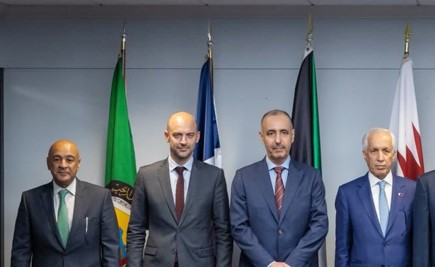
The foreign ministers of the Gulf Cooperation Council (GCC) held a series of meetings with several Arab and international counterparts on the sidelines of the 81st session of the United Nations General Assembly in New York.
Jassim Al-Budaiwi, Secretary-General of the GCC, affirmed that the first joint ministerial meeting between the GCC and Switzerland lays the foundation for a new phase of partnership and opens broader horizons for developing relations between the two sides.
The GCC General Secretariat stated that this was highlighted in a speech delivered by Al-Budaiwi during the joint ministerial meeting held the previous evening in New York. The meeting was chaired by Abdullatif bin Rashid Al-Zayani, Minister of Foreign Affairs of Bahrain and current Chairman of the GCC Council of Ministers, alongside His Highness Prince Faisal bin Farhan Al Saud, Saudi Arabia’s Minister of Foreign Affairs, and the GCC foreign ministers, together with Ignazio Cassis, Switzerland’s Federal Councillor and Minister of Foreign Affairs.
Al-Budaiwi noted that Gulf-Swiss relations have witnessed significant development this year, marked by the signing of a memorandum of understanding in January to establish a strategic dialogue between the two sides. He pointed to the preparation of a joint action plan covering cooperation in political, cultural, developmental, and humanitarian fields.
On regional issues, Al-Budaiwi highlighted the ballistic missile and drone attacks carried out by Iran and its proxies against GCC member states since February 28, which resulted in human and material losses and targeted critical infrastructure.
He warned that the disruption of international navigation and the closure of the Strait of Hormuz have had global repercussions, including rising energy prices and disruptions to supply chains. He emphasized that the security of waterways in the Gulf region is an international concern, not merely a regional one.
He called on Iran to fully comply with United Nations Security Council Resolution 2817, to permanently and unconditionally cease its attacks, to guarantee they will not recur, and to restore navigation in the Straits of Hormuz and Bab el-Mandeb to pre-February 28 levels.
Al-Budaiwi reaffirmed the centrality of the Palestinian cause, the necessity of ending the Israeli occupation, and the establishment of an independent Palestinian state on the 1967 borders with East Jerusalem as its capital, in accordance with the Arab Peace Initiative and relevant international legitimacy resolutions.
He expressed the GCC states’ hope for Switzerland’s recognition of the State of Palestine, which would support international efforts aimed at realizing a two-state solution.
The ministers also held a meeting with their French counterpart, Jean-Noël Barrot. During the meeting, they discussed regional developments and their implications for security and stability in the region, as well as areas of cooperation and coordination between the GCC states and France in addressing current challenges. They also reviewed key issues of mutual interest scheduled for discussion during the work of the UN General Assembly.
Earlier, the GCC Secretary-General affirmed that the GCC states have successfully built a strong economic, financial, and investment base and enhanced their capacity to adapt to global changes, thereby consolidating their position as a global destination for investment and long-term economic partnerships.
This was stated in a speech delivered by Al-Budaiwi the evening before last at a dialogue session titled “GCC Economies: Resilience, Investment, and Strategic Partnerships,” organized by DLA Piper and Haybridge Advisory in New York on the sidelines of the 81st UN General Assembly session.
Al-Budaiwi noted that the combined size of the GCC economies is approximately $2.4 trillion, while the assets of Gulf sovereign wealth funds exceed $5 trillion and commercial bank assets amount to approximately $3.9 trillion. He added that the volume of GCC merchandise trade with the world reaches approximately $1.6 trillion.
He explained that these capabilities support the economic transformation and diversification agenda through investment in industry, technology, artificial intelligence, clean energy, logistics, tourism, financial services, and infrastructure.
He pointed out that the stock of foreign direct investment (FDI) in the GCC states reached approximately $792.7 billion in 2025. He emphasized that the GCC’s investment vision goes beyond the volume of capital attracted, focusing on technology and knowledge transfer, enhancing productive capacities, and creating job opportunities.
He added that approximately $171.4 billion of the FDI stock received by the GCC states in 2025 originated from within the GCC itself, representing about 22 percent of the total and reflecting the growing flow of intra-Gulf capital and business activities.
