Nadeem reviews the "Adaa" project experience to enhance anti-corruption prevention efforts in the public sector
&cropxunits=450&cropyunits=286&w=770)
The Public Authority for Anti-Corruption (Nazaha) presented the State of Kuwait’s experience in transitioning the public sector code of conduct from a mere advisory text to a measurable institutional practice through the “Adaa” project, during the Arab Forum for Enhancing Anti-Corruption Prevention Efforts in the Public Sector.
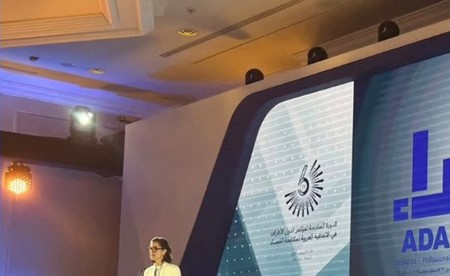
This came during Nazaha’s participation in the Arab Forum for Enhancing Anti-Corruption Prevention Efforts in the Public Sector, held as part of the sixth session of the Conference of the States Parties to the Arab Convention against Corruption, hosted by the State of Qatar in cooperation with the Secretariat-General of the Arab League, taking place from the 21st to the 23rd of the current month.
Yasmin Al-Sharhan, the Supervisor of Cooperation with Civil Society Organizations at Nazaha, participated as the keynote speaker in the forum’s first session, titled “Codes of Conduct: Implementation Reality and Their Impact on Public Sector Integrity.” In her presentation, she outlined the State of Kuwait’s experience in transitioning the public sector code of conduct from an advisory text to a measurable institutional practice through the “Adaa” project.
Al-Sharhan explained that the “Adaa” project represents one of the key preventive measures in the public sector. It is based on the Public Service Code of Conduct issued by the Public Service Bureau and rests on four integrated pillars: establishing the necessary administrative infrastructure to enhance compliance with the code; measuring and monitoring employee awareness and behavior; raising the awareness of personnel in participating entities and educating them; and providing training programs that enable them to effectively implement the code.
She noted that the project is designed on a progressive system that classifies participating entities into four accreditation levels: Bronze, Silver, Gold, and Diamond. This approach does not merely assess existing achievements but encourages continuous improvement, aiming to integrate public service conduct standards into daily operations and produce measurable impacts. The project also includes a program for training certified trainers within the entities to ensure sustainable, self-driven implementation.
Al-Sharhan pointed out that the project has achieved tangible results since its launch. Twenty-four government entities have met the requirements for the Bronze, Silver, and Gold stages, and the number of employees covered by awareness and training programs has exceeded tens of thousands. Additionally, the annual “Adaa” conference is organized in cooperation with the Public Service Bureau to honor the entities that have met the accreditation criteria and to showcase their experiences.
She emphasized that the mere existence of codes of conduct is insufficient to achieve the desired impact unless they are integrated into a comprehensive institutional system encompassing leadership, enforcement, training, and accountability.
Al-Sharhan added that the value of “Adaa” lies in its role as a tool for transitioning from formal compliance to building an institutional culture based on integrity and responsibility, while establishing objective indicators to measure impact. This aligns with the provisions of the United Nations Convention against Corruption and the Arab Convention against Corruption regarding the adoption of codes of conduct for public employees and the enhancement of their implementation as authentic preventive measures.
