Opening of the "National Identity: Deep Roots and a Renewed Vision" Conference at the Bibliotheca Alexandrina
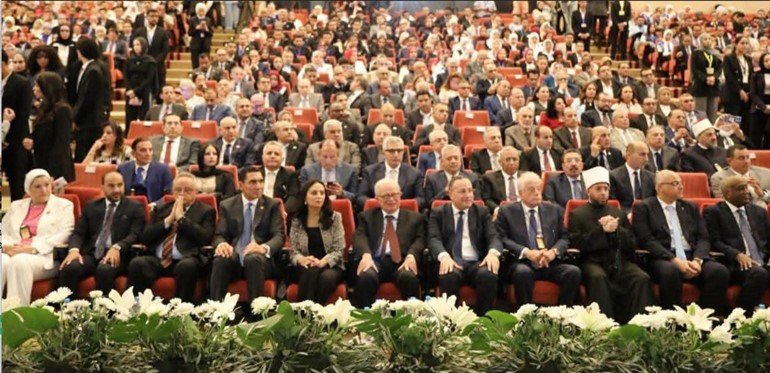
Opening of the 'National Identity: Deep Roots and Renewed Vision' national conference at the Bibliotheca Alexandrina
Translated by Qiyas from الأنباء — Original source
Cairo — Ahmed Sabry and Noha Imam
The National Conference “National Identity: Deep Roots and a Renewed Vision,” held under the patronage of President Abdel Fattah El-Sisi, opened at the Bibliotheca Alexandrina from the 21st to the 23rd of this month.
The opening session was attended by Dr. Hussein El-Eissa, Deputy Prime Minister for Economic Affairs; Dr. Abdel Aziz Qanashat, Minister of Higher Education and Scientific Research and Acting Minister of Culture; Major General Dr. Khaled Fouad, Advisor to the President for Local Development and Chair of the Conference; Dr. Osama Al-Azhari, Minister of Awqaf; Dr. Maya Morsi, Minister of Social Solidarity; Jouhar Nabil, Minister of Youth and Sports; Engineer Ayman Atia, Governor of Alexandria; Dr. Ahmed Zayed, Director of the Bibliotheca Alexandrina; and Dr. Ayman Bahaa El-Din, Deputy Minister of Education and Technical Education. The session also featured the participation of several ministers, university rectors, officials, intellectual, cultural, and media figures, a select group of academics and researchers, and youth representatives.
The opening session also included the screening of a documentary titled “Egyptian Identity: Deep Roots and a Renewed Vision,” along with a brief presentation outlining the conference’s key themes and main topics.
Dr. Hussein El-Eissa emphasized that the conference represents a qualitative and civilizational leap in addressing the issue of national identity. He noted that the choice of the title “Deep Roots and a Renewed Vision” reflects a forward-looking outlook in an increasingly complex world. He added that national identity is a fundamental pillar for achieving social cohesion and stability.
El-Eissa explained that the report issued by the Bibliotheca Alexandrina on national identity addressed the major social pressures and challenges it faces, as well as the role of state institutions in supporting and developing identity. He affirmed that the report’s findings, alongside the conference’s recommendations, can form the basis for a comprehensive approach, given that identity is a matter of state and government, particularly in light of the unprecedented pressures facing the nation and the need to consolidate identity to support stability and protect society.
In a speech delivered on behalf of the Prime Minister, Dr. Abdel Aziz Qanashat stated that national identity is a matter of state and society, with roots that begin in the family and extend to schools and universities. It interacts with culture, art, media, and religious discourse, and is influenced by rapid transformations in the economy, the digital space, and artificial intelligence. He pointed out that Egyptian identity is not merely a history and heritage to be proud of, but a living system of values, belonging, citizenship, and knowledge. He added that consolidating this identity does not mean closing off to change, but rather empowering new generations to engage consciously and confidently with the developments of the era while preserving their roots and national constants.
For his part, Major General Dr. Khaled Fouad affirmed that Egyptian identity, shaped through a long-standing civilizational and cultural interaction, is neither static nor insular. Rather, it is a living system that combines deep roots with the ability to keep pace with the future, thereby strengthening belonging and enabling Egyptians to engage consciously with technology and globalization without losing their distinctiveness and identity.
Fouad noted that national identity is built in the streets, villages, and cities, and that local development is not limited to upgrading infrastructure. It extends to preserving the Egyptian character and enhancing the local identity of each governorate as an integral part of the nation’s identity, by supporting heritage, folk traditions, and handicrafts, which contribute to safeguarding cultural distinctiveness and creating job opportunities simultaneously.
Engineer Ayman Atia welcomed the conference participants to Alexandria, the city of culture, history, and civilizational convergence, which has served throughout its history as a bridge for communication between civilizations and cultures. He expressed gratitude to President Abdel Fattah El-Sisi for his patronage of the conference and his commitment to building human capital and shaping the future.
The Governor of Alexandria noted that the conference comes at a time of great importance, amid the rapid developments witnessed worldwide and the resulting need to enhance awareness of national identity. He affirmed that Egypt possesses a deep-rooted civilization and identity. He added that the openness of new generations to diverse cultures and ideas through the digital space necessitates the integration of the roles of the family, society, and educational and cultural institutions, achieving openness to the world while preserving national identity and the distinctiveness of the homeland, and countering rumors and misleading information.
Dr. Ahmed Zayed, in turn, affirmed that the Bibliotheca Alexandrina represents a broad space for dialogue, the exchange of ideas, and the convergence of cultures. He noted that the conference comes at a time of great importance, amid the rapid transformations witnessed worldwide and the resulting need to rethink the concept of national identity, the means of preserving its constants, and the renewal of the tools for expressing it.
Zayed emphasized that national identity represents an awareness of belonging, history, and shared destiny, affirming that its importance is growing amid rapid transformations and the impact of technology and the digital space in shaping the consciousness of new generations.
