Chinese Ambassador: Cultural exchange is a bridge for mutual understanding and a pillar in the trajectory of bilateral relations
&cropxunits=450&cropyunits=300&w=770)
Osama Diab
The Ambassador of the People’s Republic of China to the State of Kuwait, Yang Xin, affirmed the depth of the cultural ties linking China and Kuwait, noting that cultural exchange has, over the 55 years of diplomatic relations between the two countries, served as a bridge for mutual understanding and bringing the two peoples closer together, and as a fundamental pillar in the development of bilateral relations.
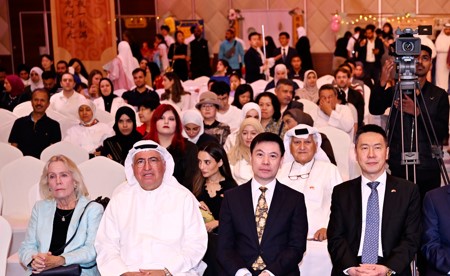
He made these remarks during the cultural event “Where the Light of Hebei’s Moon Meets the Gulf,” organized by the Chinese Cultural Center in Kuwait on the evening of the day before yesterday to celebrate the Mid-Autumn Festival. The event was attended by Dr. Mohammed Al-Jassar, Secretary-General of the National Council for Culture, Arts and Letters, along with a number of ambassadors, diplomats, and guests, and featured the participation of a distinguished group of Chinese and Kuwaiti artists.
Ambassador Yang Xin expressed his joy at celebrating the Mid-Autumn Festival in Kuwait, welcomed the artists coming from Hebei Province in China, and extended his thanks to all who contributed to supporting and strengthening the close cultural relations and ties between China and Kuwait.
He explained that the Mid-Autumn Festival is deeply rooted in Chinese traditions and represents an occasion for joy and family reunions. It also embodies aspirations for abundance, social harmony, and sharing, reflecting a common human longing for unity and a brighter future.
He added that this spirit closely aligns with the values of Kuwaiti society, reflecting the cultural affinities between the two peoples. He noted that the occasion provides an opportunity for Chinese and Kuwaitis to exchange wishes for family happiness, social harmony, and global peace.
He stated that civilizational exchange and mutual learning contribute to building lasting bridges between peoples, a reality embodied in the 55-year trajectory of Sino-Kuwaiti diplomatic relations, which has been founded on mutual respect, equality, and fruitful cooperation in various fields.
He affirmed that cultural exchange has always been a vital artery for understanding between the two peoples and has contributed to consolidating the growth of bilateral relations. He pointed out that the event adds a new chapter to the cultural relations between China and Kuwait by presenting examples of the intangible cultural heritage of Hebei Province, including lion dance, kung fu arts, and shadow puppetry.
He expressed his country’s expectation to expand the fields of cultural exchange and innovate new channels and opportunities to bring the two peoples closer together and drive bilateral relations toward further progress, adding: “Thousands of miles may separate China and Kuwait, but tonight we share the same moonlight.”
For his part, Dr. Mohammed Al-Jassar, Secretary-General of the National Council for Culture, Arts and Letters, affirmed that culture possesses a great capacity to build bridges of communication between peoples, no matter how far the distances. He expressed his appreciation to Ambassador Yang Xin and the team of the Chinese Cultural Center in Kuwait, as well as to the organizers, artists, and participants who contributed to enriching the event.
Al-Jassar said that Kuwait has always believed that art, history, and poetry constitute a universal human language. He clarified that building genuine bridges, encouraging fruitful cultural exchange, and bringing peoples closer together represent a core mission of the National Council for Culture, Arts and Letters and the essence of its work.
He pointed out that the cultural relations between Kuwait and China are based on deep historical roots that began in the mid-20th century and have been consolidated through a solid friendship and vibrant cultural partnerships. He considered the event “Where the Light of Hebei’s Moon Meets the Gulf” a clear model of this friendship and cultural closeness.
