"The Army": Disciplinary sanctions determined
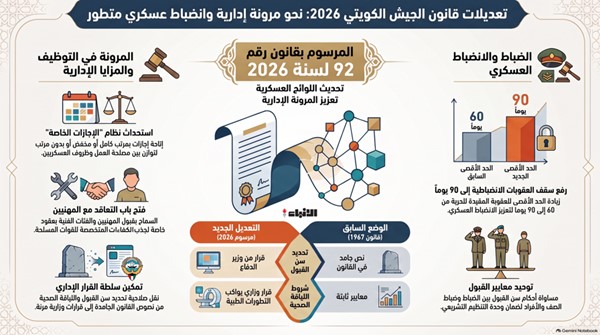
The official newspaper “Al-Kuwait Al-Youm” published in its issue yesterday Decree-Law No. 92 of 2026 amending certain provisions of Law No. 32 of 1967 concerning the Army. The decree stipulates that the age of acceptance and the medical fitness requirements for military service shall be determined by a decision of the Minister of Defense. It permits the recruitment of professionals and any other categories into the Army under special contracts, introduces special leave with full, reduced, or no pay, and raises the maximum disciplinary penalty involving deprivation of liberty from 60 to 90 days. The decree takes effect from the date of its publication. The text of the decree is as follows:
Article (23): The violations, disciplinary penalties, the manner of their imposition and execution, and the procedures for appealing them shall be determined by decree. Such penalties shall not include dismissal, expulsion, removal from office, demotion, any corporal punishment, or any penalty involving deprivation of liberty exceeding ninety days.
Article (32, Paragraphs 2–3): The following conditions shall apply to those accepted as officers:
1. They must have reached the age of acceptance, which shall be determined, along with any exceptions thereto, by a decision of the Minister.
2. They must be medically fit for military service, the conditions for which shall be determined by a decision of the Minister.
Article (40, Paragraph 2):
2. They must have reached the age of acceptance, which shall be determined, along with any exceptions thereto, by a decision of the Minister.
The decree also stipulates the addition of a new paragraph to Article (5) and a new paragraph numbered (5) to Article (82) of Law No. 32 of 1967, as referenced above, with the following text:
Article (5, New Paragraph): It shall also be permissible to recruit professionals and any other categories into the Army under special contracts, in accordance with the decisions and regulations governing this matter, which shall be issued by a decision of the Minister of Defense.
Article (82, Paragraph 5):
5. The introduction of special leave with full, reduced, or no pay.
Raising the maximum penalty involving deprivation of liberty from 60 to 90 days to enhance the effectiveness of the disciplinary violations system.
Amendment to the Army Law: Introduction of leave with full or no pay.
The Official Gazette, “Al-Kuwait Al-Youm,” published Law No. 92 of 2026, amending certain provisions of Law No. (32) of 1967 concerning the Army. The articles of the law are as follows:
Article 1: The texts of Articles (23, 32, paragraphs 2–3, and 40, paragraph 2) of Law No. (32) of 1967, as referenced above, are replaced by the following texts:
Article (23): By decree, the disciplinary violations and penalties, the manner of their imposition and execution, and the procedures for appealing them shall be specified. Such penalties shall not include dismissal, expulsion, removal from office, demotion, any corporal punishment, or any restriction on liberty exceeding ninety days.
Article (32, paragraphs 2–3): The following conditions shall apply to those accepted as officers:
1. Having attained the age of admission, the determination of which, along with any exceptions thereto, shall be issued by decision of the Minister.
2. Proof of medical fitness for military service, the conditions for which shall be determined by decision of the Minister.
Article (40, paragraph 2):
2. Having attained the age of admission, the determination of which, along with any exceptions thereto, shall be issued by decision of the Minister.
Article 2: A new paragraph shall be added to Article (5), and a new paragraph numbered (5) shall be added to Article (82) of Law No. 32 of 1967, as referenced above, with the following texts:
Article (5, new paragraph): It shall also be permissible to accept professionals in the Army, as well as any other categories, under special contracts in accordance with the decisions and regulations governing such matters, which shall be issued by decision of the Minister of Defense.
Article (82, paragraph 5):
5. Special leave with full pay, reduced pay, or without pay.
Article 3: Any provision that conflicts with the provisions of this law shall be repealed.
Article 4: The Prime Minister and the Ministers, each within their respective purview, shall implement this law. It shall be published in the Official Gazette and shall enter into force from the date of its publication.
The explanatory memorandum to Law No. 92 of 2026, amending certain provisions of Law No. (32) of 1967 concerning the Army, stated the following:
Law No. (32) of 1967 concerning the Army was issued nearly six decades ago. During this period, the Armed Forces have undergone successive organizational and administrative developments, necessitating a review of certain provisions to align with modern military operational requirements. This review aims to grant the military administration greater flexibility in organizing certain executive matters that naturally evolve with the changing needs of the Armed Forces, without compromising the fundamental guarantees afforded to military personnel.
Given that the Amiri Decree issued on May 10, 2024, stipulated in its Article (4) that laws shall be issued by laws, the present law was prepared to amend certain provisions of Law No. 32 of 1967, as referenced above. Article 1 of the present law provides for the replacement of Articles (23, 32, paragraphs 2–3, and 40, paragraph 2) of Law No. (32) of 1967, as mentioned above. Article (23) raises the maximum limit for penalties restricting liberty, as stipulated in the article, from sixty to ninety days. This is to enhance the effectiveness of the disciplinary violation system and enable the competent authority to impose penalties commensurate with the severity of the violation, thereby maintaining military discipline without affecting the other provisions and guarantees established in the article.
Article (32), in its paragraphs (2 and 3), grants the Minister of Defense the authority to determine the age of admission and any exceptions thereto by decision, rather than stipulating it rigidly in the law. This allows for keeping pace with the needs of the Armed Forces and changes related to recruitment and enlistment policies. The text also assigns the determination of medical fitness conditions for military service to a decision issued by the Minister of Defense, thereby achieving the necessary flexibility to align medical requirements with scientific advancements and military medical standards.
Article (40), in paragraph (2), unifies the provisions regarding the age requirement for the acceptance of non-commissioned officers and enlisted personnel with those governing the acceptance of officers, by making the determination of the age of admission and any exceptions thereto subject to a decision by the Minister of Defense. This achieves legislative uniformity and facilitates the updating of such criteria whenever the public interest so requires.
Article (5) adds a new paragraph permitting the acceptance of professionals in the Army, as well as any other categories, under special contracts in accordance with decisions and regulations issued by the Minister of Defense.
This amendment addresses the increasing needs of the Armed Forces to utilize specialized professional and technical personnel and establishes a legal basis for contracting with such categories under special contractual arrangements suited to the nature of their work, thereby achieving flexibility in attracting and retaining qualified personnel.
Article (82) adds a new paragraph numbered (5), introducing a new type of leave: special leave with full pay, reduced pay, or without pay.
This amendment aims to provide a legal framework that grants the military administration the necessary flexibility to handle cases requiring the granting of special leave to military personnel, in accordance with the controls established by regulations and decisions, thereby achieving a balance between operational interests and the circumstances necessitating such leave.
Article 3 of the present law stipulates the repeal of any provision that conflicts with the provisions of this law.
Article 4 of the present law obligates the Prime Minister and the Ministers, each within their respective purview, to implement its provisions, with the law entering into force from the date of its publication in the Official Gazette.
