Al-Musallam and Al-Ali: The return of “Abid and Shalwai” ignites laughter in “The Promise on the Track”
Yasser Al-Aila
The stage of Al-Salmiya Club hosted an exceptional artistic and cultural event the evening before last, marked by the highly anticipated theatrical production “Ya Habibi, Don’t Say ‘No’ and I Won’t Say ‘Yes’… The Promise on the Track.” The performance drew a massive and distinguished audience of artists, critics, and media figures. The production’s directorial vision was crafted with remarkable ingenuity by artist Muhammad Al-Hamli.
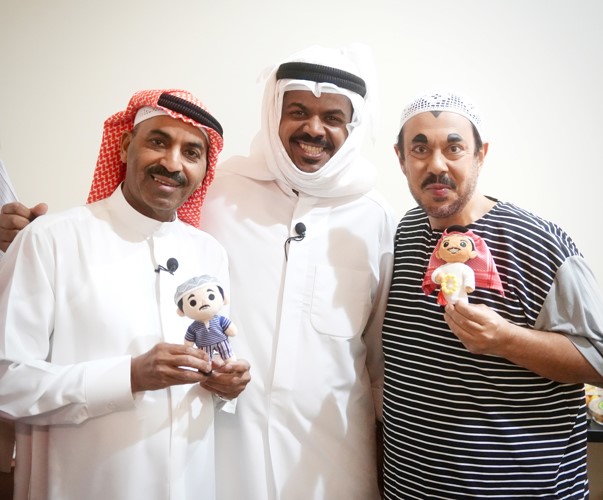
The most prominent element underpinning the show’s dramatic value was the historic reunion of stars Abdulaziz Al-Musallam and Tariq Al-Ali, after an absence of nearly 38 years since their last collaboration in “Hello Bangkok” (1988). The revival of the iconic characters “Shaliwi” and “Ubaid” did not fall into the trap of nostalgic lamentation; instead, they were skillfully reimagined to address contemporary issues.
The greatest challenge lay in testing the ability of Tariq Al-Ali and Abdulaziz Al-Musallam to navigate this narrow and unconventional theatrical space. The outcome affirmed their historic leadership through the revival of “Shaliwi” and “Ubaid” with a contemporary spirit. Tariq Al-Ali emerged as the primary beneficiary of this geometric stage design. His style, rooted in “interactive comedy” and improvisation, found an ideal environment. The extremely close proximity to the audience—particularly the stars and media personnel in the front rows—provided Al-Ali with rich material for immediate improvisation and direct quips based on the reactions and facial expressions of the attendees. Al-Ali did not remain stationary; rather, he distributed his comedic energy to the left and right.
Abdulaziz Al-Musallam’s strength lay in his use of facial expressions and the distinctive vocal tone characteristic of the character “Ubaid.” The closeness to the audience allowed his smile, sense of wonder, and the hesitant gaze he is known for to land with impact and without excessive exaggeration. The brilliance of Al-Musallam’s performance was evident in the “handoffs” between him and Al-Ali. While “Shaliwi” charges ahead with improvisation, “Ubaid” absorbs the shock with intelligence and redirects the scene toward the script and new developments, creating a cohesive blend of calculated impulsiveness and comedic gravitas after a 38-year hiatus.
Director Muhammad Al-Hamli took a bold risk by moving the production away from the traditional proscenium arch structure to a completely different space. He designed the stage as a longitudinal corridor (a fashion runway) with the audience seated on both sides, face-to-face. This geometric shift imposed harsh and strict conditions on the performance: the actors were exposed at 360 degrees, stripped of the “safe rear space.” This scenographic approach turned the audience into a vital part of the human set and forced the actors into continuous kinetic dynamics, which positively impacted the highly professional dance sequences used to break the stagnation of classical narrative and generate a fast-paced visual flow.
Al-Hamli positively shocked the audience with his appearance and his masterful embodiment of the character “Turki” (Shaliwi’s son). He portrayed this character with an enjoyable and beautifully human comedic style.
Alongside Al-Hamli’s brilliance, artists Abdullah Al-Khadir and Abdulmohsen Al-Omar formed the striking force and the backbone of the play’s rhythm. Al-Khadir delivered a masterclass in expressive flexibility and character versatility, transitioning quickly and gracefully between multiple roles throughout the performance through changes in costume and vocal tone.
Abdulmohsen Al-Omar, on the other hand, served as the work’s balance. His performance was characterized by discipline and sharp intelligence in managing situations, forming the dramatic link that prevented the comedic dialogues from becoming fragmented amidst the high flow of jokes from the stars.
Phone Ban
Perhaps the boldest and most central decision in this experiment was director Muhammad Al-Hamli’s insistence on banning the use of smartphones and fully covering their cameras for the audience inside the hall. This measure liberated the theater from the shackles of “false digitality” and achieved two highly important reflections:
For the audience: It compelled attendees to fully immerse themselves and live in the theatrical moment with all their senses, enjoying the exclusivity of the event away from the obsession with photography and sharing clips on social media.
In conclusion, the play “Ya Habibi, Don’t Say ‘No’ and I Won’t Say ‘Yes’… The Promise on the Track” succeeded in offering a modern formulation of 1980s nostalgia. The work proved that Kuwaiti theater is native and capable of leading avant-garde and experimental movements, provided that bold production vision and directorial awareness are present. This production remains a landmark in the record of modern Gulf theater.
