Executive Regulations for the Notarization Law: 8 Conditions for Licensing Private Notaries and 4 Prohibitions
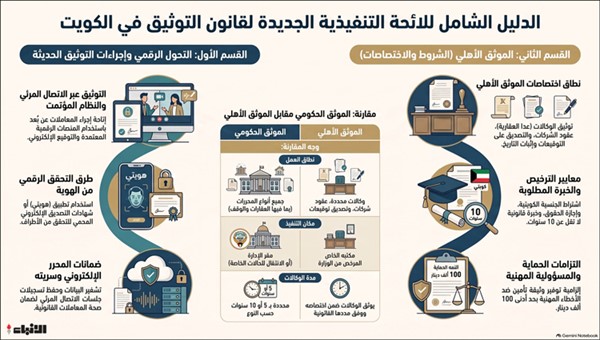
The Official Gazette, "Al-Kuwait Al-Youm," published Decision No. 590 of 2026 issued by Minister of Justice, Counselor Nasser Al-Samit, enacting the Executive Regulations for Law No. (10) of 2020 concerning Notarization, as amended by Law Decree No. (147) of 2025. The decision stipulates the following:
Article 1: The provisions of the Executive Regulations for Law No. 10 of 2020 concerning Notarization, as amended by Law Decree No. 147 of 2025, attached hereto, shall come into force.
Article 2: Ministerial Decision No. (348) of 2021 is hereby repealed, as are any provisions that contradict the provisions of this decision or the attached Regulations.
Article 3: The competent authorities shall, each within their respective scope, implement this decision, which shall take effect from the date of its issuance and be published in the Official Gazette.
Executive Regulations for Law No. 10 of 2020 concerning Notarization, as amended by Law Decree No. 147 of 2025
Chapter One: General Provisions and Notarization Procedures
Article 1: Definitions
For the purposes of these Regulations, the following terms and expressions shall have the meanings assigned to them below, unless the context otherwise requires:
1. Minister: The Minister of Justice.
2. Ministry: The Ministry of Justice.
3. Law: Law No. 10 of 2020 concerning Notarization, as amended by Law Decree No. 147 of 2025.
4. Administration: The Notarization Administration.
5. Notary: A person entrusted with performing notarization acts and related matters, whether a government or private notary.
6. Government Notary: A notary within the Administration responsible for performing the acts specified in the Law and these Regulations.
7. Assigned Notary: A government notary specifically designated to notarize documents related to endowments (waqf) and the personal status of Muslims.
8. Private Notary: A licensed person registered in the Register who practices within the limits permitted by these Regulations.
9. Administration Seal: The manual seal of the Administration, which may be electronic when transactions are conducted through the approved electronic system in accordance with these Regulations.
10. Private Notary Seal: The manual seal of the private notary, approved by the Administration.
11. Notary Seal: The manual seal of the notary.
12. Dated Seal: A seal affixed to customary documents submitted for the purpose of proving their date.
13. Licensing Committee: The committee established under Article 20 of the Law to examine applications for licensing to practice as a private notary.
14. Disciplinary Committee: The committee established under Article 22 of the Law to discipline private notaries and impose the penalties specified therein.
15. Register: The Register of Private Notaries.
16. Electronic System: The digital platform approved by the Ministry of Justice for conducting notarization or attestation remotely using video conferencing or an automated electronic system.
17. Automated Electronic System: A system that automatically completes certain notarization or attestation tasks without direct intervention by the notary, once technical requirements are met.
18. Video Conferencing: A means of direct audio-visual communication between the notary and the parties concerned via the electronic system.
19. Approved Electronic Signature: An electronic signature approved in accordance with the laws and decisions governing electronic transactions in the State of Kuwait.
20. Electronic Verification Code: A digital code (QR Code) included in the document that allows verification of its authenticity and validity through the approved platform.
21. Electronic Document: A document created using the electronic system.
22. Electronic Register: A digital database in which transactions conducted using the electronic system are recorded, along with any cancellations, expirations, or endorsements, and any facts required by these Regulations to be recorded. Entries in the register shall not be erased; corrections shall be made by subsequent entries.
Article 2: Document Requirements
The document to be notarized, whether paper or electronic, must include, in addition to data pertaining to its subject matter, the following:
1. The date of notarization, including hour, day, month, and year.
2. The name, surname, and title of the notary, unless the transaction was conducted through the automated electronic system.
3. The full names of the parties concerned as recorded in official registers, including their surnames if applicable.
Paper documents must be free from erasures or insertions. If a document consists of multiple pages, they must be numbered, and the total number of pages must be indicated at the end. Any deletions or additions must be certified by the notary’s signature and seal, as well as the signature of the parties concerned.
Article 3: Verification of Identity
The notary must verify the identity of the parties concerned before conducting notarization, attestation, or date certification, by examining the original civil ID or passport. Identity verification may also be conducted using electronic means, including biometric electronic signatures or other digital verification methods, in accordance with the provisions of Chapter Two of these Regulations.
Article 4: Grounds for Refusal
If it is apparent that the parties concerned lack legal capacity or consent, or if the document is manifestly invalid, the notary must refuse to proceed with the notarization and record the refusal and its reasons in a dedicated register.
If the transaction is conducted via video conferencing, the notary must record the refusal and its reasons in the electronic register.
Article 5: Prohibition on Handling Personal or Family Matters
A notary shall not perform any of the acts specified in the Law and these Regulations in matters concerning themselves personally, their spouse, or any person related to them by blood or affinity up to the fourth degree.
If such a conflict of interest arises, the notary must refrain from handling the transaction, disclose the reason for their recusal, and refer the transaction to another notary designated by the Administration. If the conflict involves a private notary, they must refrain and direct the parties concerned to the Administration or another private notary. The recusal and its reason must be recorded in the register.
Article 6: Reading of the Document and Explanation of Consequences
The notary must read the full text of the document and its attachments to the parties concerned and explain their legal consequences, and record this in the minutes before they sign.
The parties concerned shall sign, or affix their thumbprint if they are illiterate. If a party is unable to sign or affix a thumbprint due to a physical disability, they must appoint a representative to sign on their behalf. The notary must verify the party’s intent and consent to this appointment, and verify the identity of the representative by examining their original civil ID, passport, or equivalent document, and instruct them to sign at the end of the document. This must be recorded in the minutes.
If the transaction is conducted via video conferencing, the reading and explanation shall be done through the video link, and the signature shall be provided via the biometric electronic signature of the parties concerned.
If the transaction is conducted through the automated electronic system, the parties concerned shall be allowed to review the full text of the document and its attachments before approval. After their approval and the application of their protected electronic signature, this shall serve as confirmation of their review and awareness of the consequences.
Article 7: Assistance in Expressing Intent
If a party concerned suffers from a disability that prevents them from expressing their intent naturally, the notary must seek the assistance of a qualified expert or appoint a person deemed appropriate, upon the request of the parties concerned, to provide assistance. The notary must administer an oath to the assistant and instruct them to sign at the end of the document, and record this in the minutes.
If a party concerned suffers from a mental disability, the guardian appointed by the court shall sign on their behalf, after the notary has verified the guardian’s status and the existence of guardianship or authority based on official documents.
If the notary determines from the submitted documents or inquiries with the competent department of the Ministry that a court order appointing a judicial assistant to the applicant has been issued and published in accordance with the Civil Code, notarization shall not be conducted for transactions for which assistance was ordered unless the judicial assistant is present and provides assistance, or unless the court grants the party concerned permission to act independently. This must be recorded in the minutes.
Article 8: Translation
If the notary does not understand the language of the parties concerned, they must engage an accredited legal translator. If this is not possible, the notary must instruct the parties concerned to bring a translator who will swear an oath and sign at the end of the document, and this must be recorded in the minutes.
Upon request of the parties concerned, translated electronic forms prepared by the Administration with the assistance of an accredited translator may be used, provided the document does not contain phrases or conditions not covered by the approved translation.
The parties concerned shall bear the fees of the translator or assistant, if any.
Article 9: Representation and Capacity
If a person acts on behalf of another to request any notarization procedure through power of attorney or otherwise, the notary must verify their capacity, the extent of their authority, and its limits, and request supporting documents.
Article 10: Scope of Power of Attorney and Representation of Legal Persons
A power of attorney using general terms without specifying the type of legal act does not grant the attorney-in-fact authority to perform acts of administration only.
Legal persons—such as banks, companies, and associations—shall be represented by their managers or attorneys if their purpose, according to their founding documents or bylaws and subsequent amendments, permits such representation. Informal authorizations or communications shall not be accepted in this regard.
Article 11: Attorney-in-Fact Contracting with Themselves
An attorney-in-fact shall not contract with themselves on behalf of the principal unless explicitly stated in the power of attorney.
Article 12: Guardianship over Minors
The natural guardian may act on behalf of the minor under their guardianship within the limits prescribed by law.
The guardian’s authority does not extend to disposing of any property acquired by the minor through gratuitous transfer without the judge’s permission. Disposal of such property shall only be made by a special guardian appointed by the court.
Article 13: Copies and Replicas
Photocopies of notarized or attested documents shall not be accepted unless certified by the competent notary as valid and matching the original, and stamped with the Administration or private notary seal, indicating that the originals were examined and verified.
For copies of other documents, the notary must require the submitter to have them certified by the issuing authority as matching the originals.
Submission of the original document or certification of its copy is not required for data verification necessary for notarization when conducted through electronic linkage with the competent authority.
Article 14: Fees and Copies
Notarization, attestation, or date certification shall not be performed until the prescribed fee is paid. Certified copies shall only be issued to the parties concerned or those legally entitled to them.
The copy must bear the transaction number, date, and delivery details, and be signed and sealed by the notary and the Administration or private notary, as applicable. All copies issued from the original document must be noted on the original.
Article 15: Place of Notarization
Government notaries shall perform notarization at the Administration’s headquarters. They may not leave the premises except in the following cases:
1. If the party concerned is unable to attend for health reasons, supported by a medical report accepted by the Administration.
2. If the party concerned is sixty-five years of age or older.
3. If the parties concerned are detained in prisons or detention centers.
4. In social circumstances deemed appropriate by the Administration, including the waiting period (iddah) of a woman whose husband has died.
5. Upon request for a special mobile service by the Administration.
In all cases, the reason for the visit must be recorded in the document and the dedicated register, and the visit shall not take place until the prescribed fee is paid.
Article 16: Duration of Power of Attorney Notarization
First: The notarization of a power of attorney shall be valid for five years from the date of notarization, unless a shorter period is agreed upon or the power of attorney terminates earlier for any reason.
Second: Exception to the first paragraph, the notarization of a power of attorney shall be valid for ten years from the date of notarization in the following two cases:
1. A power of attorney issued by a lawyer registered on the Register of Lawyers to practice law and conduct litigation.
2. A power of attorney prepared for use outside the State of Kuwait only, whether for acts of disposition, administration, or otherwise.
Unless a shorter period is agreed upon or the power of attorney terminates earlier for any reason.
Third: In all the above cases, the document must include the expiration date of the notarization.
Chapter Two: Use of the Electronic System
Article 17: Transactions via Video Conferencing
Subject to the provisions of Articles 18 and 19 of these Regulations, notarization or attestation may be conducted via video conferencing, provided the parties concerned have an approved electronic signature. An electronic verification code may be included in the document to allow verification of its authenticity and validity.
Article 19: Transactions via the Automated Electronic System
Subject to the provisions of the previous article, and as an exception to the provisions regarding personal presence in these Regulations, notarization or attestation of the acts listed in Table 1 attached to these Regulations may be conducted through the automated electronic system, provided the parties concerned have an approved electronic signature. The electronic seal issued by the competent Administration shall suffice for these transactions.
Article 20: Identity Verification
Identity verification of the applicant shall be conducted in accordance with the provisions of this chapter by the following means, appropriate to the nature of the transaction and how it is conducted:
1. Authentication through the digital identity application (Hawiti).
2. Certificate of attestation for the protected electronic signature.
3. Verification of the civil ID or passport when the transaction is conducted via video conferencing.
Article 21: Storage and Confidentiality of Electronic Documents
Electronic documents or records issued from transactions conducted using the electronic system shall be stored in a manner that ensures their confidentiality and protection from unauthorized access, use, modification, or destruction, and allows for the verification of the accuracy of the data contained therein and their retrievability at any time, indicating the identity of the parties concerned and the date and time of their creation, transmission, or receipt, as applicable.
Article 22: Recording of Video Conferencing Sessions
The electronic system shall create an audio-visual recording of each session conducted via video conferencing, including identity verification, reading of the document, explanation of its consequences, and approval by the parties concerned. The recording shall be stored in the transaction file for the period determined by the Administration. If notified of a dispute regarding the transaction, the storage period shall extend until a final judgment is rendered.
Access to, copying of, or extraction of a copy from the recording shall not be permitted except upon request by the investigation authority or the competent court in a pending case. All access, copying, or extraction must be recorded in the electronic system.
Article 23: Fees for Electronic Transactions
Fees prescribed for notarization or attestation conducted using electronic means or the automated electronic system shall be the same as those prescribed for transactions conducted with personal presence at the Administration.
Article 24: Operating Systems
The Administration shall coordinate with the competent department of the Ministry to provide the necessary systems to ensure the secure operation of the electronic system and enable the performance of the tasks specified in the Law and these Regulations.
Chapter Three: Notarization of Documents Related to Endowments and Personal Status
Article 25: Competence for Notarizing Documents
The judge or the assigned notary shall be competent to notarize the following documents:
1. Inventory of the estate.
2. Legal partition.
3. Marital approval where final judicial rulings have been issued.
4. Marital approval where marriage documents issued abroad for Kuwaiti citizens are recognized, provided they meet the conditions under the Law.
5. Certification of divorce, khul‘ (divorce at the wife’s request), reconciliation, and similar matters.
6. Declaration of conversion to Islam.
7. Certificate of non-marriage or certificate of continued marriage.
8. Notarization of amendments or additions to the documents listed in the preceding items, upon request of the parties concerned and in accordance with the Law.
9. Certification of endowment, changes in its beneficiaries, or revocation thereof.
10. Official notification of a will, its amendment, or revocation.
11. Issuance of a marriage certificate.
Article 26: Guidelines for Notarizing Marriage Contracts
Before notarizing a marriage contract, the judge or assigned notary must verify that there are no religious or legal impediments, that the parties have legal capacity and consent, and that the rules of the waiting period (iddah) are observed where required.
A marriage contract shall not be notarized for a woman whose husband has died unless a certificate verifying death and inheritance is submitted. A divorced woman must also submit a divorce certificate.
If the guardian is not the father, the judge or assigned notary must verify that the guardian is the closest guardian to the bride.
In case of the loss of capacity or death of the closest guardian, guardianship shall pass to the next in line, as evidenced by the inheritance inventory or official documents proving the transfer of marriage guardianship. All this must be recorded in the marriage contract.
Loss of capacity shall only be established by a final judicial ruling or a recent official medical report issued by the Ministry of Health and approved by the judge.
Article 27: Verification of Guardianship in Marriage
If the guardian is not the father, the judge or assigned notary must verify that the guardian is the closest guardian to the bride.
In case of the loss of capacity or death of the closest guardian, guardianship shall pass to the next in line, as evidenced by the inheritance inventory or official documents proving the transfer of marriage guardianship. All this must be recorded in the marriage contract.
Loss of capacity shall only be established by a final judicial ruling or a recent official medical report issued by the Ministry of Health and approved by the judge.
Article 28: Marriage in the Absence of a Guardian
If there is no legal guardian for the woman, the marriage contract shall be conducted by the judge, in accordance with the prescribed religious and legal rules.
Article 29: Delivery of Notarized Documents
The judge or assigned notary must deliver an original copy of the notarized document to each party concerned or their legal representative.
If the wife or her representative is not present when notarizing a divorce or reconciliation, her original copy shall be sent to the competent Administration for delivery to her via the enforcement officer.
If notarization is conducted using the electronic system, a paper extract of the electronic document
