Why does the Summer Triangle remain in the sky after summer ends?
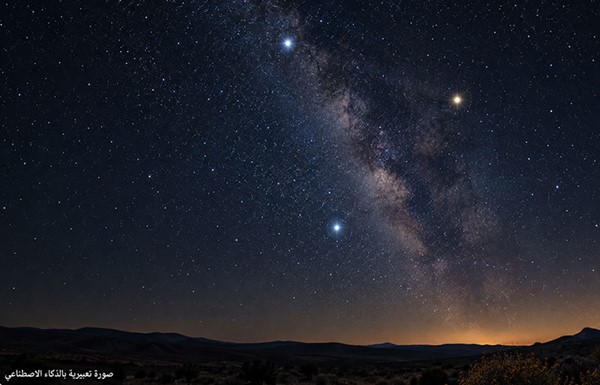
With the arrival of autumn, skywatchers might expect the “Summer Triangle” to disappear, yet it remains brilliant after sunset for weeks and can be seen from many parts of the Northern Hemisphere until the early winter.
This triangle is not an official constellation but an asterism formed by three exceptionally bright stars: Vega in the constellation Lyra, Altair (the Flying Eagle) in Aquila, and Deneb (the Tail of the Swan) in Cygnus.
The reason for its persistence is simple: the changing of the seasons does not abruptly alter the sky. As the Earth orbits the Sun, stars appear approximately four minutes earlier each night. Consequently, the Summer Triangle is visible for nearly the entire night, from twilight until dawn, while in autumn it appears high in the sky at the start of the evening, then moves toward the western horizon and sets before morning.
This is the origin of its name, as it serves as a clear marker of the summer sky, not because it is invisible in other seasons.
Although the three stars appear close together, they are extremely distant from one another in space. Altair is about 16.7 light-years away, Vega is approximately 25 light-years distant, while Deneb lies at an estimated distance of around 1,600 light-years or more. Nevertheless, it appears bright because it is an extremely luminous supergiant star.
