Video: Health Minister: Breast cancer accounts for over 40% of cancer cases among women in Kuwait
&cropxunits=450&cropyunits=300&w=770)
Abdulkarim Al-Abdullah
Health Minister Dr. Ahmad Al-Owaidi revealed that the Ministry is preparing to soon open the new Kuwait Cancer Control Center in the Sabah Medical City, as part of an agreement with the French global medical institution Gustave Roussy. He noted that the Ministry is working diligently to finalize this agreement, adding that the project represents an expansion of capacity to provide specialized care. It is expected to enhance the patient experience and treatment outcomes through improved access to services, faster processing of procedures, integration of specialties, and the safety and continuity of care.
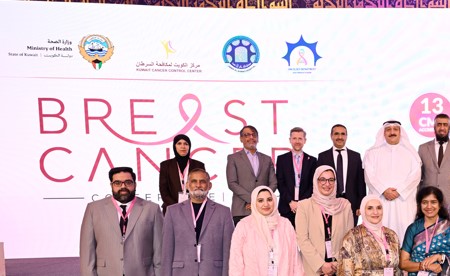
These remarks were made during his address at the opening of the Third Kuwait Breast Cancer Conference, organized by the Kuwait Cancer Control Center. Minister Al-Owaidi emphasized that breast cancer accounts for more than 40 percent of registered cancer cases among women in Kuwait, noting that the number of patients living with the disease, who are receiving treatment and follow-up at Ministry of Health facilities, exceeds 8,000.
Al-Owaidi stated that these figures place a clear responsibility on the Ministry of Health to detect the disease at early stages, shorten the diagnostic journey, and provide appropriate treatment in a timely manner, while safeguarding patient dignity and their right to information and participation in treatment decisions. He explained that cancer control lies at the core of the Ministry’s responsibilities and requires a comprehensive vision extending from awareness and early detection to diagnosis, treatment, rehabilitation, and follow-up, linking medical decisions to scientific evidence, health planning to reliable data, and spending to measurable outcomes.
He added that Kuwait has strengthened its capabilities in combating breast cancer over the past years, starting with the launch of the National Early Breast Disease Detection Program in 2014 and the establishment of a rapid diagnostic clinic at the Kuwait Cancer Control Center in 2015, which enhanced early detection opportunities, accelerated case assessment, and completed diagnostic procedures. A genetics laboratory was also established in 2016 to support understanding the molecular characteristics of tumors and leveraging this for selecting appropriate treatments. The opening of the Oncology Department at Jaber Al-Ahmad Hospital in 2022 marked a step in expanding specialized services, followed by the establishment of a team for breast tumor surgery and reconstruction in 2023, enhancing care integration and attention to functional and psychological aspects alongside disease treatment.
He highlighted the Ministry’s alignment with advancements in pharmaceutical treatments and the provision of modern therapeutic options, including hormonal, targeted, immunotherapies, and antibody-drug conjugates, tailored to the nature of the disease, its characteristics, and each patient’s clinical condition. He stressed the importance of introducing new technologies and drugs alongside rigorous scientific evaluation of their efficacy and safety, and monitoring their outcomes to achieve the greatest possible benefit for patients while enhancing resource efficiency and service sustainability.
Al-Owaidi disclosed that the Kuwait Cancer Control Center has begun implementing liquid biopsy technology to support molecular tumor analysis and utilize the results to guide treatment decisions in appropriate cases, within the context of rapid advancements in oncology and precision medicine. He also announced that the Center will begin preparing and conducting a clinical study in the field of breast cancer in 2026, supporting the development of a research environment that contributes to local knowledge production, while adhering to established scientific and ethical standards and prioritizing participant safety and rights.
He pointed to the establishment of a specialized department for epidemiology and a cancer registry in 2026, aimed at enhancing institutional capacity to monitor incidence patterns and trends, analyze data, and utilize it for planning and service evaluation.
He emphasized that accurate data form the foundation for identifying needs, directing resources, and measuring the impact of early detection and treatment programs. He stressed that the Ministry of Health’s strategies are built on clear priorities, evidence-based decisions, and indicators that measure actual improvements in human health.
Regarding the development of national human resources, Al-Owaidi explained that the specialized training program in oncology, conducted under the Kuwait Institute for Medical Specialization and supported by the Ministry of Health, has contributed to the graduation of six oncologists over the past five years.
He affirmed that investing in competencies extends to all members of the care team, including physicians, nurses, pharmacists, and specialists in diagnostics, rehabilitation, and psychological support, given that cancer care is an integrated institutional effort in which expertise converges and responsibilities are interconnected.
For his part, Dr. Anwar Al-Nouri, President of the Third Kuwait Breast Cancer Conference, stated that the conference focuses on the latest developments in breast cancer treatment, particularly chemotherapy, biological, hormonal, and targeted therapies.
He explained that among the key advancements discussed at the conference are “smart chemotherapy” (ADCs), which enable the delivery of chemotherapy to cancer cells with greater precision, alongside targeted therapies based on the identification of genetic mutations. He noted that genetic mutation testing is available at the Kuwait Cancer Control Center.
He pointed out that Kuwait has provided access to several modern treatments at an early stage, including the drug Elacestrant, and emphasized the importance of keeping pace with scientific advancements and exchanging expertise to improve the treatment of breast cancer patients.
