Islamic Cooperation Secretary-General: Kuwait’s role in mediation and humanitarian work has added value to the organization’s journey
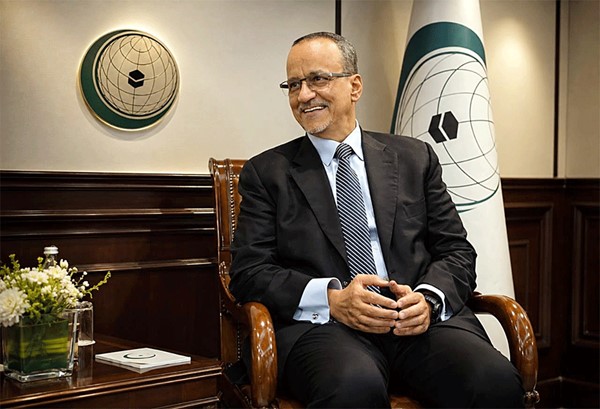
Ismail Ould Cheikh Ahmed, Secretary-General of the Organization of Islamic Cooperation (OIC), affirmed on Thursday that Kuwait is a fundamental partner in the shared Islamic endeavor, playing a key role in translating Islamic solidarity into concrete positions, initiatives, and outcomes.
In his first press interview since his election as Secretary-General, granted exclusively to the Kuwait News Agency (KUNA), Ould Cheikh Ahmed stated that Kuwait’s role in diplomacy, mediation, and humanitarian work, along with its established track record in these fields, adds significant value to the OIC’s mission. This is particularly relevant in the current phase, which underscores the need for greater dialogue, consensus, and solidarity among member states.
He added that the coming period offers both parties the opportunity to enhance cooperation in high-impact areas, foremost among them humanitarian action, crisis response, mediation, and preventive diplomacy, alongside supporting sustainable development and food and water security.
He pointed to the potential to build upon Kuwait’s humanitarian legacy to develop joint institutional initiatives and strengthen coordination in international forums. This would reinforce a unified Islamic stance on priority issues and challenges, and help transform existing cooperation into more effective and sustainable partnerships that serve the interests of member states and enhance the presence of the Islamic world on the international stage.
In this regard, he expressed his desire to visit Kuwait to strengthen consultation and coordination with Kuwaiti officials on issues of concern to the Islamic world.
Regarding the priorities he will place at the top of the OIC’s agenda, Ould Cheikh Ahmed said, “The coming phase requires genuine reform of the OIC, shifting it from managing crises to generating initiatives, and from issuing decisions to implementing them.”
He outlined his strategic vision, which is built on six pillars: institutional reform to enhance the organization’s efficiency; strengthening unity and solidarity among member states; supporting security, stability, and conflict resolution; building economic, scientific, and technological partnerships; investing in youth, women, and human capital; and enhancing the OIC’s presence and international influence.
He emphasized the importance of establishing clear mechanisms for implementation, monitoring, and accountability so that the OIC’s decisions are translated into tangible programs and results. This will make the organization more cohesive and effective, ensuring that Islamic solidarity is reflected in joint action rather than limited to positions and statements.
He noted that leading an organization comprising 57 diverse member states with varying priorities and circumstances represents a significant responsibility. He clarified that diversity can be a source of strength if differences are managed well and consensus is built.
He stressed the importance of prioritizing shared issues and interests, activating mediation mechanisms to bridge differences and avoid polarization, and translating consensus on positions into joint action through initiatives and projects in the fields of economy, development, security, science, and technology.
Regarding his extensive diplomatic experience and how it can be leveraged for the benefit of the organization, Ould Cheikh Ahmed said that experience in international diplomacy and UN work constitutes a valuable asset for enhancing the OIC’s political and diplomatic presence. This can be achieved by expanding partnerships with states and international and regional organizations, and strengthening coordination with the United Nations and multilateral institutions.
He affirmed that his expertise can be utilized to support preventive diplomacy, mediation, and consensus-building, enabling a shift from reacting to events to anticipating them by proposing practical initiatives and building international alliances that serve the priority issues of the Islamic world.
When asked about the priority of the Palestinian cause within the organization’s agenda, he stated that the Palestinian cause remains the central issue at the forefront of the organization’s concerns and work agenda. The organization prioritizes continuing diplomatic efforts to strengthen partnerships with international organizations to mobilize international support for implementing a two-state solution and exposing Israeli violations in the media, while supporting legal efforts to hold the Israeli occupation accountable for the crimes committed against the Palestinian people, their land, and their holy sites.
Regarding the need for the organization to develop its mechanisms for dealing with crises and the necessity of implementing reforms, he emphasized the importance of enhancing the organization’s crisis management mechanisms, noting that institutional reform has become an urgent necessity driven by the rapid transformations in the international system. He added that, in his view, this reform extends from strengthening political and diplomatic performance to activating developmental cooperation among member states.
In this context, he viewed the convening of an economic summit for the Organization of Islamic Cooperation as a significant step toward translating this direction into practical programs and projects by mobilizing resources, encouraging joint investments, supporting less-developed member states, promoting intra-organizational trade, and building economic partnerships that serve mutual interests.
He stated that the desired reform is a comprehensive one that makes the organization more effective, flexible, and influential, enabling it to better manage and anticipate crises and enhance political, economic, and developmental cooperation, thereby serving the interests of its member states and the issues of the Islamic world.
He added that “the success of any vision for the coming phase cannot be achieved through the efforts of the Secretariat General alone, but requires genuine partnership and shared commitment from all member states. The Secretariat General is a tool for executing the will of the member states, and the greater the consensus and political support, the greater our capacity for achievement.”
He expressed his hope that member states will strengthen unity and solidarity, coordinate their positions, and support the organization’s initiatives and stances in international forums, in addition to participating in the implementation of its projects and initiatives, particularly in the economic and developmental fields.
When asked about the Islamic Court of Justice affiliated with the organization, which has not yet been fully operationalized, Ould Cheikh Ahmed stated that efforts will be intensified in the coming days to enhance consultations with member states and support initiatives aimed at completing the legal and institutional track for the court, enabling it to transition from the establishment phase to exercising its actual role, thereby becoming a qualitative addition to the system of shared Islamic work and strengthening justice, the rule of law, and the protection of rights.
He clarified that the court is an institutional project that reinforces the justice system and legal work in the Islamic world, commending the State of Kuwait for hosting its headquarters.
He affirmed that the organization’s success is linked to the ability to work together in a spirit of consensus and solidarity, and to translate principles and decisions into practical steps and tangible results. He pledged that over the coming years, he would work to strengthen the unity of the Islamic front, develop consultation and coordination mechanisms, and commit to enhancing the organization’s presence and effectiveness in international forums, as well as developing partnerships with regional and international organizations.
Ould Cheikh Ahmed is the 13th Secretary-General of the Organization of Islamic Cooperation, having been elected in late August last year to succeed former Secretary-General Hussein Taha, drawing on a decades-long, distinguished diplomatic and United Nations career.
Ismaïl Ould Cheikh Ahmed held several senior positions, most notably as the United Nations Secretary-General’s Special Envoy to Yemen from 2015 to 2018. He also served in high-level roles at the United Nations, including assignments in Libya and as head of the UN mission to combat Ebola, in addition to serving as Resident Coordinator and Humanitarian Coordinator for Syria and Yemen.
He also served as Minister of Foreign Affairs, International Cooperation, and Mauritanians Abroad from 2018 to 2022, alongside other governmental and diplomatic posts.
