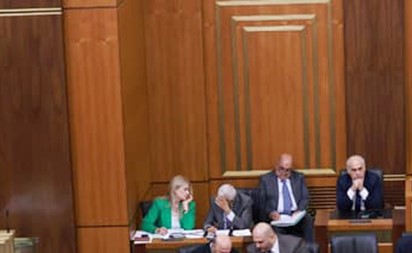
Parliament renews confidence in the government; Salam thanks "all who offered constructive criticism"
&cropxunits=450&cropyunits=253&w=770)
Beirut – Mansour Shaaban
The parliamentary inquiry session, which spanned two days, concluded with the House of Representatives renewing its confidence in the government by 68 votes to 12 against, with two abstentions. Members of the “Development and Liberation” bloc, led by Speaker of the House Nabih Berri, voted in favor of the government. During the vote, MP Qablan Qablan stated, “Regrettably, we vote for confidence.”
Prime Minister Nawaf Salam expressed his gratitude to “all who offered constructive criticism,” noting that “the citizen demanding the presence of the state is right, as is the citizen complaining about its absence.”
He clarified that “the tripartite framework is a political framework for negotiations, not a treaty or agreement in the legal sense. It entails a phased Israeli withdrawal and calls for the exclusive extension of the Lebanese state’s sovereignty over its territory. Our position at the negotiating table is stronger when we are all united behind the state.”
He added, “I do not claim that the outcomes we seek have been achieved. The attacks have not stopped, Israel has not yet withdrawn from all of Lebanon’s territory, a large number of our detainees remain held, and many of our people are still unable to return to their towns and villages. However, the negotiations have not ended. While it is true that any negotiation process is ultimately measured by the results it achieves, we must also ask ourselves: with what Lebanon do we go to the negotiating table? Our position at the table is stronger when we are all united behind the state.”
He continued, “The more we strengthen our national unity and ensure that the state’s authority alone is extended over its entire territory, the more we reinforce our strength and our ability to secure our rights.” He noted that “when we regained the confidence of our brothers and friends in the Lebanese state and its institutions, we were able to mobilize greater Arab and international support, whether for the army or for reconstruction efforts.”
He stated, “We want to be one people in one state, protected by one army, with our state exercising sovereignty over its entire territory.”
He pointed out that “the government pursues a policy that rejects Lebanon becoming a battleground for proxy wars, and we seek to put an end to the logic of subordination or reliance on external powers, regardless of their origin.” He added, “If anyone has an alternative path that stops the attacks, brings back our detainees, and returns our people to their villages at a lower cost to Lebanon and its people, we are with them, provided they show us the way.”
Regarding “relations with Syria and the file of Syrian refugees,” Salam said, “We are building today a relationship with Syria based on mutual respect for the sovereignty of both countries, shared interests, and non-interference in each other’s affairs. Accordingly, work is underway to review previous bilateral agreements and to enshrine the principle of reciprocity in several areas.”
He added, “Syrian citizens sentenced in Lebanese prisons have been transferred to Syria to complete their sentences. This is the implementation of a Lebanese-Syrian judicial agreement, similar to those in place with many other countries. It is neither a concession of Lebanese sovereignty nor a release of the sentenced, as some have tried to portray it.”
On the refugee file, he said, “The government has formulated a plan to facilitate their dignified and safe return to their homeland. We consulted and cooperated with the Syrian government, mobilized international support for this return, and also put an end to a years-long dispute over the exchange of information regarding refugees. This policy, along with changing conditions in Syria and the incentives provided by international organizations for returnees, has led to the return of nearly 700,000 Syrians to their homeland. In fact, we facilitated and organized this return.”
Regarding the files of electricity, energy, and water, he said, “Some almost claim that the electricity crisis began with this government. The truth is that what the Lebanese citizen pays today is largely the cost of more than two decades of neglect in developing the electricity sector. This experience cannot be separated from the contracting mechanisms with the companies that own and operate the power barges, the fuel contracts awarded without tender, and the tenders that have been repeatedly postponed.”
