Nicaraguan Ambassador: Kuwait is a model of wisdom, balance, and diplomacy
&cropxunits=450&cropyunits=300&w=770)
Ossama Diab
Nicaragua’s Ambassador to the country, Muhammad Farara Lashtar, affirmed the depth and solidity of Nicaraguan-Kuwaiti relations, noting that they are grounded in a historical friendship, mutual respect, and fruitful developmental cooperation. He expressed his country’s aspiration to expand the horizons of cooperation with Kuwait across several sectors, foremost among them health, education, transportation, tourism, and investment.
Lashtar praised the wisdom of Kuwait’s leadership and its balanced approach in dealing with regional crises, emphasizing that Kuwait represents a model of balance, diplomacy, and restraint. He underscored that dialogue remains the only path to achieving security, peace, and the resolution of crises.
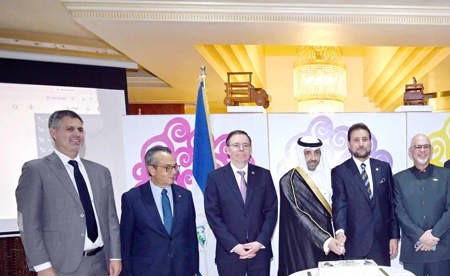
These remarks were made in statements to journalists on the sidelines of the Nicaraguan Embassy’s celebration of the 205th anniversary of the Republic’s independence. The event was attended by Ahmad Shinar Al-Bukhait, Counselor for Protocol Affairs, a number of ambassadors, members of the diplomatic corps, representatives of Kuwaiti entities, and friends of Nicaragua.
The Ambassador stated that relations between Nicaragua and Kuwait are “strong and solid,” explaining that diplomatic relations between the two countries were established in 1990, followed by the opening of the Nicaraguan Embassy in Kuwait, which became his country’s first embassy in the Gulf region and the Arab world.
He noted that the embassy in Kuwait covers several countries in the region, including the Gulf Cooperation Council (GCC) states, as well as Jordan, Lebanon, and Libya, while Nicaragua maintains another embassy in Algeria.
He affirmed that bilateral relations have witnessed cooperation in several fields over the past years, particularly in developmental areas, expressing his hope to strengthen this cooperation and transform the distinguished political relations between the two countries into broader practical partnerships that serve the interests of both peoples.
Lashtar pointed out that developmental cooperation between Kuwait and Nicaragua has spanned many years, especially in the health sector, praising the role played by the Arab Kuwait Fund for Economic Development in supporting developmental projects in his country.
He explained that the Kuwait Fund’s contributions helped establish and open the largest hospital in Nicaragua, located in a region with a population of approximately 700,000, considering the project a qualitative addition to the health sector and the medical services provided to citizens. He noted that the hospital project is valued at $120 million, with the Fund’s contribution amounting to approximately 33% of the total value.
He indicated that there are opportunities for further cooperation in the field of medical devices and equipment, noting that the Spanish language, as the official language in Nicaragua and most Latin American countries, can sometimes pose a challenge to expanding certain areas of cooperation.
He revealed that a significant project in the transportation sector began implementation about three to four months ago, concerning the construction of several major bridges in Nicaragua, thereby strengthening the transportation network and connectivity between the country’s Pacific and Caribbean coastal regions. He affirmed that the project is among the most prominent infrastructure and transportation projects currently being implemented in his country. He added, “In the roads and transportation sector, the Kuwait Fund is providing a loan of approximately $15 million. This project replaces outdated infrastructure and will connect key areas for livestock production, mining, and agriculture, thereby reducing travel times and logistical costs in the northern Caribbean.”
