New archaeological discovery at Tell al-Abqa'in in Al-Buhaira reveals details of military and daily life within one of the fortresses of the Modern State
&cropxunits=450&cropyunits=440&w=770)
Cairo – Hanaa El-Sayed
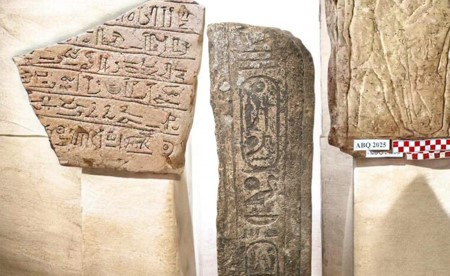
The Egyptian archaeological mission working at the Tell Afaqain archaeological site in Beheira Governorate has uncovered a series of significant structures and artifacts that shed light on military life, daily routines, and urban planning within ancient Egyptian fortresses. The findings underscore the site’s strategic importance as one of the military fortresses established along the western border of the Delta during the New Kingdom period to protect the country from incursions by Libyan tribes.
Shareef Fathy, Minister of Tourism and Antiquities, affirmed that this discovery adds a new dimension to understanding the system of military fortifications constructed by the ancient Egyptians to safeguard the nation’s borders. He noted that the residential structures, storage facilities, and diverse artifacts uncovered by the mission provide a comprehensive picture that extends beyond the fortress’s military aspect, revealing details of the daily, economic, and religious lives of its inhabitants.
The Minister commended the efforts of Egyptian archaeological missions and the discoveries they have made, which contribute to uncovering further secrets of ancient Egyptian civilization. He emphasized the Ministry’s continued support for excavation and scientific research at various archaeological sites, as well as its commitment to preserving, studying, and documenting the findings using the latest scientific methods.
For his part, Dr. Hisham El-Leithy, Secretary-General of the Supreme Council of Antiquities, explained that excavation work has revealed a large residential complex built of mudbrick. On its northern side, a main street approximately four meters wide was discovered, running from east to west and intersecting with another street extending from south to north. The complex’s main entrance is connected to the southern entrance of the fortress, which is constructed of limestone, reflecting a precise urban and engineering plan within the fortress.
He added that the residential complex is divided into several rooms containing granaries for storing grain and cylindrical clay ovens used for preparing food, baking grain, and meeting the daily needs of the fortress’s residents. This indicates the existence of an integrated system for provisioning and resource management.
Additionally, a group of residential rooms was discovered near the well area in the fortress’s southeastern corner. Previously, three stone wells inscribed with the titles of Pharaoh Ramesses II had been found in this area, suggesting the presence of a residential settlement linked to various daily activities and water sources within the site.
Mohamed Abdel-Badee, Head of the Egyptian Antiquities Sector, noted that some of the discovered rooms, particularly those located north of the main street, were used as storage facilities for wheat, as large clay jars were found inside them.
