U.S. Ambassador in Western Zoutar, inquiring about Salam before Parliament: “Lebanon’s situation is difficult and very difficult”
&cropxunits=450&cropyunits=300&w=770)
Beirut – Mansour Shaaban
U.S. Ambassador to Lebanon Michel Issa conducted a field visit to the town of West Zoutar, accompanied by a delegation from the Council for Development and Reconstruction. He began his tour at the Annunciation Church, coinciding with an Israeli drone flying overhead. Meanwhile, Israeli military vehicles were observed moving within East Zoutar. These developments come as official meetings intensify to discuss “negotiations” and recent consultations, ahead of the preparatory conference for the International Conference in Support of the Lebanese Army and Internal Security Forces, scheduled for Thursday in Paris.
President Joseph Aoun addressed this file with Defense Minister General Michel Mounzer, as well as the missions being carried out by the army in the south. Yesterday, Finance Minister Yassin Jaber opened the International Monetary Fund (IMF) meetings in Beirut.
In Pakistan, Minister of Interior and Municipalities Ahmad al-Hajar and his counterpart, Mohsin Naqvi, signed a memorandum of understanding on the exchange of prisoners between the two countries. Al-Hajar also met with Pakistani President Asif Ali Zardari and Prime Minister Shehbaz Sharif. Zardari expressed “concern over the continued instability and hostilities in Lebanon and the Middle East,” and affirmed “Pakistan’s support for Lebanon’s sovereignty, independence, unity, and territorial integrity.” He stated that his country “supports diplomatic efforts to halt escalation, achieve sustainable peace, and resolve conflicts through dialogue in accordance with international law.”
Meanwhile, all stakeholders closely followed the parliamentary “accountability” session of the government, convened by Speaker of the Parliament Nabih Berri. Parliamentary trends were reflected in the speeches of the deputies, with the session on “granting or withdrawing confidence” set to continue today.
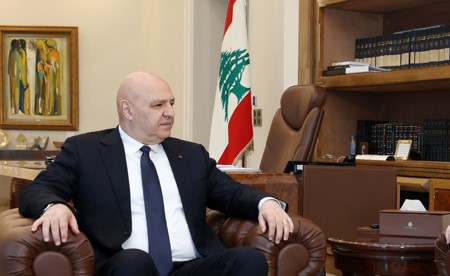
In his address, President Salam described “the state of Lebanon” as “difficult and very difficult,” emphasizing that “exiting the crisis is not impossible, provided efforts are pooled and the national interest is placed above other considerations.” He clarified that “there is no sustainable reconstruction without financing, no financing without trust, and no trust without a capable state.” He reaffirmed the commitment to “completing financial and banking reforms and reaching an agreement with the IMF.”
He added, “According to the World Bank’s assessment of the first war, which began on October 8, 2023, the total cost reached approximately $14 billion, of which about $7.2 billion was in physical damages and about $6.8 billion in economic losses resulting from disrupted activity, declining production, and reduced revenues. Of course, its greatest cost was more than 4,000 martyrs and more than 16,000 wounded. As for the most recent war, which began on March 2, its direct cost to date, according to a preliminary World Bank estimate, ranges between $3 and $4 billion. This figure does not include the economic cost, which extends beyond direct physical destruction and reaches, at a minimum estimate to date, between $4 and $5 billion. Here too, the greatest cost, of course, is more than 4,000 martyrs and more than 12,000 wounded. Consequently, the two wars together have certainly cost Lebanon more than $20 billion, and their total cost may exceed $27 billion once the accounting for the 2026 war is completed.”
Regarding negotiations with Israel, Salam stated, “You all know that the tripartite framework agreed upon in the negotiations serves as a reference in the negotiation track. However, it is not an agreement in the legal sense of the word, but rather a political framework. Certainly, it is not a finalized treaty to be presented to the Council of Ministers for ratification. Nevertheless, the tripartite framework included a series of executive measures, albeit without a timeline, leading to a gradual Israeli withdrawal and the deployment of the Lebanese Army.”
He continued, “It is the state’s responsibility to choose the path that is least costly to Lebanese citizens in achieving its objectives. Negotiation in itself is not a concession of rights, but a means to reclaim them through diplomatic channels.”
