US Economic Delegation Including Representatives of 50 Companies Holds Roundtable Meetings in Damascus
&cropxunits=450&cropyunits=300&w=770)
Syrian Foreign Minister Asaad al-Shaybani held talks in Damascus with Jake McGee, Assistant Secretary of State for Near Eastern Affairs, to explore ways to strengthen bilateral cooperation between the two countries, discuss the latest regional and international developments of mutual interest, and examine expanding the scope of partnership between Syria and the United States, according to statements released by the Foreign Ministry via its official channels.
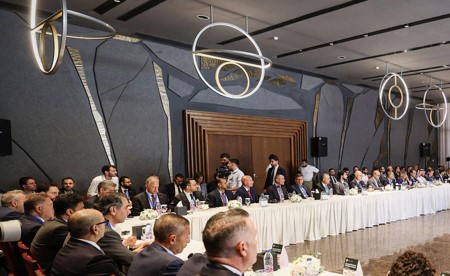
The meeting took place on the sidelines of Assistant Secretary McGee’s visit to Damascus, accompanied by a large U.S. economic delegation comprising representatives from approximately 50 American companies. The delegation held meetings with various Syrian ministries and official bodies to discuss opportunities for enhancing economic and investment cooperation and opening new horizons for U.S. companies to operate and invest in Syria, thereby supporting economic ties and broadening cooperation between the two sides.
In this context, the Ministries of Finance and Communications, the Central Bank of Syria, the Investment Authority, and other official Syrian institutions held roundtable discussions with the U.S. economic delegation in Damascus to explore ways to enhance cooperation and open new avenues for partnerships and investments across various sectors.
Malak al-Amri, head of the U.S. Cooperation Department at the Directorate of International Cooperation within the Ministry of Foreign Affairs and Expatriates, told journalists, as reported by SANA news agency, that the primary objective of the meetings was to identify investment opportunities, review the overall situation, and foster an environment of trust between the Syrian government and U.S. companies.
For his part, Finance Minister Yasser al-Barzni clarified that discussions focused on explaining fiscal and monetary policies, and how the ministry collaborates with each investor and both public and private sectors as partners in contributing to reconstruction and placing the economy on a path to recovery. He emphasized Syria’s commitment to creating favorable conditions to encourage companies to invest in the country, as well as establishing legislative, regulatory, and conducive environments that promote investment.
Al-Barzni noted that the country is entering a promising phase for investment following the removal of Syria’s name from the U.S. list of State Sponsors of Terrorism, expressing his hope that the volume of U.S.-Syrian trade across various sectors would increase.
Meanwhile, Central Bank of Syria Governor Safwat Rusalan explained that the presence of several bankers and commercial and industrial companies within the U.S. delegation is indicative of interest in the Syrian market and the significant opportunities it offers for the U.S. side. He stated that this would positively reflect on the influx of new investments and job opportunities, as well as the restoration of banking relations between the two countries.
Rusalan affirmed that the Central Bank supports investors by providing a sound and stable banking environment in Syria, in addition to working to attract certain financial and banking institutions abroad to enter the Syrian market and facilitate the operations of traders, industrialists, and investors.
