Approval of the Pathways System Regulations: Extends over 3 years across 6 academic semesters
&cropxunits=450&cropyunits=300&w=770)
Alaa Khalifa: Minister of Education, Eng. Sayed Jalal Al-Tabatabaee, issued a decision approving the pathways regulation for the secondary stage, to take effect from the current academic year 2026/2027.
The Ministry of Education emphasized that the standard academic plan for the pathways system spans three years, from the tenth to the twelfth grade, distributed across six semesters. It clarified that a student’s progression depends on the courses and units they have passed. In the event of difficulty in a specific course, the student’s situation is addressed within that same course, while retaining credit for all previously passed courses. The student’s academic record includes their results, grade point average (GPA), and remaining requirements, enabling the student and their guardian to continuously monitor academic progress. This also assists schools in identifying cases of academic difficulty and intervening promptly to address them.
The Ministry explained that upon acceptance into the system, students begin with a foundational and exploratory phase. During this period, they study Islamic Studies, Arabic Language, English Language, Mathematics, Integrated Sciences, Social Studies, Computing, and Exploration, alongside Physical Education and Free Choice courses. Students select one of the two Exploration courses in the first semester and the other in the second semester. These two courses provide students with practical experience to help them understand the different pathways and make more informed choices. Their results are factored into the criteria for pathway determination.
The Ministry noted that pathway selection begins after a student completes 18 units and fulfills the requirements of the foundational stage, including aptitude and interest assessments, as well as counseling sessions. Educational counselors review the results with students and discuss their preferences. Guardians are informed of available options and the requirements for each pathway, with all counseling and selection procedures documented in the student’s file. The regulation outlines eight educational pathways: Mathematics, Sciences, Languages, Commercial, Industrial, Technology and Artificial Intelligence, Law, and Social Sciences.
The Ministry clarified that a student’s preference is the primary basis for pathway selection, provided that eligibility criteria are met and sufficient capacity is available. In cases of competition among applicants, the selection criteria are weighted as follows: 35% for cumulative GPA, 25% for the average score of courses related to the pathway, 15% for aptitude test results, 10% for interest assessment results, 10% for exploratory performance, and 5% for the counseling report. Additionally, students must achieve a minimum GPA of 2.0 in each prerequisite course required for entry into a specific pathway. This requirement is independent of the standard passing grade for the course. Students are informed of the pathway determination decision and the reasons behind it, with the option to review and appeal the decision in accordance with established regulations.
The Ministry of Education stated that during the four subsequent semesters of the Foundation and Exploration stage, students study four common general courses and four courses within their chosen pathway in each semester, alongside Physical Education and Free Choice. The Ministry clarified that pathway courses include mandatory and elective requirements, and students may change their pathway in accordance with specified regulations. Prior to such a change, the equivalent courses, remaining academic requirements, and the impact of the pathway change on the graduation date must be clearly communicated to ensure transparency for both the student and their guardian.
The Ministry further explained that each semester consists of nine units, with a weekly workload of 35 periods. A unit represents the weight of a course, while a period denotes its instructional time. Physical Education is allocated half a unit and one weekly period, whereas Free Choice is allocated half a unit and two weekly periods. This applies to each of the six semesters. The results for both subjects are recorded on a pass/fail basis, their units count toward graduation requirements, but they are excluded from the calculation of the Grade Point Average (GPA).
The Ministry highlighted that the curriculum includes a mandatory weekly FLEX period dedicated to guidance, support, monitoring, skill development, and approved activities. Schools are responsible for organizing these sessions and assigning supervisors based on the nature of the activity, documenting student attendance through a separate register. The FLEX period carries no academic grade or credit units; absence from it does not constitute absence from any course, nor does it have academic consequences. However, it may be addressed through educational and disciplinary measures. The Ministry emphasized that the FLEX period must not be used to teach academic courses or make up for missed class periods.
Regarding assessment, the Ministry noted that the evaluation system combines semester work and final assessments according to the nature of the course. In theoretical courses, 40 points are allocated to semester work and 60 points to the final assessment. In laboratory and practical courses, 50 points are assigned to each component. The Exploration course receives 60 points for semester work and 40 points for the final task and portfolio. Final assessments are subject to central specifications and standards. Course grades contributing to the GPA are converted to points on a four-point scale, which is used to calculate both the student’s semester and cumulative GPA.
The Ministry affirmed that learning difficulties and academic setbacks are addressed through support and monitoring plans, alongside specific provisions for retaking courses and improving grades. The system also allows eligible failing students to take a second attempt in accordance with approved regulations. Students who miss the final assessment due to an accepted and documented medical reason may benefit from the relevant provisions, retaining their semester work and not being considered failed solely due to their absence for the accepted reason.
Concerning attendance, the Ministry indicated that it is recorded per period for each course, taking into account excuses, notifications, support, and graduated warnings before any decision to deny graduation is made. The platform handles calculation and documentation, while decisions are issued by authorized entities after ensuring all safeguards are met, through the integrated roles of teachers, educational counselors, the registration office, and school administration. Graduation requires the completion of 54 units, fulfillment of pathway courses and all graduation requirements, and achieving a cumulative GPA of at least 1.0.
Additionally, 48 units are included in the GPA calculation, while the six units allocated for Physical Education and Free Choice are excluded. The graduation project is a mandatory independent requirement worth zero units and excluded from the GPA. It enables students to apply acquired knowledge and skills to produce a project or study, with results recorded on a pass/fail basis.
Graduation requirements also include community service and field training. Students must complete 60 documented field hours, distributed as 15 hours per semester from the third to the sixth semester. The pathway system offers an optional summer semester for completion, addressing academic setbacks, or acceleration, with a maximum of nine units. Qualified students may graduate at the end of the fifth semester if they complete the required units and fulfill all graduation requirements, while maintaining the defined learning outcomes and study duration.
She confirmed that the implementation plan for the Track System targets 12 schools, with one school for boys and one for girls in each educational region. She explained that the current phase will be subject to continuous monitoring and evaluation of the quality of guidance and track selection, school attendance, assessment mechanisms, and the performance of the electronic platform.
Central Control Room: 338 Traffic Surveillance Cameras Distributed Across Roads
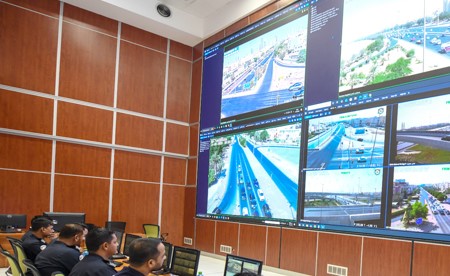
Amid screens displaying live footage of roads and intersections across the country, security personnel at the Central Control Room within the Ministry of Interior continue to monitor traffic flow in real time, coinciding with the return of students to their schools for the new academic year (2026–2027).
The expansive screens inside the room form a live traffic map that tracks vehicle movements and identifies congestion hotspots via 338 traffic surveillance cameras distributed across roads. This enables rapid response to traffic issues and enhances traffic fluidity, particularly around schools and the roads leading to them.
Security staff have been monitoring traffic conditions since the early hours of the morning, managing signal timing to support the efforts of security officers deployed on the ground and ensuring the safety of students, their parents, and road users.
This monitoring from the Control Room is integrated with the deployment of 870 security and traffic patrols, as part of the Ministry of Interior’s preparations to accompany the academic year, regulate traffic flow, and reduce congestion.
These efforts coincide with the Ministry of Interior’s ongoing awareness campaign, “Waqaaya.. Wa Aman” (Protection and Safety), which runs throughout the academic year to reinforce safe practices and responsible behavior, and to enhance security and traffic awareness among members of society.
