Syrian Government Temporarily Raises Fuel Prices; Energy Ministry Attributes Hike to Exceptional Circumstances and Global Market Changes
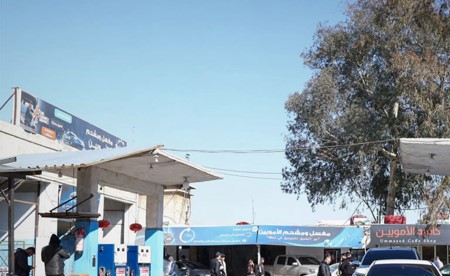&cropxunits=450&cropyunits=300&w=770)
The Syrian Oil Products Pricing Committee announced a temporary increase in the prices of gasoline, diesel fuel, and gas starting yesterday, with the Ministry of Energy attributing the hike to exceptional circumstances and global market fluctuations. According to a statement published by the official news agency SANA, the Standing Committee for Determining Prices of Petroleum Materials and Mineral Wealth issued a bulletin of “temporary new prices” as follows:
The price of a liter of “95-octane gasoline” is now 195 new Syrian pounds, up from 152 Syrian pounds.
The price of a liter of “90-octane gasoline” is 185 Syrian pounds, up from 142 new Syrian pounds.
The price of a liter of diesel fuel is 175 Syrian pounds, up from 125 Syrian pounds.
The price of a domestic gas cylinder is 1,600 new Syrian pounds, up from 1,470 Syrian pounds.
Industrial gas was set by the committee at 2,570 Syrian pounds, down from 2,350 Syrian pounds.
These adjustments come amid continuous volatility in global oil markets, alongside a review of local factors affecting the cost of oil products. The pricing mechanism relies on periodic evaluations of prices, both upward and downward, to ensure that price bulletins reflect the actual economic reality at the time, as clarified by the Oil Products Pricing Committee.
Abdulhamid Salat, Director of the Media Department at the Ministry of Energy, confirmed that the price adjustments were the result of exceptional conditions and temporary changes in global energy markets, which led to a significant rise in the cost of procuring oil products. In statements to SANA, Salat explained that prices are not fixed nor do they move in a single direction; rather, they are subject to review and adjustment up or down based on cost changes and market conditions.
He noted that the ministry recognizes that price adjustments impose an additional burden on citizens, especially given current living conditions and income levels. However, Syria currently relies heavily on imports to meet its needs for oil products, meaning that the cost of securing these materials cannot be decoupled from global market fluctuations.
Salat pointed out that the belief held by some that Syria’s domestic oil production is sufficient to meet local market demand is “incorrect.” He clarified that current domestic production stands at approximately 100,000 barrels per day, while average market demand ranges between 300,000 and 325,000 barrels per day. This means domestic production covers only about one-third of the requirements.
Regarding refining capacity, Salat stated that the Homs refinery is currently operating at a capacity of nearly 30,000 barrels per day, while the Baniyas refinery has entered an emergency and temporary maintenance shutdown after its technical condition reached a critical stage, making continued operation impossible without posing real risks to the facility.
