Agreement to establish the 'Ebla' submarine communications cable linking Syria and Cyprus, with global companies involved
&cropxunits=450&cropyunits=300&w=600)
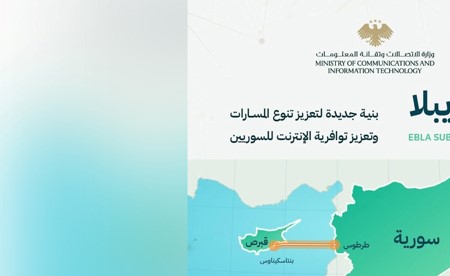
The Syrian Ministry of Communications and Information Technology has signed an agreement to establish the “Ebla” submarine cable between the Syrian Telecommunications Establishment, the Cypriot telecommunications authority Cyta, and the American company UNIFI Communications, Inc. This moves the project into the implementation phase as part of the ministry’s plan to modernize Syria’s international connectivity and diversify its routes.
According to a statement issued by the ministry and reported by the Sana News Agency, the new cable will connect the city of Tartus with the Pentaskeuas station in Cyprus. It will comprise 24 pairs of optical fibers, enabling data transmission at a capacity of 31 terabits per second upon launch, with scalability up to 370 terabits per second. The cable will provide direct connectivity to Cyprus, and from there, via Cyta’s networks, to European and global networks.
The ministry highlighted its efforts to develop Syria’s telecommunications and internet infrastructure through a comprehensive vision that integrates modern submarine fiber optics, the national backbone network, and regional terrestrial routes. This strategy aims to enhance capacity for telecommunications operators and service providers, ultimately benefiting citizens.
In this context, the ministry noted that the “Ebla” project re-establishes direct connectivity to Cyprus. Additionally, plans are underway to establish a Syrian landing station on the “Medusa” cable to expand connectivity in the Mediterranean Sea, increase international destinations, and enhance options for dealing with carrier operators within a neutral and open-access framework.
These two projects complement the SilkLink initiative, which is developing an open-access national fiber backbone network connecting submarine landing stations to cities, data centers, licensed operators, and land border crossings. This integration facilitates the distribution of international capacity within Syria and supports its role in data transmission between Europe, neighboring countries, the Gulf region, and Asia.
Regarding preparations for project implementation, the ministry stated that marine equipment has been ordered from Prysmian’s NSW facility. Elettra has been selected to carry out the cable laying and installation at sea, while Nokia will supply the optical transmission equipment. Concurrently with the cable manufacturing process, marine surveys are underway for the route between Pentaskeuas and Tartus.
The ministry indicated that installation, testing, and trial operations will be completed, with the cable expected to become operational by early 2028. This timeline is linked to the completion of licensing procedures, implementation phases, favorable marine conditions in the eastern Mediterranean, and the availability of vessels required for cable laying.
