Creation of "Trainee Teacher" Position for Newly Appointed Staff in the Ministry of Education
Establishment of a new job title for trainee teachers with revised appointment conditions
Translated by Alqyas from Al-Anba — Original source
Decree-Law No. 86 of 2026 was issued, replacing Schedule No. 1 attached to Law No. 28 of 2011 concerning the granting of allowances and bonuses to Kuwaiti teaching staff in the Ministries of Education and Islamic Affairs, in a move aimed at developing the appointment conditions for the teaching profession and enhancing the quality of educational outputs.
According to the explanatory memorandum of the decree, published in *Al-Kuwait Al-Yaum*, the amendment comes within the framework of supporting and empowering teachers to fulfill their noble mission, and keeping pace with the rapid changes in education.
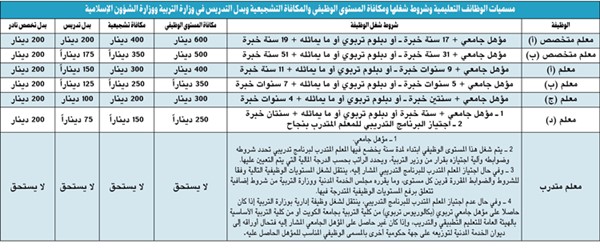
The amendment includes reorganizing the appointment conditions for Kuwaitis in the teaching profession. Appointments will now begin for a one-year period in a newly created job title, “Trainee Teacher,” during which the teacher performs teaching duties and undergoes a one-year training program comprising theoretical study and practical training. During this period, the appointee receives a salary based on the financial grade assigned to the position, but no allowances or bonuses specific to the teaching staff related to teaching are paid.
The explanatory memorandum noted that “if the Trainee Teacher fails to pass this training program, they will be transferred to an administrative position in the Ministry of Education, provided they hold a university qualification in education from the College of Education at Kuwait University or from the Basic Education College of the Public Authority for Applied Education and Training. If they do not hold the aforementioned university qualification and fail to complete the specified training program, their file will be referred to the Civil Service Bureau for assignment to another government entity in a job title appropriate to their qualification.”
For further details: Amendment of conditions for holding educational positions and establishment of a one-year “Trainee Teacher” role without allowances or bonuses.
Decree-Law No. 86 of 2026, replacing Schedule No. (1) attached to Law No. 28 of 2011 concerning the granting of allowances and bonuses to Kuwaiti teaching staff in the Ministry of Education and the Ministry of Islamic Affairs, was published in the Official Gazette (*Al-Kuwait Al-Yaum*).
Its articles stipulate the following:
Article One: Without prejudice to acquired rights, Schedule No. (1) attached to the aforementioned Law No. 28/2011 is replaced by the schedule attached to this Decree-Law.
Article Two: Any provision conflicting with the provisions of the schedule attached to this Decree-Law is repealed.
Article Three: The Ministers shall each implement this Decree-Law within their respective jurisdictions, and it shall take effect from the date of its publication in the Official Gazette.
The explanatory memorandum for the Decree-Law states the following: The Ministry of Education seeks to support teachers and provide all means to enable them to fulfill their noble mission, recognizing their role in advancing academic and cultural standards. Education is witnessing rapid changes that have imposed new roles on teachers beyond the traditional framework of classroom instruction, and the contemporary educational reality demands the development of tools and methods aligned with modern technologies.
Therefore, the Ministry of Education is keen on investing in the development of teachers’ skills by providing advanced training programs and workshops that keep pace with recent developments, aiming to enhance the educational process and adapt to modern advancements in order to build a modern educational system based on the latest international standards.
Given that Law No. 28 of 2011 concerning the granting of allowances and bonuses to academic staff, as amended by Law No. 26 of 2016, stipulated in its articles and as outlined in its explanatory memorandum, that it was enacted to modify the existing system in order to primarily ensure stability for academic staff, thereby creating a professional reality for the teaching profession that makes it attractive to qualified candidates and those with the necessary credentials, encourages constructive competition among its practitioners, and primarily rewards outstanding performance in promotion processes. This rationale prompted the approval of certain financial benefits for teaching staff in both the Ministry of Education and the Ministry of Islamic Affairs.
Table No. (1) attached to this law detailed the job levels covered, ranging from Level E Teacher up to Level A Specialist Teacher. Each job level was associated with specific eligibility requirements, which included the required academic qualification for each level, as well as the value of the level bonus, incentive bonus, teaching allowance, and rare-specialty allowance granted according to each job level. Subsequently, Law No. 86 of 2017 amended Law No. 28 of 2011, replacing the aforementioned tables with a new one.
Since Article 1 of the Decree issued on April 4, 1979, concerning the Civil Service System, specified the general conditions for holding civil service positions, and Article 1(4) thereof stipulated that candidates for public office must meet the required conditions and qualifications for the position, the final paragraph of that article further provided that the government entity may add other conditions after obtaining the opinion of the Civil Service Bureau.
Article 4 of the same decree stipulated that “appointment to the group of public service positions requires obtaining an academic qualification commensurate with the nature of the position. The Civil Service Council shall determine the academic qualification levels necessary for appointment to this group. Nevertheless, individuals without the required qualifications but possessing relevant experience or who have completed training courses may be appointed to the positions in the aforementioned group, in accordance with the rules and conditions determined by the Civil Service Council upon the proposal of the Civil Service Bureau.”
Given that the position of “Teacher” possesses a special nature due to its importance and impact on shaping and forming students’ thinking, as well as being a comprehensive educational and pedagogical mission rather than mere rote instruction, it requires a combination of academic and pedagogical skills, the ability to handle and modify behavioral issues, and the performance of diverse tasks such as planning and delivering curricula and evaluating student performance. It also requires teachers to engage in continuous professional development to keep pace with developments, while serving as role models for students in behavior and values, given the teacher’s direct influence on shaping students’ personalities. Consequently, considering the nature of these tasks, additional conditions must be met regarding candidates for educational positions to ensure the effective performance of job duties and achieve the intended objectives.
Decision No. (2) of 1996 of the Civil Service Board concerning the positions, allowances, and bonuses of teaching staff members stipulated in its Article 1 the definition of the teaching staff members covered by the decision. Article 2 specified the job levels for teaching staff, ranging from Level E (Teacher E) to Level A (Specialized Teacher A), and referred to Table No. (1) attached to the decision regarding the conditions for filling each of these job levels. This table included the required academic qualifications and years of experience for each of the aforementioned job levels.
With regard to the first of these levels (Teacher E level), the sole requirement for appointment is a diploma qualification. As for the next level, Teacher D, the requirement is a university degree or a secondary diploma plus two years of experience.
The notes attached to this table clarified that newly appointed holders of a university degree would be appointed at the D level, while holders of a diploma would be appointed at the E level. These notes also stated that the Ministry of Education may add other conditions to those listed in the table, such as passing training courses or examinations, in agreement with the Civil Service Bureau. Given that Law No. (28) of 2011, as stated in its explanatory memorandum, was intended solely to amend the existing system, it is evident that the additional conditions set forth in Decision No. (2) of 1996 of the Civil Service Board, which were not included in Law No. 28 of 2011 and do not conflict with its provisions, remain in force and effective.
This is particularly relevant because all the conditions mentioned in the aforementioned law for holding the position of teacher, as outlined in Table No. (1) attached to the law, pertained only to the conditions for occupying the progressive job levels, without addressing the conditions for initial appointment to the position of teacher. Regarding the first level for initial appointment, the law specified that for the Teacher E level, a commercial diploma qualification is required, and for the Teacher D level, a university educational degree or its equivalent plus one year of experience, or a pedagogical diploma or its equivalent plus three years of experience, is required.
Subsequently, Law No. (86) of 2017 came into effect, replacing the aforementioned table. It amended the conditions for holding the Teacher D level to require a university educational degree or its equivalent (excluding the years of experience requirement), or a pedagogical diploma or its equivalent plus two years of experience.
The essence of this is that the initial appointment conditions for the position of teacher did not differ from the general conditions prescribed for holding any other position, except for the educational qualification requirement. No conditions were stipulated regarding the actual ability to perform the teaching duties that constitute the core of the teacher’s role, despite the significant responsibility attached to those holding this position, which necessarily demands additional conditions to achieve the desired objectives.
In practice, it has become evident that the initial conditions for appointing recent graduates as teachers are insufficient to ensure the proper performance of the duties assigned to this role, particularly the skills required to carry them out. Moreover, the academic qualification itself—whether a university-based educational degree or a pedagogical diploma—is inadequate as a standalone condition for initial appointment. This is especially true given the varying levels of graduate performance and graduation rates, which sometimes indicate weaknesses in these outcomes that are inconsistent with the requirement that those occupying this position must possess the highest level of competence. Such competence is not necessarily reflected merely by graduation and obtaining an academic degree, nor by prior years of service in the profession, as those years may not represent genuine, substantive experience that benefits the educational institution.
Given the need to study and understand the developments affecting the educational sector and to update appointment procedures for teaching staff accordingly—ensuring that only individuals with high competence are recruited into these positions—the objective is to select the most qualified candidates for these roles and determine eligibility based on objective criteria rooted in the nature of the job. This approach ensures equality of opportunity and legal equality, guaranteeing that only those who meet the general conditions and possess the specific attributes and capabilities necessary to perform the role to the highest standard are appointed, thereby ensuring the smooth operation of the educational system.
To reconcile the right of recent graduates from the College of Education at Kuwait University and the Basic Education College of the Public Authority for Applied Education and Training to work in teaching positions within the Ministry of Education based on their academic qualifications, with the Ministry’s right to select the best candidates to achieve optimal results that positively impact the efficiency of the entire educational system and infrastructure, the matter was referred to the Parliamentary Committee for Education, Health, and Youth, as well as the Civil Service Bureau. They approved the reorganization of appointment conditions for Kuwaiti nationals in the teacher position. Under the new system, initial appointments are made for a one-year period in a newly created job title: “Trainee Teacher.” During this year, the trainee teacher performs teaching duties while undergoing a one-year training program that includes theoretical study and practical training. The appointee receives a salary according to the financial grade assigned, without any additional allowances or bonuses specific to the teaching profession.
If the trainee teacher fails to successfully complete this training program, they will be transferred to an administrative position within the Ministry of Education, provided they hold a university-based educational degree from the College of Education at Kuwait University or from the Basic Education College of the Public Authority for Applied Education and Training.
If the individual does not hold the aforementioned university qualification and has not passed the specified training program, his documents shall be referred to the Civil Service Bureau for assignment to another government entity in a job title appropriate to his attained qualification. In the event that the trainee teacher passes the training program, he shall be promoted to the next functional level within the career ladder for teaching staff, subject to the conditions set forth in Table No. (1) attached to the Law and the allowances stipulated for each level in that table, as well as any additional conditions determined by the Civil Service Council and the Ministry of Education regarding the progressive technical promotion of functional levels.
In light of the foregoing, and given that the Emiri Amr issued on 2 Dhu al-Qi'dah 1445 AH (corresponding to 10 May 2024) stipulated in Article (4) that laws shall be issued by legislative decrees, the aforementioned draft Legislative Decree has been prepared, consisting of three articles, including the replacement of Table No. (1) attached to Law No. 28 of 2011 concerning the granting of allowances and bonuses to Kuwaiti teaching staff at the Ministry of Education and the Ministry of Islamic Affairs.
