In Video: “Once Upon a Time, a Madman” – The Wisdom of Madmen’s Mouths!
&cropxunits=450&cropyunits=301&w=770)
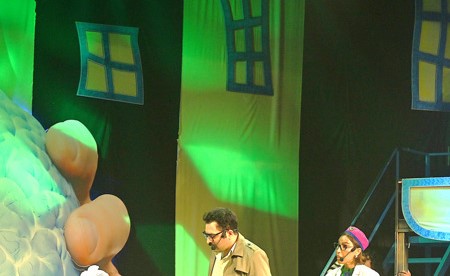
Yasser Al-Ayila: If you are looking for three hours of laughter, singing, music, and spectacle, do not hesitate to enter the “Seagull Sanatorium”! However, there is one condition for fully enjoying the play “Once Upon a Time, One Minon”: you must leave your mind outside the theater door for a while and decide to immerse yourself in every detail of the experience with these “madmen,” who do not confine themselves to the stage but descend into the audience multiple times, turning everyone into part of this delightful, crazy journey.
“Once Upon a Time, One Minon” is not just a traditional comedic play, but a Kuwaiti experience that, for the first time, offers a unique blend of live musical theater, comedy, and spectacle, intertwined with a dramatic and human story that quietly slips between the laughter, songs, and satirical moments. For nearly three hours, the audience experiences continuous variety; hardly do they settle into one scene before transitioning to another with a different hue of comedy, song, or performance.
The story begins inside the “Seagull Sanatorium,” where the audience meets a group of patients, each with their own story and “tale” that led them to this place. With the arrival of Inspector Louai from the Ministry of Health to investigate reports of violations and harsh practices within the sanatorium, the events take a more thrilling turn. Facts intertwine with hallucinations and memories, until the work surprises us with its most important dramatic truth: the sanatorium and its patients were merely reflections of the shocks and painful memories living within Inspector Louai’s own mind!
This is where one of the strengths of the script, written by Musab Al-Salem, lies. He succeeded in hiding his dramatic surprise amidst a boisterous comedic atmosphere, making the audience laugh and interact with the characters and their stories, only to make them reconsider much of what they had seen. Almost every character becomes part of a journey within Louai’s mind, serving as a mirror reflecting aspects of human trauma that can change a person’s life and push them into complex psychological territories.
The beauty of the work is that it does not present these psychological themes in a heavy or direct manner, but embeds them within an entertaining framework filled with comedy, music, and song. This approach allowed the humanistic messages to reach the audience smoothly. Between the laughter, issues of love, betrayal, poverty, divorce, and painful memories emerge, affirming that behind every smile lies a story, and behind every person is a pain that others may not see.
Director Mohammed Jamal Al-Shati deserves credit for his success in steering this diverse mix and maintaining the show’s rhythm, especially with the constant transitions between dialogue, spectacle, and musical scenes. He managed to give the stage a sense of movement and vitality, leveraging the actors’ presence among the audience at several points. This broke the traditional barrier between spectator and theater, allowing everyone to experience the performance more interactively.
Regarding the acting performances, it was clear that a strong team spirit was present. The stars Osama Al-Muzayen and Hiba Al-Dari formed a charming and endearing duo through their characters “Nabihah” and “Hamad,” combining comedy, wit, and high energy. They were indeed a spark of activity and vitality on stage, with their scenes possessing a distinct charm.
The brothers Mishaal and Shamlan Al-Majed also delivered outstanding performances, infusing the show with a large dose of joy and happiness through their cheerful spirits and likable presence. Meanwhile, young artist Saleh Al-Filakawi managed to draw attention with his performance and presence, demonstrating artistic tools worthy of closer examination.
They were joined in this brilliance by Manal Al-Jarallah, Shahin Al-Shahin, and Mishaal Al-Majed, each portraying their character in their own unique way. Together, they contributed to completing the collective image of the play, which is one of the key elements of the show’s success. Here, the spotlight was not monopolized by a single name; rather, the stage was spacious enough for everyone.
It is impossible to discuss the work without highlighting the beautiful talent of Musab Al-Salem, the playwright and one of its stars. He did not merely present a script full of twists and surprises; he also delivered a distinguished performance as Inspector Louai. This was particularly significant given that the character carries the primary dramatic burden of the work, transitioning from attempts to uncover the truth within the sanatorium to discovering the harshest reality: that much of this world was a journey within his own mind and memory.
Another element that gave “Once Upon a Time, One Minon” its unique flavor was the musical band, which performed live throughout the duration of the show. They participated with the theater stars in creating an atmosphere of joy and happiness. The music was not merely background for the scenes but a living, interactive element. The band presented a diverse selection of Gulf and Arabic songs in a beautiful and vibrant style, making the audience feel at times as if they had moved from the theater to a distinctive and varied nightclub with its musical and spectacle segments.
This celebratory atmosphere was one of the secrets of the show’s enjoyment. The live music succeeded in maintaining the high energy of the play, giving it a distinctiveness suited to the nature of the live musical experience. The songs and spectacles became an integral part of the overall mood, not just interludes between scenes.
Although the ending of “Once Upon a Time, One Minon” carries an emotionally moving dramatic aspect, the work does not leave the audience’s memory as a sad tale. Instead, it leaves behind a set of humanistic messages that may touch the feelings of many of us. Perhaps this paradox is the most beautiful aspect of the play: we laugh throughout the journey with a group of “madmen,” only to discover at the end that they may have been wiser and more truthful than many of the “sane”!
“Once Upon a Time, One Minon” is a theatrical experience that indirectly tells its audience: do not always take life with utmost seriousness. Laugh, sing, and let go of the mind’s constraints for a while, but do not forget to listen carefully to what the characters say between the laughs. You may find in the words of the “madmen” a truth that we, the sane, do not dare to admit.
After more than three hours of laughter, singing, and beautiful madness, it seems we have left the “Seagull Sanatorium” fully convinced by an old saying: “Take wisdom from the mouths of madmen.” However, “Once Upon a Time, One Minon” has presented it in its own unique way.
