$166.5 Billion in Projects Reshape Kuwait’s Economic Map
Ahmed Maghraby
Kuwait enters a new phase of investment activity, driven by a massive portfolio of projects valued at approximately $166.5 billion. Spanning a wide range of economic and vital sectors, this landscape reflects the broadening scope of capital expenditure, extending from energy and industry to construction, transport, electricity, and water. It provides the economy with a wider base for growth and non-oil activity in the coming years, despite the region’s geopolitical tensions.
This portfolio derives its significance not only from its substantial financial value but also from its sectoral diversity and its simultaneous extension into infrastructure, production, and service sectors. This makes the projects a central pillar in the anticipated economic activity cycle, whether through direct investment spending or the associated demand for construction, services, financing, supply, and operations.
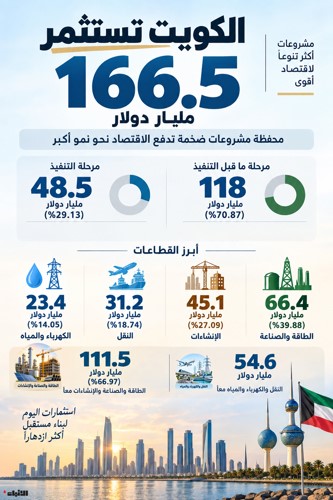
According to data cited by Al-Anbaa from MEED magazine, the active project portfolio of $166.5 billion is distributed between approximately $48.5 billion in projects that have entered the implementation phase and $118 billion in projects in the pre-implementation stage. This reveals a large block of projects poised to transition into implementation in the near future.
This composition means that approximately 70.87% of the portfolio’s value remains in the pre-implementation stage, compared to 29.13% for projects that have entered the implementation phase. This places before the Kuwaiti economy a long line of potential investment spending, the actual impact, size, and timing of which depend on the pace of project awarding and their transition from planning and preparation to on-the-ground execution.
Energy and Industry at the Forefront
Energy and industry projects top the investment map with a total value of $66.4 billion, accounting for approximately 39.88% of the total project portfolio. This reflects the continued significant weight of production and energy sectors within Kuwait’s investment plans.
The project map does not stop at the energy sector; the construction sector comes in second with a portfolio valued at $45.1 billion, representing about 27.09% of total active projects. This highlights the large scale of urban and construction projects linked to infrastructure development and developmental needs.
The transport sector also holds a prominent position within the portfolio, with projects valued at $31.2 billion, equivalent to approximately 18.74% of the total. Meanwhile, projects in the electricity and water sector reach $23.4 billion, or about 14.05% of the portfolio.
These figures reveal a fundamental characteristic of the new Kuwaiti project cycle: they are not concentrated in a single economic activity but are distributed across energy, industry, construction, transport, electricity, and water. These are sectors interconnected through a wide chain of activities, services, and supporting works.
$111.5 Billion for Energy, Industry, and Construction
The magnitude of investment weight becomes even clearer when combining the energy, industry, and construction sectors. Their projects total $111.5 billion, equivalent to approximately 66.97% of the entire portfolio. This means that nearly two-thirds of the value of active projects in Kuwait are concentrated in these sectors.
Conversely, the combined portfolio for transport, electricity, and water amounts to $54.6 billion, highlighting another dimension of the project map: the development of infrastructure and key services necessary to support economic and urban expansion.
From Projects to Growth
This broad investment map coincides with indicators of improvement in the Kuwaiti economy’s trajectory. The International Monetary Fund (IMF) expects Kuwait’s real GDP to grow by 3.8% in 2026, driven by a 4.7% growth in the oil sector, alongside continued 3.0% growth in the non-oil sector. Real economic growth is projected at 2.5% in 2027, with non-oil sector growth remaining at 3.0%.
Crucially, in its assessment of the project portfolio, the IMF explicitly links investment expansion with non-oil activity. It forecasts non-oil GDP growth of 2.7% in 2025 and 3.0% in 2026, driven by increased public investment, before non-oil growth continues in subsequent years.
The Fund notes that Kuwait has announced new public investment projects to improve infrastructure, particularly focusing on housing, electricity, water, and transport. It estimates that these projects will lead to a cumulative increase in public investment spending equivalent to 26% of GDP between 2025 and 2030.
Here, the importance of the $166.5 billion portfolio becomes clearer. The projects do not represent isolated capital expenditure; rather, as they gradually transition into implementation, they serve as a source of non-oil economic activity. They generate demand for contracting, materials, engineering, consulting, logistics, financial services, and other activities associated with the project execution cycle.
$118 Billion on the Horizon
Perhaps the most indicative figure for the coming phase is the presence of $118 billion in projects in the pre-implementation stage—more than double the value of currently executing projects, by a factor of 2.43.
This large size gives the Kuwaiti project portfolio a significant future dimension, as the majority of it has not yet entered the execution cycle. Consequently, the speed at which planned projects are converted into actual contracts and construction works will determine the extent to which this portfolio impacts economic activity in the coming years.
This aligns with the IMF’s view that the pace of infrastructure project implementation and structural reforms is a key domestic factor influencing economic prospects. The Fund emphasizes that public investment has already begun and that improving the efficiency of investment project management will be essential to maximizing their economic returns.
An Economy with Multiple Sectors in Motion
Overall, the figures present a different picture of the project cycle in Kuwait. Instead of relying on a single sector to drive activity, investments are distributed across four main blocks: energy and industry, construction, and transport, electricity, and water. This creates spaces for economic activity in interconnected sectors, ranging from major projects to the associated companies, suppliers, and service providers.
Furthermore, the broadening base of projects coincides with a phase in which the IMF expects the Kuwaiti economy to recover and non-oil activities to continue growing. In its latest consultations with Kuwait, the Fund confirmed that economic activity is recovering and that the country has embarked on a transition toward a more dynamic and diversified economy, paralleling increased public investment and the continuation of fiscal and structural reforms.
Thus, the most critical issue in the coming phase is not merely the size of the $166.5 billion project portfolio, but the economy’s ability to rapidly convert the $118 billion in the pre-implementation stages into actual projects. This will strengthen the investment cycle, increase the contribution of non-oil sectors, and provide greater space for the private sector to participate in economic activity.
