Kuwait: Our position is firm in the face of Iranian aggression
&cropxunits=450&cropyunits=293&w=770)
Kuwait reaffirmed its steadfast position in confronting Iranian aggression and the attacks carried out by its proxies, as well as its resolve to safeguard its security and sovereignty. It renewed its full solidarity with sister and friendly countries that have been targeted by such attacks, calling for the formulation of a unified, clear, and resolute stance against aggressions targeting Arab states, regardless of their source.
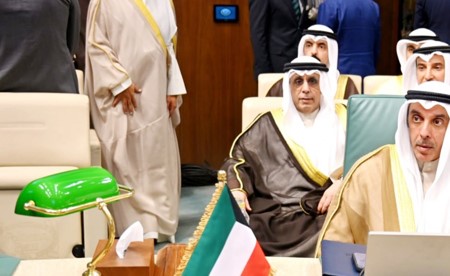
This was stated in Kuwait’s statement delivered by Deputy Foreign Minister Ambassador Hamad Al-Mushaan, who headed the Kuwaiti delegation participating in the consultative meeting of Arab foreign ministers and the Arab League Council at the ministerial level during its 166th ordinary session, held yesterday in Cairo.
Ambassador Hamad Al-Mushaan reiterated Kuwait’s condemnation of Israeli aggression against Palestine, Syria, and Lebanon, emphasizing the need to develop mechanisms for joint Arab action and to advance the concept of collective Arab security from political solidarity to deterrence and prevention. He stressed the importance of enhancing the role of the Arab League in translating common positions into effective action and tangible outcomes, noting that the success of de-escalation efforts requires a complete halt to aggression, respect for the sovereignty and territorial integrity of states, and the guarantee of freedom and security of navigation in the Strait of Hormuz in accordance with international law.
For his part, Arab League Secretary-General Nabil Fahmy announced a proposal to develop mechanisms for joint Arab action by introducing early warning tools, crisis management capabilities, and threat monitoring systems, aimed at strengthening Arab states’ capacity to protect their security and interests.
Tunisian Foreign Minister Mohamed Naifti affirmed that all Arab states had condemned Iranian aggression targeting several sister countries, stressing that any attack on an Arab state affects the security and stability of the entire region.
Naifti added that the meeting underscored that solidarity, coordination, and the unification of Arab positions are essential to enhancing the resilience, effectiveness, and influence of joint Arab action.
For more details: Deputy Foreign Minister Ambassador Hamad Al-Mushaan heads the Kuwaiti delegation to the consultative meeting of foreign ministers and the ministerial session of the Arab League Council in Cairo. Kuwait: Our position is firm in confronting Iranian aggression, and we safeguard our security and sovereignty.
Deputy Foreign Minister Ambassador Hamad Al-Muqdad reaffirmed Kuwait’s steadfast position in confronting Iranian aggression and the attacks carried out by its proxies, as well as its resolve to safeguard its security and sovereignty. He reiterated Kuwait’s full solidarity with the brotherly and friendly countries that have been targeted by such attacks, calling for the formulation of a unified, clear, and resolute Arab stance against aggression on Arab states, regardless of its source.
During Kuwait’s statement delivered at the Arab League Council meeting at the ministerial level in Cairo, Ambassador Al-Muqdad renewed Kuwait’s condemnation of Israeli aggression against Palestine, Syria, and Lebanon. He emphasized the necessity of developing mechanisms for joint Arab action, transitioning the concept of collective Arab security from political solidarity to deterrence and prevention, and enhancing the role of the Arab League in translating common positions into effective action and tangible outcomes.
Al-Muqdad appreciated regional and international efforts aimed at de-escalation in the region, stressing that the success of de-escalation tracks requires a complete halt to aggression, respect for the sovereignty and territorial integrity of states, and the guarantee of freedom and security of navigation in the Strait of Hormuz in accordance with international law.
Deputy Foreign Minister Ambassador Hamad Al-Muqdad led the Kuwaiti delegation participating in the consultative meeting of Arab foreign ministers and the 166th regular session of the Arab League Council at the ministerial level, held at the League’s General Secretariat headquarters in Cairo. The meetings discussed recent developments in the regional situation and efforts to enhance security and stability in the region, alongside ways to support joint Arab action and review agenda items.
For his part, Arab League Secretary-General Nabil Fahmy announced a proposal to develop mechanisms for joint Arab action by introducing early warning tools, crisis management systems, and threat monitoring, aimed at strengthening Arab states’ capacity to protect their security and interests and to influence their regional and international environment.
Fahmi condemned Iranian attacks on Arab states, emphasizing that the Arab League neither accepts the targeting of territories and facilities nor finds any justification for such actions, and that Arab states are not parties to the war that has erupted in the region. He stressed that the security of Gulf Arab states is an integral part of Arab national security, and any threat to it concerns the League and its member states. He underscored the importance of the Strait of Hormuz and the Bab al-Mandab straits, calling for respect for the rights of riparian states and freedom of navigation in accordance with international law.
In his address at the 166th session of the Arab League Council at the level of foreign ministers, Fahmi called for the development and adaptation of the Arab League to bolster the national and regional capacities of member states, enabling them to anticipate risks, confront crises, manage their repercussions, and support Arab decision-making with information, expertise, and proactive vision. He stated that the League is in the process of establishing a “Center of Excellence” as an Arab platform for expertise and strategic analysis to identify emerging sources of threat, prioritizing preventive diplomacy, early warning, crisis management, and support for settlement efforts.
For its part, Egypt called for the development of Arab security arrangements that enhance collective capacity to protect Arab national security by advancing security and defense integration, coordinating available Arab capabilities, and building upon the Arab Collective Defense Treaty and relevant Arab resolutions.
Egyptian Minister of Foreign Affairs and International Cooperation Dr. Badr Abdelatty, in his speech at the ministerial meeting, stated Cairo’s readiness to work with the Arab League and member states to prepare a comprehensive vision for these arrangements, coordination frameworks, crisis response mechanisms, and implementation and follow-up pathways, thereby translating shared political will into practical Arab capacity capable of prevention, deterrence, and collective response to threats and crises, while respecting the sovereignty of Arab states.
In this context, he reiterated Egypt’s unequivocal condemnation of Iranian attacks targeting several sister Arab states, expressing full solidarity with the Gulf Cooperation Council countries, Jordan, and Iraq, and stressing Egypt’s rejection of any infringement on the sovereignty, security, or territorial integrity of Arab states.
He emphasized the necessity of avoiding an escalation of confrontation and returning to the diplomatic track to address sources of tension, achieve de-escalation, and build upon the memorandum of understanding reached between the United States and Iran last June, leading to a final and sustainable agreement.
Dr. Badr Abdelatty stressed the imperative to ensure freedom of navigation in international waterways and straits, particularly the Strait of Hormuz and the Red Sea, affirming that the security of the Red Sea is the shared and exclusive responsibility of riparian states.
The Arab League Council called on Tehran to fully comply with its obligations under international law and United Nations resolutions.
- Iran is responsible, under international law, for immediately and unconditionally reopening the Strait of Hormuz and restoring freedom of navigation therein.
Cairo, KUNA: The Council of the Arab League at the level of foreign ministers condemned on Monday Iran’s continued attacks on the Gulf Cooperation Council (GCC) countries, Jordan, and Iraq, citing violations of their sovereignty and territorial integrity, as well as breaches of international law and the UN Charter.
In a decision issued at the conclusion of its 166th ordinary session, presided over by Tunisia, the Council affirmed that these attacks constitute a violation of UN Security Council Resolution 2817, a breach of the principle of non-use of force, and a threat to regional and international peace and security.
The Council called on Iran to fully comply with its obligations under international law and relevant UN resolutions, and to immediately and permanently cease any attacks or threats targeting Arab states, their territories, citizens, or civilian and vital infrastructure. It urged addressing the root causes of tension through dialogue, negotiations, and peaceful means.
The Council again condemned Iran’s illegal closure of the Strait of Hormuz and its continued obstruction and disruption of navigation in the Bab al-Mandab through its proxies in the region, stressing that such actions pose a threat to the security of sea lanes, international trade, and global energy security.
It firmly rejected Iran’s establishment of the so-called “Persian Gulf Strait Authority” and any characterization of it as a sovereign entity responsible for managing and regulating ship traffic through the Strait of Hormuz. It also rejected the imposition of any fees under any name for ships passing through the strait, or the adoption of unilateral measures aimed at subjecting freedom of navigation to Iranian regulatory or supervisory authority.
The Council strongly condemned any attacks targeting commercial and civilian ships, emphasizing Iran’s responsibility to immediately and unconditionally reopen the Strait of Hormuz and restore freedom of navigation in accordance with international law, including the removal of mines and obstacles to safe passage.
Arab foreign ministers stressed the strategic importance of the Strait of Hormuz, Bab al-Mandab, and the Red Sea for international trade, energy supplies, and global supply chains, warning of the consequences of any attempt to disrupt navigation in these waterways for economic security and energy security.
They emphasized that regional peace and stability can only be achieved through dialogue, mutual understanding, respect for the principles of good neighborliness, sovereignty, and non-interference in internal affairs, calling for an immediate halt to escalation and military actions, and for dialogue and diplomacy to prevail.
They called on the UN Security Council to fulfill its responsibilities in maintaining international peace and security, support efforts to halt escalation, ensure full implementation of its 2026 Resolution 2817, and take necessary measures against any acts or threats that could hinder freedom of navigation or threaten the security and integrity of international sea lanes.
They reaffirmed Arab states’ commitment to freedom and safety of navigation, and the right of passage through the Strait of Hormuz and Bab al-Mandab, rejecting any restrictions or transit fees of any kind, or unilateral arrangements that hinder maritime navigation.
They stressed that ensuring freedom of navigation is a shared international responsibility requiring action by the international community, expressing readiness to work with all countries in the region and the International Maritime Organization (IMO) to ensure unhindered maritime traffic and to reach permanent arrangements consistent with international law, the UN Convention on the Law of the Sea (UNCLOS), and state sovereignty.
They reiterated the inherent right to self-defense, individually or collectively, in response to armed attacks launched by Iran, as stipulated in Article 51 of the UN Charter, emphasizing Arab states’ right to protect their ships, ports, maritime facilities, vital infrastructure, and transport means, and to take necessary measures in accordance with international law.
The Council noted that states may take purely defensive measures to protect their ships and contribute to restoring freedom of navigation in accordance with international law, based on paragraph 20 of the IMO resolution issued in July 2026.
It affirmed that Iran bears international responsibility for the aggressions and their consequences, including the obligation under international law to provide reparation for injuries and economic losses, including damages to ships, ports, maritime facilities, and energy infrastructure.
It reaffirmed Arab states’ support for the right of affected states to resort to competent international and regional institutions and mechanisms to protect their rights, obtain necessary decisions to ensure accountability and reparation in accordance with international law.
The League Council expressed full Arab solidarity with Arab states targeted by Iran, stressing the danger of continued Iranian provocative attempts to drag Arab states into the crisis.
The Council tasked Arab groups in international organizations, Arab ambassadorial councils, and Arab missions to the UN, IMO, and other relevant international forums with taking urgent and coordinated action to convey the content of the decision and mobilize international support to protect freedom of navigation and ensure the security and integrity of sea lanes and energy corridors.
Arab Foreign Ministers Call on the International Community for Immediate Intervention to Protect the Palestinian People from Israeli Occupation Crimes
The Council of the Arab League at the level of foreign ministers called on the international community to intervene immediately to protect the Palestinian people from the crimes committed by Israeli occupation forces and settlers in the West Bank and the Gaza Strip.
In a decision on Palestine issued at the conclusion of the 166th ordinary session, the Council urged the full implementation of all stages of the ceasefire agreement in the Strip, issued by the 2025 Sharm El-Sheikh Peace Summit, and the implementation of UN Security Council Resolution 2803, ensuring the cessation of aggression, the reconstruction of the Strip, and enabling the Palestinian people to exercise their right to self-determination and realize the independence of their state.
The Council appealed to all countries to provide political, financial, and legal support for the Arab-Islamic plan for recovery and reconstruction in the Gaza Strip, and to consolidate the Palestinian people on their land. In this regard, it welcomed efforts to hold an international conference in Cairo as soon as possible, in coordination with the State of Palestine and the United Nations.
Foreign ministers renewed their condemnation of the genocidal, starvation, siege, and aggression crimes, as well as war crimes and crimes against humanity, still being committed by Israeli occupation forces in Gaza.
The Council also condemned Israeli occupation measures aimed at annexing occupied West Bank lands, including East Jerusalem, as well as forced displacement, home demolitions, land confiscation, the establishment of military checkpoints, and the entrenchment of the fragmentation of the West Bank into isolated areas and cantons, emphasizing that the annexation of any part of the Palestinian land occupied in 1967 constitutes a war crime.
It considered the continuous Israeli aggression and occupation against the people and land of the State of Palestine as a violation of Arab national security and a undermining of international peace and security, calling for the enhancement of joint Arab action to protect the Palestinian people by activating and developing mechanisms for joint Arab defense, including the activation of the Treaty of Joint Defense and Economic Cooperation between Arab States.
The decision called on the UN Security Council to adopt a resolution under Chapter VII of the UN Charter to compel the Israeli occupation to comply with its relevant resolutions on the Palestinian issue, halt its aggression against the Palestinian people, and implement the orders and advisory opinions of the International Court of Justice.
It expressed its firm rejection of any form of displacing the Palestinian people from their land or altering their demographic composition, including what the occupation promotes under the guise of "voluntary migration," noting that displacement is a form of genocide and ethnic cleansing, and a grave violation of international law.
It also rejected measures and plans targeting the fragmentation of the geographical and demographic unity of the Palestinian people, including separating the Gaza Strip from the occupied West Bank or imposing different systems in the Strip, affirming that the Palestinian people are one people and that the Gaza Strip is an inseparable part of the land of the State of Palestine.
The Council condemned the Israeli occupation authorities’ demolition and takeover of the United Nations Relief and Works Agency for Palestine Refugees in the Near East (UNRWA) headquarters in Sheikh Jarrah, the closure of its offices, schools, and centers in Jerusalem, and the replacement of these facilities with Israeli institutions, considering these measures to target the Palestinian refugee issue and their right to basic services.
It also welcomed the UN General Assembly’s decision to renew UNRWA’s mandate until 2029, condemning the Israeli aggression against the Agency’s facilities and staff in the Gaza Strip, which resulted in the martyrdom of more than 350 employees, injured hundreds, and destroyed approximately 315 of its facilities.
It expressed its rejection and condemnation of the systematic Israeli and American campaigns against UNRWA, urging member states to pay their assessed contributions of 7.8 percent of the Agency’s general budget and to encourage exceptional contributions to its funding. The Secretary-General of the Arab League was called upon to continue coordinating with the UNRWA Commissioner-General to mobilize financial support for the Agency’s budget.
The ministers called on the international community to continue providing aid to strengthen the institutions of the State of Palestine and support its development plans and programs. They also urged Arab countries to continue supporting the Palestinian economy, opening their markets to Palestinian-origin products, exempting them from customs duties, and encouraging Arab private sector institutions to invest in Palestine.
They affirmed their support for the relief, recovery, reconstruction, and development plan prepared by the State of Palestine, calling on countries, organizations, development agencies, and national and international funds to contribute to its financing and implementation in coordination with the Palestinian side.
They also called on the Arab League to act and coordinate with international and national organizations and institutions to assist Palestinian children who lost their fathers or suffered limb amputations as a result of the Israeli aggression on the Gaza Strip, with special attention to providing prosthetic limbs for children.
The Council expressed its appreciation for Arab efforts in providing relief, medical, food, and shelter supplies to the Palestinian people in light of the crimes and aggression they are subjected to.
Arab foreign ministers approve appointment of assistant secretaries-general and closure of Arab League missions
On Monday, Arab foreign ministers approved the appointment of three assistant secretaries-general for the Arab League, nominated by the Kingdom of Bahrain, Egypt, and Sudan, for a five-year term. This decision was issued at the conclusion of the 166th session of the Arab League Council at the ministerial level.
The Council appointed Sheikh Mohammed bin Khalifa Al Khalifa, Bahrain’s nominee; Ambassador Sherif Kamel, Egypt’s nominee; and Ambassador Badr al-Din al-Jaafari, Sudan’s nominee, as assistant secretaries-general of the League.
The ministers also approved the renewal of the five-year terms for a second period for Ambassador Hussein al-Hindawi, the Arab League’s assistant secretary-general for Iraq, and Ambassador Mohand Laoussifi, the League’s assistant secretary-general for Algeria.
The Council also approved the closure of three Arab League missions abroad—those in Berlin, Nairobi, and Buenos Aires—while assigning the League’s missions in neighboring countries to assume the responsibilities of the closed missions.
These decisions follow deliberations by the Arab League Council at the ministerial level, as part of efforts to complete the restructuring of the League’s Secretariat-General and enhance its operations in the coming period.
