Artificial Intelligence Suggests Physics Experiments That Challenge Scientists' Intuition
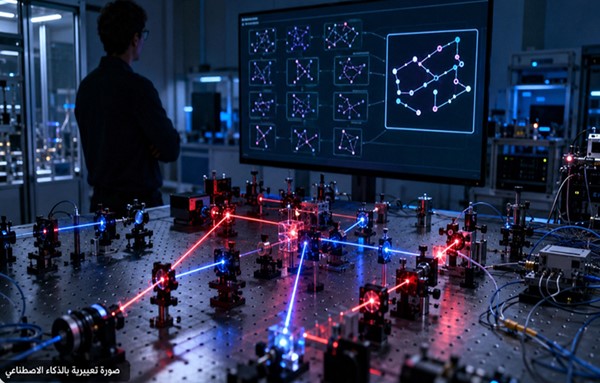
Can a computer arrange lasers, lenses, and mirrors in ways that never occurred to physicists? A new review published in the journal Nature states that this has become possible in certain fields, with computational design
Translated by Alqyas from Al-Anba — Original source
Can a computer arrange lasers, lenses, and mirrors in ways that never occurred to physicists? A new review published in the journal Nature states that this has become possible in certain fields, with computational designs sometimes matching or even surpassing the performance of human-designed experiments.
The concept does not rely primarily on a chatbot writing a general proposal, but rather on transforming experimental design into a mathematical optimization problem. Scientists input a list of available components, physical laws, desired outcomes, and practical constraints, after which the system explores a vast number of possible arrangements within a digital simulation.
An early example was a program that proposed an unconventional arrangement of photon sources and mirrors to generate a quantum entanglement state that a research team had failed to design manually. This approach later led to systems that discovered dozens of potential experiments in quantum optics.
The application has extended to optimizing the shapes of nuclear fusion reactor components, distributing particle detector components, designing neutrino antennas, and even proposing new shapes for gravitational wave detectors.
The review notes that some recent designs have outperformed proposals for next-generation detectors within simulations under specific realistic conditions.
However, these results do not imply that machines have become independent physicists or that they always outperform scientists.
Humans still define the questions, components, laws, and success criteria. Moreover, a solution that succeeds digitally may be costly, overly complex, or impossible to build.
The greatest challenge lies in creating accurate and fast simulations, and ensuring that the system does not exploit loopholes in the model to propose an experiment that appears excellent computationally but fails in the laboratory. Therefore, researchers view the future as a partnership: the machine explores possibilities, while physicists interpret the results, test them, and decide what is worth building.
