US Army Threatens to Destroy Iran's Oil Fleet
&cropxunits=450&cropyunits=263&w=770)
US Secretary of War Pete Hegseth threatened to destroy Iranian oil tankers if Tehran repeated attempts to target US vessels near the Strait of Hormuz. Hegseth stated in a post on his official X account following the US Central Command’s (CENTCOM) announcement targeting three Iranian oil tankers, “It’s simple… if Iran fires on US ships, we will destroy and sink their oil tankers.” He added that “all they have to do is stop firing on the US Navy.”
The US Secretary of War emphasized that “the Iranian oil tanker fleet is defenseless and unprotected… Iran lacks the capability or naval and air forces to protect its oil fleet,” warning that the US Navy and Air Force are capable of “striking them all.”
The US military had previously announced that its forces bombed three Iranian oil tankers, stating this was done “after the Iranian Revolutionary Guard fired ballistic missiles at two US Navy warships conducting patrols in territorial waters.” CENTCOM said in a statement on its official X account: “A US aircraft carrier and a guided-missile destroyer successfully evaded multiple unjustified Iranian attacks, with no US personnel casualties.”
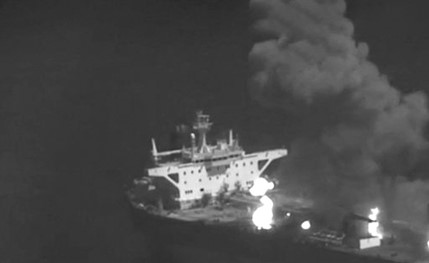
It added: “Following the failed Iranian attacks, US Central Command disabled two crude oil tankers belonging to the Revolutionary Guard off the coast of Kharg Island and near Jask. Our forces also completely destroyed the empty crude oil tanker M/T Kylo (also known as Noxen) in the Gulf of Oman, targeting the vessel in several critical locations to render it inoperable, after directing the crew to abandon ship.”
CENTCOM clarified that “the three Iranian crude oil tankers are part of a secret network worth billions of dollars that funds the Iranian Revolutionary Guard and Iran’s proxies in the region,” noting that Tehran has no means to defend these tankers.
Admiral Brad Cooper, commander of CENTCOM, said in the same statement: “The message to the Revolutionary Guard is clear: if you fire on two of our ships, we will impose a much higher economic cost by destroying three of yours.” He added: “We will not hesitate to defend US forces, and we will destroy – if necessary – Iran’s limited and exposed oil fleet.”
Meanwhile, the US Embassy in Bahrain issued a security advisory to US citizens in the Middle East, urging them to exercise extreme caution and monitor flight updates in anticipation of any disruptions to navigation, according to Al Jazeera satellite channel. The embassy noted in a statement that threats may target civilian infrastructure and US interests in the region, including hotels and diplomatic facilities.
Earlier yesterday, the semi-official Iranian Tasnim News Agency reported that US forces targeted an Iranian oil tanker 6 nautical miles from Kharg Island. The agency added that the tanker was hit by four projectiles fired by US forces while it was in the anchorage area of Kharg Island, noting that the incident resulted in no casualties and that the crew evacuated the vessel.
Meanwhile, the United States announced that the European Union has officially joined the “Economic Outcast” campaign led by Washington against Iran. US Treasury Secretary Scott Bessent posted on his official X account yesterday that “Washington stands firmly with its allies to ensure the Iranian regime cannot exploit the global financial system,” emphasizing that the United States will not stop until every remaining financial artery to Iran is cut. Bessent confirmed that the US administration, along with its allies, is working to ensure Tehran cannot exploit the global financial system or international banking channels to fund its activities, expressing Washington’s appreciation for the early European stance in supporting joint measures.
On the diplomatic front, Egypt and the Kingdom of Bahrain emphasized the importance of intensifying efforts to contain tensions and de-escalate the situation to help maintain regional security and stability and spare their peoples from the repercussions of an expanding confrontation. The Egyptian Ministry of Foreign Affairs stated in a press release that this came during a phone call between Foreign Minister and International Cooperation Dr. Badr Abdelatty and his Bahraini counterpart Dr. Abdulatif Al Zayani, as part of continuous consultations between the two countries. The two ministers stressed the necessity of halting current escalation and avoiding any steps that would widen the confrontation, while working to create favorable conditions for returning to political and diplomatic tracks.
In a related development, the Egyptian Foreign Minister discussed regional developments and efforts to contain current tensions in a phone call with his Omani counterpart, Badr Al Busaidi. The Egyptian Ministry of Foreign Affairs stated in a separate release that Abdelatty emphasized during the call the priority of stopping escalation and avoiding any steps that would inflame tensions and threaten regional security and stability, affirming the necessity of making room for diplomatic efforts as the optimal path to address the root causes of the crisis. Abdelatty also stressed the importance of returning to negotiations between the United States and Iran in accordance with the (Islamabad) memorandum of understanding and building upon it as a framework to resolve outstanding issues through dialogue and negotiation. The call, according to the statement, also touched on developments in the Strait of Hormuz and their impact on regional security and the global economy, where the two ministers affirmed the necessity of maintaining the security and integrity of maritime navigation and ensuring the smooth flow of trade and energy supplies.
