Where are the most dangerous snakebite hotspots? A global map overturns common perceptions
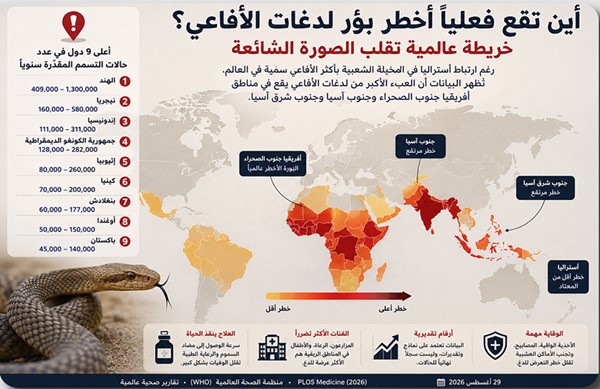
Although Australia is popularly associated with having the world’s most venomous snakes, the greatest threat to humans lies elsewhere—particularly in sub-Saharan Africa, South Asia, and Southeast Asia.
A new study published in the medical journal PLOS, which relied on data from 79 countries and geographic models, has reassessed the global burden of snakebite envenoming.
According to the model, approximately 75% of cases are concentrated in 20 countries, led by India, Nigeria, Indonesia, the Democratic Republic of the Congo, Ethiopia, Kenya, Bangladesh, Uganda, and Pakistan.
In India alone, the number of annual envenoming cases may range from about 409,000 to 1.3 million, according to the study’s estimates. Sub-Saharan Africa emerges as a particularly high-risk hotspot, not only due to the presence of snakes but also because of the prevalence of rural communities, distance from hospitals, and shortages of antivenom in some areas.
This highlights an Australian paradox: despite harboring highly venomous species, it does not rank among the top 20 countries in estimated snakebite cases. The World Health Organization confirms that the heaviest global burden falls in Africa, Asia, and Latin America, and that timely access to treatment may be as critical as the snake’s venom potency itself.
The study cautions that the new figures are modeling estimates rather than definitive records, as many snakebites in rural areas never reach health systems.
