Saad Al-Alaati: The Economic and Social Council is one of the fundamental pillars of the Arab joint work system
&cropxunits=450&cropyunits=339&w=770)
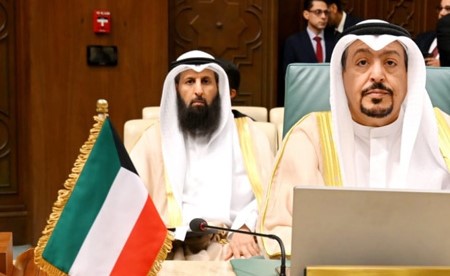
Kuwait participated in the 118th ordinary session of the Arab Economic and Social Council at the level of Arab finance and economy ministers, held at the headquarters of the Arab League Secretariat in Cairo. The session was attended by the Arab ministers of finance and economy, the Secretary-General of the Arab League, and the directors general of specialized Arab organizations and institutions of joint Arab action. The Kuwaiti delegation participating in the session’s proceedings was led by Saad Aqela Al-Alawi, Assistant Undersecretary for Technical Services Affairs at the Ministry of Finance, on behalf of Minister of Finance Dr. Yaqoub Al-Sayed Yousef Al-Rafai. The Kuwaiti delegation included several officials from the Ministry of Finance and from Kuwait’s Permanent Delegation to the Arab League.
During the opening session, Assistant Undersecretary Al-Alawi delivered a statement on behalf of Kuwait. He emphasized that the Economic and Social Council constitutes one of the fundamental pillars of the joint Arab action framework and serves as a pivotal platform for enhancing economic and social cooperation and integration among Arab states, thereby supporting development efforts and advancing the shared interests of member states. He expressed Kuwait’s appreciation for the constructive efforts undertaken by the friendly People’s Democratic Republic of Algeria during its presidency of the previous session, and congratulated the Kingdom of Saudi Arabia on assuming the presidency of the current session, expressing confidence in its ability to lead the Council’s work in a manner that strengthens joint Arab cooperation and achieves the desired goals and aspirations.
Al-Alawi highlighted his appreciation for the efforts and contributions made by Ahmed Aboul Gheit during his tenure as Secretary-General of the Arab League, particularly in supporting joint Arab action and enhancing the League’s role in confronting regional and international challenges. He also extended congratulations to Ambassador Nabil Fahmy upon assuming the role of Secretary-General of the Arab League, reaffirming Kuwait’s support for his efforts to develop the joint Arab action framework and enhance the efficiency of its institutions, in line with the aspirations of Arab states and their peoples.
He noted that Kuwait is closely following the vision presented by the Secretary-General for the coming period, which focuses on enhancing the effectiveness of joint Arab action, consolidating a culture of follow-up and implementation, improving institutional performance, investing in human capital and technology, and aligning development policies with economic and social priorities. He affirmed that this vision represents an important strategic framework for strengthening the capacity of the Arab system to keep pace with rapid changes and to translate recommendations and decisions into tangible, practical outcomes.
Al-Alawi stressed the importance of advancing the enhancement of Arab economic integration and consolidating interlinkages among Arab economies. This should be achieved by developing more efficient and resilient Arab supply chains, supporting food and energy security, and encouraging joint Arab investments and projects. Such measures would contribute to strengthening the ability of Arab states to confront global challenges and changes and to achieve sustainable development goals. He reiterated Kuwait’s firm commitment to supporting the progress of joint Arab action and its institutions, based on the conviction that the success of this framework relies on a unified vision, complementary capacities, institutional efficiency, and the ability to translate decisions into tangible achievements that serve the interests of Arab states and their peoples.
In conclusion, Assistant Undersecretary Al-Alawi expressed Kuwait’s hope that the current session’s proceedings would yield practical decisions and initiatives that enhance Arab economic and social integration, support sustainable development pathways, and contribute to consolidating security, stability, and prosperity in Arab states, thereby fulfilling the aspirations of their peoples for a more prosperous and advanced future.
