Crown Prince of Bahrain: Strengthening Gulf Integration and Cooperation to Support Development Pathways
&cropxunits=450&cropyunits=378&w=770)
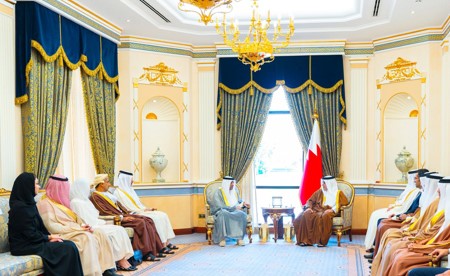
Bahraini Crown Prince and Prime Minister, His Highness Prince Salman bin Hamad Al Khalifa, emphasized the importance of continuing to strengthen integration and cooperation among the Gulf Cooperation Council (GCC) member states, in a manner that supports all development pathways and realizes the visions and aspirations of the Council’s leaders.
Bahrain’s state news agency, BNA, reported that this came during a meeting between the Crown Prince at Qasr Al-Qudibiya and Jassim Al-Bedaiwi, Secretary-General of the GCC, along with the heads of delegations participating in the 38th meeting of the GCC Committee for Agricultural Cooperation and Food Security. Among those present was Dr. Reem Al-Faleh, Kuwait’s Minister of State for Development and Sustainability Affairs.
The agency stated that the delegations conveyed greetings from the GCC leaders to Bahraini King Hamad bin Isa Al Khalifa and to Crown Prince Salman bin Hamad. In turn, the Bahraini Crown Prince conveyed greetings from the King of Bahrain and his own regards to the GCC leaders.
The Crown Prince expressed his hope that the meetings would contribute to enhancing cooperation and coordination among GCC member states in the fields of agriculture and food security, yielding further joint initiatives and efforts that strengthen Gulf integration and achieve shared goals and aspirations. He affirmed that the Kingdom of Bahrain, under the leadership of King Hamad bin Isa Al Khalifa, supports all endeavors aimed at advancing the trajectory of joint Gulf work across all sectors.
He highlighted the importance of continuing to bolster food security by developing supply and logistics chains and enhancing their efficiency, thereby ensuring the sustained flow of goods and products. He stressed the significance of Gulf integration and expanding international partnerships in strengthening the resilience of the food security system in the face of various changes and challenges. He also pointed to the role played by the GCC Committee for Agricultural Cooperation and Food Security and its contributions to enhancing joint cooperation and coordination among member states in agricultural and food-related fields.
For her part, Dr. Reem Al-Faleh, Kuwait’s Minister of State for Development and Sustainability Affairs, emphasized that Kuwait attaches great importance to food security and supports efforts to enhance Gulf integration in this area, particularly regarding strategic reserves, the sustainability of supply chains, the exchange of expertise and information, and the development of joint legislation and regulations.
This statement was made by Minister Al-Faleh to KUNA following her participation in the 38th meeting of the GCC Committee for Agricultural Cooperation and Food Security. She noted that the meeting was held as part of continued joint Gulf efforts to enhance cooperation and integration among GCC member states in the agricultural and food sectors, thereby supporting the achievement of food security and resource sustainability in the member states.
She stressed the importance of continuing work to transition Gulf cooperation in the agricultural and food sectors to broader levels of integration and coordination, thereby enhancing the GCC’s capacity to handle regional and international crises and challenges, and solidifying a sustainable Gulf food security system.
She explained that the meeting discussed several priority Gulf files, foremost among them the study on establishing strategic Gulf storage zones for food, medicines, and other necessities, the food security strategy, and the plant genetic assets bank. These initiatives aim to enhance the preparedness and capacity of GCC states to confront challenges and changes related to food security and supply chains.
She added that the agenda also included discussions on several joint GCC legislations and regulations in the agricultural sector, including lists of prohibited and restricted pesticides, the revised draft law on the (system) of pesticides, the draft executive regulations for the law on the (system) of fertilizers and soil amendments, and the unified system regarding organic inputs and products for GCC member states.
For his part, GCC Secretary-General Jassim Al-Bedaiwi affirmed that the agricultural and food security system in Gulf states constitutes a strategic priority and a fundamental pillar in the trajectory of joint Gulf work.
This was stated in a speech delivered by Al-Bedaiwi during the 38th meeting of the GCC Committee for Agricultural Cooperation and Food Security, which was chaired by Bahrain’s Minister of Municipalities and Agriculture, Eng. Wael Al-Mubarak, and attended by ministers responsible for agriculture and food security in GCC member states.
Al-Bedaiwi said this reflects the member states’ interest in developing agricultural and food production, enhancing the sustainability and efficiency of natural resource use, and increasing their capacity to meet food needs and bolster preparedness against all changes and challenges.
Al-Bedaiwi extended his highest expressions of gratitude, appreciation, and thanks to King Hamad bin Isa Al Khalifa of Bahrain, Chairman of the current term of the Supreme Council, for hosting the meeting, and for the facilitations and support provided and continued by the Kingdom to ensure the success of GCC work, as well as for the support and attention accorded to joint Gulf work by the Bahraini King and the leaders of GCC member states in all fields.
He clarified that the interest in developing agricultural and food production was reflected in the outcomes of the 19th Consultative Meeting of the Supreme Council held in Jeddah on April 28, 2026, and the directives issued therein to enhance the preparedness and capacity of GCC states to confront crises and challenges, including the study on establishing strategic Gulf storage zones.
