In Video: Nof Boubakhi: Enhancing environmental action requires a clear vision based on science and an effective dialogue that keeps pace with the developments of the current stage
&cropxunits=450&cropyunits=300&w=770)
Nada Abu Nasr
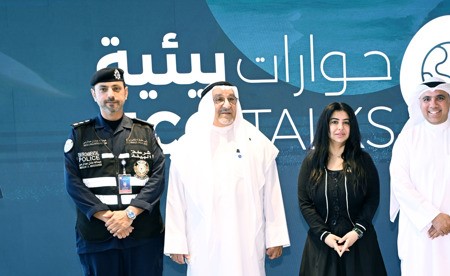
The Scientific Center, one of the centers under the Kuwait Foundation for the Advancement of Sciences, organized the “Environmental Dialogues 2026” event in collaboration with the Public Authority for Applied Education and Training’s General Authority for the Environment, with the participation of various government, academic, research entities, and organizations concerned with environmental affairs. This initiative is part of the Center’s ongoing efforts to enhance environmental awareness, consolidate the concepts of sustainability, and preserve natural resources and biodiversity in the State of Kuwait.
Speaking to the press, the Center’s Director General, Eng. Muaysad Al-Yassin, stated that the event stems from the Center’s role in promoting scientific and environmental culture and providing a platform that brings together specialists, experts, and relevant stakeholders to exchange knowledge and experiences, and to discuss the most prominent issues and challenges facing the Kuwaiti environment.
Al-Yassin added that the event focuses on three main axes reflecting the nature of the country’s environment: the desert, coastal, and marine environments, along with related topics such as climate change, preservation of natural habitats, biodiversity, pollution, and sustainability.
He clarified that the event highlights the importance of integrating roles among government, scientific, academic, and research institutions, and strengthening partnerships that contribute to translating scientific knowledge into practical practices and initiatives supporting national efforts in environmental protection.
He noted that preserving the desert, coastal, and marine environments is a shared responsibility requiring knowledge, awareness, and coordinated efforts. He pointed out that “Environmental Dialogues 2026” aims to bring scientific knowledge closer to society and open a space for dialogue among experts, specialists, and relevant parties.
He explained that the event comes within the Center’s continuous efforts to enhance cooperation with national entities concerned with the environment and to affirm the importance of scientific dialogue and experience exchange in raising awareness of environmental issues and supporting initiatives aimed at protecting the environment and preserving Kuwait’s natural resources.
For her part, Acting Director General of the General Authority for the Environment, Nouf Bahbahani, stated that enhancing environmental work requires a clear vision based on science and effective dialogue that keeps pace with the developments and challenges of the coming phase and supports the shift toward more sustainable solutions.
In a similar press statement, Bahbahani added that this strengthens the State of Kuwait’s efforts to protect the environment and conserve its resources, and realizes its aspirations for a sustainable future for coming generations.
For her part, Dr. Amira Al-Hasan, Head of the Environment Programme at UN-Habitat, emphasized the importance of enhancing environmental efforts in Kuwait, given the increasing challenges facing desert cities due to climate change.
She pointed out that rising temperatures, rainfall scarcity, and increased dust storms and haze have become among the most prominent challenges that directly affect public health and quality of life, in addition to their impact on traffic and daily activities. The United Nations has confirmed that Kuwait is already facing challenges related to hot weather, sandstorms, and water scarcity.
She clarified that addressing these challenges requires adopting more conscious patterns of water and energy consumption, emphasizing the importance of using resources in line with actual needs, as well as leveraging technological advancements in water desalination, energy efficiency, thermal insulation, and modern building materials, thereby contributing to enhancing the sustainability of buildings and cities.
She also shed light on the issue of waste management, noting that organic waste, particularly food waste, represents a significant portion of household waste in Gulf countries, reaching approximately 60% according to previous data from UN-Habitat. She called for reducing food waste, sorting waste at the source, composting organic waste, as well as recycling plastic and other materials to produce new products.
Al-Hasan stressed that sustainability is not limited to the role of government institutions but also begins with the behavior of individuals and families. She called for adopting the concept of conscious consumption, whether in the use of water and energy or when designing and building homes, ensuring that spaces and resources used align with the actual needs of residents to minimize waste of materials and energy.
She affirmed the importance of legislation, urban planning, and environmental education in building cities more capable of facing crises, alongside developing early warning systems that help alert residents and enable rapid response to environmental phenomena and disasters.
Regarding transportation, she called for reducing heavy reliance on private cars in cities and encouraging more sustainable means of transport, which would contribute to lowering pollution and improving quality of life.
For her part, Dr. Haya Al-Husseini, Associate Professor in the Department of Geography at the College of Social Sciences, Kuwait University, discussed the state of the desert environment and the challenges it faces due to climate change and human activities.
Her participation focused on the most prominent impacts affecting the desert environment, including rising temperatures, increased duration of the dry season, and a rise in dust storms and haze.
She also addressed proposed solutions in the post-sustainability phase, which include enhancing contractual sustainability within the framework of environmental dialogue, as well as increasing the percentage of natural reserves and limiting human activities and construction that may increase pressure and stress on the desert environment.
For his part, Colonel Abdullah Al-Eissa, Director of the Environment Police Department, emphasized the important role played by the department in protecting the Kuwaiti environment and enhancing compliance with the Environmental Protection Law, during his participation in the “Post-Sustainability” event held at the Scientific Center.
He explained that the participation of the Environment Police Department aims to introduce its duties, jurisdictions, and nature of work, as well as to raise public awareness of the mechanisms for implementing the Environmental Protection Law and limiting practices that harm the environment.
He noted that the department’s work includes environmental supervision and inspection, monitoring the marine environment, and conducting round-the-clock mobile patrols to detect violations and take necessary legal action. He clarified that the department monitors various violations stipulated by the Environmental Protection Law, including those related to land and marine areas and public places, as well as smoking in enclosed and semi-enclosed spaces.
